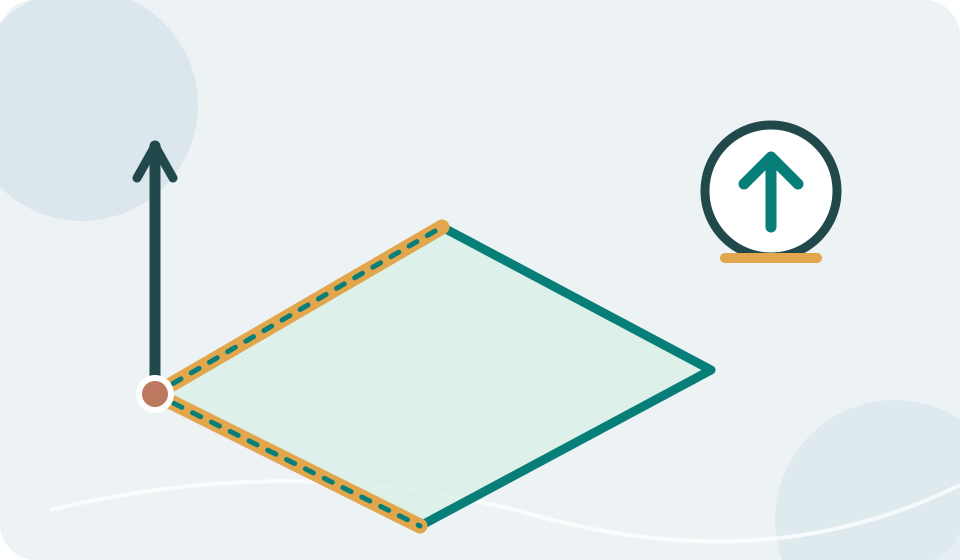

Calculate the cross product components
For u=(uₓ,uᵧ,u_z) and v=(vₓ,vᵧ,v_z), u×v=(uᵧv_z−u_zvᵧ, u_zvₓ−uₓv_z, uₓvᵧ−uᵧvₓ). The magnitude is √(cₓ²+cᵧ²+c_z²), where c=u×v. Each component is a signed difference of two products, so preserve the vector order and signs.
The fields enter u first and v second: uₓ,uᵧ,u_z followed by vₓ,vᵧ,v_z. Swapping the two vectors reverses the cross-product direction, u×v=−(v×u), but leaves its magnitude unchanged. The calculator still reports component signs because they help audit the calculation.
Read the area from a worked example
For u=(1,2,2), v=(3,0,1), the components are (2×1−2×0, 2×3−1×1, 1×0−2×3)=(2,5,−6). Their length is √(4+25+36)=√65≈8.06226. This is the parallelogram area in squared coordinate units when both vectors describe lengths in the same unit.
The triangle that uses these vectors as adjacent sides has area half the parallelogram: √65/2≈4.03113. The tool’s displayed magnitude is rounded to five decimal places and component values to four; halve the unrounded magnitude when accuracy matters. It does not label the output as triangle area.

Worked examples
Example 1 · non-orthogonal vectors
Inputs: u=(1,2,2), v=(3,0,1).
Calculation: u×v=(2,5,−6); |u×v|=√(2²+5²+(−6)²)=√65.
Magnitude=8.06226; the spanned triangle area is about 4.03113.
Example 2 · perpendicular vectors
Inputs: u=(1,0,0), v=(0,3,4).
Calculation: u×v=(0,−4,3), so |u×v|=√(16+9)=5; also |u||v|=1×5.
Parallelogram area=5; triangle area=2.5.
Use perpendicular and parallel checks
For u=(1,0,0) and v=(0,3,4), the cross product is (0,−4,3) and its magnitude is 5. The vectors are perpendicular, so the area also equals |u||v|=1×5=5. This independent area formula is a useful check when the angle is known to be 90 degrees.
If two nonzero vectors are parallel, the angle between them is 0 or π and the parallelogram collapses to a line, so the cross-product magnitude is zero. A zero input vector also gives zero. The result is a nonnegative size; unlike the signed two-dimensional cross product, this tool does not return an oriented area sign.
Understand the geometric formula
The magnitude identity is |u×v|=|u||v|sinθ, where θ is the angle between the vectors. Taking |u| as the base, |v|sinθ is the perpendicular height, so their product is the parallelogram area. This connects the component formula to geometry and explains why parallel vectors give zero and perpendicular vectors give the largest area for fixed lengths.
The cross product is perpendicular to both input vectors in three-dimensional Euclidean space. Its direction follows the right-hand rule and depends on the order u then v. Magnitude discards that direction. If orientation matters for torque, a surface normal, or signed conventions, inspect the component vector as well as its norm.
Keep units and modeling assumptions consistent
If both vector components are measured in meters, each cross-product component and its magnitude have units of square meters; the result is an area. If u and v are forces, velocities, or mixed physical quantities, the product units follow from multiplying their units and the geometric interpretation may be a different derived quantity. The calculator does not select units or convert them.
The formula assumes the components refer to a common Cartesian coordinate frame with the standard right-handed cross-product convention. If values come from different coordinate systems, transform them consistently first. Rounding inputs can change small angles or areas, especially when the vectors are nearly parallel.
Verify the result before using it
Check each cross component from the two product terms, then square the three results, add, and take the nonnegative square root. For a parallel-vector check, verify one vector is a scalar multiple of the other and expect a zero magnitude. For an orthogonal pair, compare with the product of vector lengths. These checks catch component-order and sign errors.
A small reported magnitude can mean the vectors are almost parallel, one vector is short, or both. It does not mean the inputs are invalid. When a downstream calculation depends on a unit normal, divide the cross product by its magnitude only after checking that the magnitude is nonzero and sufficiently far from numerical noise; this calculator does not normalize the vector.