3D unit vector calculator
Normalize a nonzero 3D vector so its length becomes one while its direction is preserved.
How to use this calculator
Normalize a nonzero 3D vector so its length becomes one while its direction is preserved.
- Enter Vector x, Vector y, Vector z. Match the units shown beside each field and review the result together with the assumptions below.
- Read the worked example below to check the expected input format and result.
- Compare another scenario by changing one input at a time. Use Reset to return to the starting values.
How the 3D unit vector calculator works
Normalize a nonzero 3D vector so its length becomes one while its direction is preserved.
Inputs and units
- Vector x: Vector x is the signed x-coordinate component.
- Vector y: Vector y is the signed y-coordinate component.
- Vector z: Vector z is the signed z-coordinate component.
Formula and method
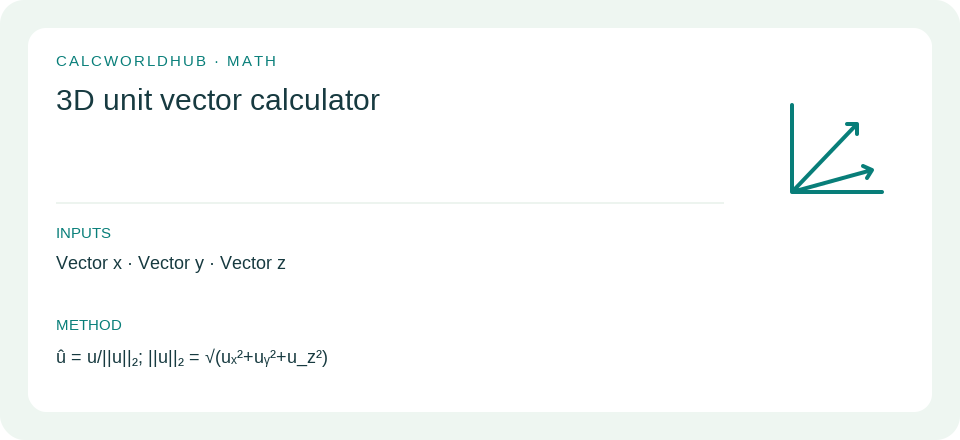
û = u/||u||₂; ||u||₂ = √(uₓ²+uᵧ²+u_z²)
Worked example
For u = (2,3,6), ||u|| = 7 and û = (2/7,3/7,6/7) ≈ (0.28571,0.42857,0.85714).
Interpreting the result
The components specify direction only; their Euclidean norm is 1. The zero vector has no direction and cannot be normalized.
Assumptions and limits
Components must be finite and use a common coordinate frame. The output is unitless direction ratios.
Frequently asked questions
Must all components be positive?
No. Component signs encode direction and are preserved by normalization.
Why is the zero vector rejected?
Its length is zero, so there is no direction to scale to unit length.
How do I use the 3D unit vector calculator?
Enter Vector x, Vector y, Vector z. Match the units shown beside each field and review the result together with the assumptions below.
What is a worked example of 3D unit vector?
For u = (2,3,6), ||u|| = 7 and û = (2/7,3/7,6/7) ≈ (0.28571,0.42857,0.85714).
What does the 3D unit vector calculator calculate?
Normalize a nonzero 3D vector so its length becomes one while its direction is preserved.
See the calculation methodology.