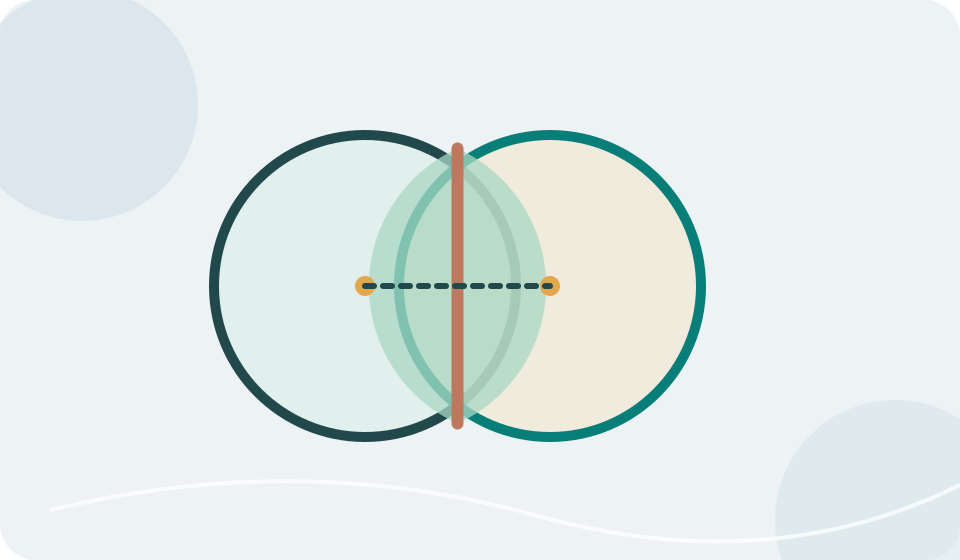

Identify the three measurements
Enter radius r₁ of the first circle, radius r₂ of the second, and the centre distance d. All three must use the same length unit. The centers define a line of symmetry: for ordinary intersections, the shared chord is perpendicular to that line. The calculator needs no absolute x-y coordinates because translation or rotation of both circles leaves the chord length unchanged.
This result is the straight common segment between the two intersection points. It is not the arc along either circle and it is not the area of the lens between them. That distinction matters when the task is to cut a shared edge, position a boundary, or check a geometric construction. If the circles are tangent, the two intersection points merge and the chord length is zero.
How the half-chord is located
Place the first centre at zero and the second at distance d along a horizontal axis. The perpendicular bisector of the common chord meets that axis at x = (d² + r₁² − r₂²)/(2d) from the first centre. A radius and this offset form a right triangle, so the half-chord is √(r₁² − x²); the full chord is twice that value.
The formula uses the law of cosines in the triangle formed by both centres and one intersection point. It still works when one circle is larger than the other, provided their boundaries actually meet. For a stable calculation, keep the unit consistent and avoid rounding x before taking the square root; rounding intermediate values can make a valid shallow intersection look invalid.
Interpret the examples and offset
When the radii are equal, the common chord lies halfway between the centres, so its offset from either centre is d/2. With unequal radii, it shifts toward the smaller circle’s side of the geometry according to the squared-radius difference. The calculator also reports the offset from the first centre, which helps place the chord in a drawing when that first circle is the reference.
A chord close to a circle’s diameter indicates a deep intersection; a short chord indicates that the circles barely overlap. The common chord cannot exceed either diameter. Comparing the reported length with 2r₁ and 2r₂ is a quick reasonableness check, while the intersection conditions below confirm that the chosen values describe real circles.

Check whether the circles intersect
For positive radii and distinct centres, the boundaries meet when |r₁ − r₂| ≤ d ≤ r₁ + r₂. If d is greater than the sum of radii, the circles are separate. If d is less than the absolute radius difference, the smaller circle is completely inside the larger without crossing it. The runtime rejects both cases instead of inventing a common chord.
A centre distance of zero is also rejected. Concentric circles either coincide, giving no unique shared chord, or have different radii and do not intersect. At either equality limit the circles are tangent and the chord is a single point of zero length. If a measurement is near a limit, small input uncertainty can change the classification, so report that uncertainty rather than over-interpreting the displayed digits.
Verify from the right triangle
For an independent check, compute x with the formula, then evaluate h = √(r₁² − x²) and c = 2h. Confirm that x is measured from the centre used by the displayed offset. Substituting the offset into the second circle gives the same half-chord: √(r₂² − (d − x)²). The two values should agree apart from floating-point rounding.
Keep enough digits through the offset and square-root steps, then round the final length to suit the measurements. If the two half-chord calculations disagree materially, check whether r₁ and r₂ were swapped, whether d uses the same unit, or whether rounded inputs changed the intersection conditions. The calculator does not infer geometry from a diagram or adjust inconsistent measurements to force an intersection.
Worked examples
Equal circles six units apart
Inputs: r₁ = 5 units; r₂ = 5 units; d = 6 units.
Calculation: x = (6² + 5² − 5²)/(2 × 6) = 3; c = 2√(5² − 3²) = 2 × 4 = 8 units.
The common chord is 8 units long and sits 3 units from the first centre.
Unequal radii with an offset chord
Inputs: r₁ = 5 units; r₂ = 4 units; d = 5 units.
Calculation: x = (5² + 5² − 4²)/(2 × 5) = 3.4; c = 2√(5² − 3.4²) = 2√13.44 ≈ 7.332121 units.
The common chord is about 7.33212 units long, measured from an offset of 3.4 units from circle 1’s centre.