
The two-body circular relation
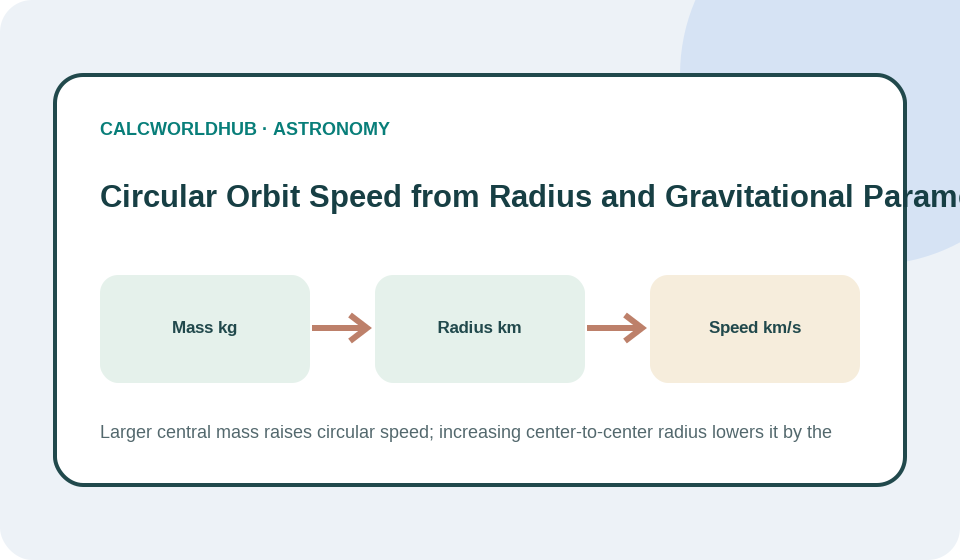
For a small object in a circular Newtonian orbit around a much more massive body, gravity supplies the centripetal acceleration. Equating GM/r² with v²/r gives v = √(GM/r). The calculator asks for central mass in kilograms and orbital radius in kilometres, then uses G = 6.6743 × 10⁻²⁰ km³·kg⁻¹·s⁻² so the output is kilometres per second. The body mass is not the spacecraft mass in this approximation.
The radius must be measured from the primary body’s centre. If a problem gives altitude above the surface, add the body’s mean or specified reference radius before entering it. A 400 km altitude above Earth, for example, is not a 400 km orbital radius. The interface accepts finite numbers and the evaluator rejects non-finite results; it does not impose physical minimums on every input, so a user should use a positive mass and positive radius.
Mass, radius, and gravitational parameter
The same relation is often written v = √(μ/r), where μ = GM is the gravitational parameter. Using mass makes the calculation easier to connect to a body’s kilograms, while using μ can be more precise when a trusted planetary parameter is known. This calculator specifically requests mass, so enter a value consistent with its units rather than inserting μ into the mass field.
For a fixed central body, doubling orbital radius reduces the circular speed by a factor of √2. Increasing the body mass by a factor of four doubles the speed at the same radius. Those proportional checks are useful when comparing results. The speed does not include a launch trajectory, orbital insertion cost, or the energy required to change from one orbit to another.
What counts as circular
A circular orbit has constant centre-to-centre radius and constant speed in the ideal model. An elliptical orbit has a speed that changes along the path, so this equation gives neither its speed everywhere nor the velocity at a specified true anomaly. A low orbit can also depart from the two-body approximation because of atmospheric drag, oblateness, third-body gravity, and non-spherical mass distribution.
The model treats the orbiting object as a test mass and uses one central mass. That is usually a good first approximation for a spacecraft around a planet, but a binary-star problem needs the two-body relative orbit and the combined mass. Use the separate binary-system relationship for that case instead of adding the companion’s mass casually to a spacecraft calculation.
Read the numerical result carefully
The displayed value is rounded to four decimal places in kilometres per second. The underlying relation has no built-in uncertainty estimate, and its precision cannot exceed the quality of the entered mass and radius. A radius recorded only to the nearest kilometre does not make every displayed decimal physically meaningful.
Compare like quantities: radius from centre to centre, mass of the central body, and circular speed. Do not compare the result directly with a spacecraft’s total mission delta-v or a ground-relative velocity. The latter can include rotation of the body, orbital eccentricity, reference-frame choice, and other effects absent from this model.
When to use another model
Use a more complete orbital propagator when the orbit is elliptical, perturbed, or tied to a specific epoch and coordinate frame. A mission design also needs inclination changes, finite burns, gravity losses, and operational constraints. This calculator is for a single idealized circular speed and cannot answer how much propellant or time a transfer will require.
For surface-based comparisons, state the primary body and the altitude-to-radius conversion explicitly. For very small bodies or unusual mass distributions, the point-mass assumption may be weak. Treat this result as a transparent baseline that helps check an orbit scale, then use a validated ephemeris or mission model for decisions that depend on trajectory accuracy.
Worked examples
These examples use the displayed inputs and keep the formula’s units visible so the result can be checked independently.
Low Earth orbit scale
Inputs: Central mass = 5.972 × 10²⁴ kg; centre-to-centre radius = 7,000 km.
Calculation: v = √(6.6743 × 10⁻²⁰ × 5.972 × 10²⁴ ÷ 7,000) = 7.545946840… km/s; displayed 7.5459 km/s.
The ideal circular speed is 7.5459 km/s at a 7,000 km centre-to-centre radius. This is not a speed at 7,000 km altitude.
Small-body orbit comparison
Inputs: Central mass = 6.39 × 10²³ kg; centre-to-centre radius = 4,000 km.
Calculation: v = √(6.6743 × 10⁻²⁰ × 6.39 × 10²³ ÷ 4,000) = 3.265301556… km/s; displayed 3.2653 km/s.
The result is the point-mass circular speed for the chosen mass and radius. It does not account for shape, rotation, or perturbations.
