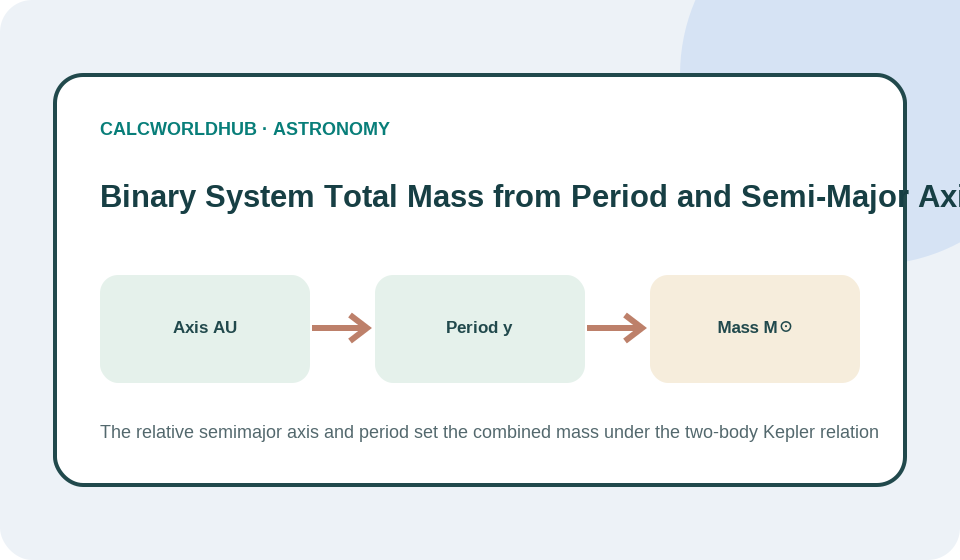

Use the relative orbit
In a binary system, both stars orbit their common centre of mass. Kepler’s third law relates the period to the semi-major axis of the relative orbit and the sum of the two masses. The word relative matters: the input is the separation vector’s orbit size, equal to the sum of the two stars’ barycentric semi-major axes, not just one star’s path around the barycentre.
With a in astronomical units, P in years, and total mass expressed in solar masses, the familiar approximation is M₁+M₂ = a³/P². The calculator asks for relative semi-major axis in AU and orbital period in years, then formats a³/P² to a maximum of five decimal places, suppressing trailing zeros. In this unit convention the number represents solar masses, even though the result display does not append a unit label; interpret it as M☉.
Measure the orbit and period consistently
The semi-major axis is half the longest diameter of an ellipse. It is not the current separation unless the orbit is circular. For an eccentric binary, use the fitted relative semi-major axis from an orbital solution, not a single snapshot distance. The period is the time for one complete relative orbit and must use years under this shortcut.
If the orbital solution reports metres, astronomical units, days, or another unit, convert before entering the values. One year in the selected convention is the standard astronomical year used to form the solar-mass approximation. Mixing days with years changes the period squared and can make the inferred mass dramatically wrong.
What the mass estimate includes
The result is the combined gravitating mass M₁+M₂, not the mass of either star individually. To split the total, one needs additional information such as the relative sizes of the two component orbits, radial velocities, or a reliable mass ratio. The calculator has no fields for those observations and cannot infer a component’s mass alone.
The relation assumes Newtonian two-body motion and a bound orbit described by a single period and semi-major axis. It does not model a third star, strong relativistic corrections, significant mass loss, tides, or changing orbital elements. For many ordinary stellar binaries this gives an instructive first estimate, but it is not a complete fit to a measured orbit.
Check scale and sensitivity
Mass varies with the cube of the semi-major axis and the inverse square of the period. If the axis doubles while the period stays fixed, the inferred mass becomes eight times larger. If the period doubles at fixed axis, the mass becomes one quarter. This strong dependence means a small uncertainty in orbital size can matter more than a similar fractional uncertainty in period.
The five displayed decimal places are only formatting. Uncertainty in astrometry, radial velocities, period fitting, and the adopted distance can dominate the final digits. When reporting a scientific mass, carry measurement uncertainties through the orbital solution and round the answer to justified significant figures rather than presenting the calculator’s display precision as measured accuracy.
Interpret the answer as a system property
A mass above one solar mass means the pair’s combined mass exceeds the Sun’s mass under this convention. It does not say that either component has that mass. For example, equal-mass stars would each contribute half the total, but the calculation does not assume equal components.
Use the estimate to check whether an orbital solution has a plausible scale or to learn how period and separation connect. If the result is surprising, first verify that the semi-major axis belongs to the relative orbit, the period is in years, and neither number was copied from a projected separation without orbital correction. A professional analysis should document the fitted parameters and their uncertainties.
Worked examples
These examples use the displayed inputs and keep the formula’s units visible so the result can be checked independently.
A two-year orbit with a 2 AU relative axis
Inputs: Relative semi-major axis = 2 AU; period = 2 years.
Calculation: Mtotal = a³ ÷ P² = 2³ ÷ 2² = 8 ÷ 4 = 2.00000 M☉.
The binary’s combined mass is 2 solar masses under the AU/year Kepler convention. It does not allocate mass between the two stars.
A wider, slower relative orbit
Inputs: Relative semi-major axis = 1.5 AU; period = 3 years.
Calculation: Mtotal = 1.5³ ÷ 3² = 3.375 ÷ 9 = 0.37500 M☉.
The calculation gives 0.375 solar masses combined. This interpretation assumes a fitted relative orbit and does not identify either component’s individual mass.
