Binary-system total mass from period and semi-major axis calculator
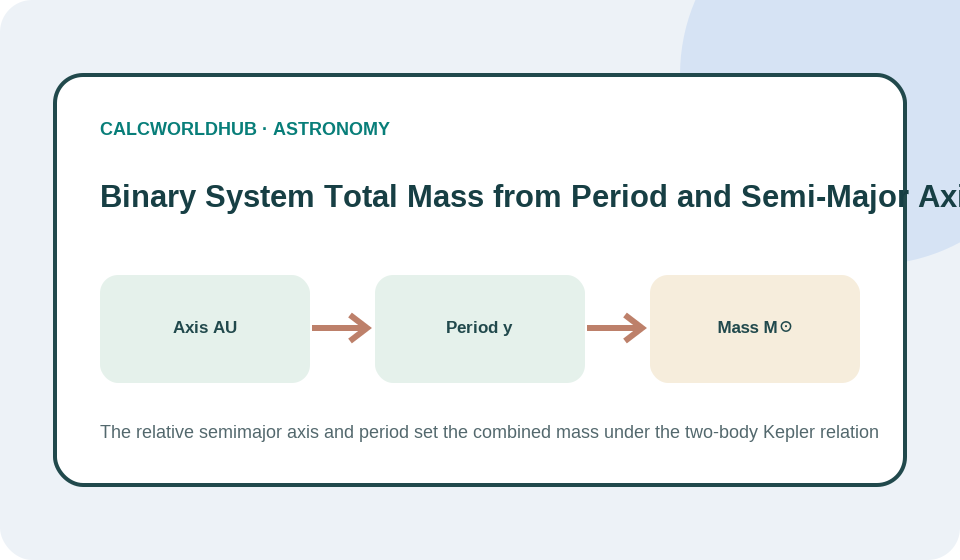
Estimate total binary mass from relative-orbit period and semi-major axis using Kepler’s third law. Enter your values below to see the result and method.
inputs.
Related calculators
These tools cover nearby questions while keeping this page focused on its own calculation.
How to use this calculator
Estimate total binary mass from relative-orbit period and semi-major axis using Kepler’s third law.
- Use the units printed beside each field. These values are Relative semi-major axis (AU), Orbital period (years). Relative semi-major axis (AU): Semi-major axis of the separation vector between the two bodies, not either body's individual orbit about the barycenter. Orbital period (years): Time for one complete relative orbit, in years; use an orbit described by the same semi-major axis.
- Read the worked example below to check the expected input format and result.
- Compare another scenario by changing one input at a time. Use Reset to return to the starting values.
Set the orbit and reference body
Use the generalized Kepler relation to estimate the combined mass of two orbiting bodies from their relative-orbit period and semi-major axis. The AU/year form returns mass in solar masses.
Inputs and units
Use the units printed beside each field. These values are Relative semi-major axis (AU), Orbital period (years).
- Relative semi-major axis (AU): Semi-major axis of the separation vector between the two bodies, not either body's individual orbit about the barycenter.
- Orbital period (years): Time for one complete relative orbit, in years; use an orbit described by the same semi-major axis.
Orbital equation and worked example
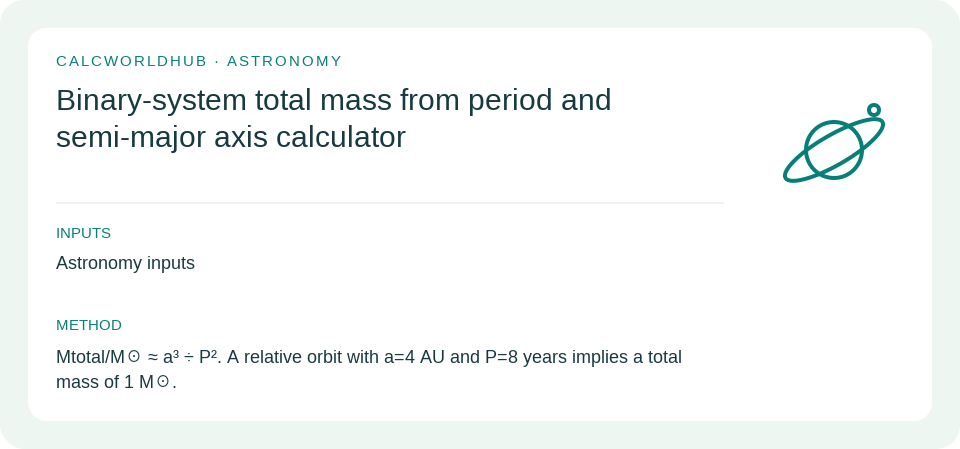
Mtotal/M☉ ≈ a³ ÷ P².
A relative orbit with a=4 AU and P=8 years implies a total mass of 1 M☉.
How to interpret the orbit result
The two-body estimate assumes the measured semi-major axis belongs to the relative orbit. Additional bodies, mass transfer, or strong perturbations can make this simple Kepler model inadequate.
Assumptions and limitations
For a two-body Keplerian orbit, use the semi-major axis of the relative orbit and period in AU and years; perturbations are ignored.
Source: NASA: deriving Kepler's formula for binary stars — Derives the two-body relation between orbital period, relative separation, and combined mass.
Frequently asked questions
Which values are needed for the binary-system total mass from period and semi-major axis?
Enter Relative semi-major axis (AU), Orbital period (years). Check that distances and periods use the units shown beside the inputs.
Does this binary-system total mass from period and semi-major axis include real-world effects?
For a two-body Keplerian orbit, use the semi-major axis of the relative orbit and period in AU and years; perturbations are ignored.
How does the orbital-period calculator relate to this mass estimate?
The orbital-period tool solves the neighboring Kepler relationship when total mass and semi-major axis are known and period is the desired result.
How do I use the Binary-system total mass from period and semi-major axis calculator?
Use the units printed beside each field. These values are Relative semi-major axis (AU), Orbital period (years). Relative semi-major axis (AU): Semi-major axis of the separation vector between the two bodies, not either body's individual orbit about the barycenter. Orbital period (years): Time for one complete relative orbit, in years; use an orbit described by the same semi-major axis.
What is a worked example of Binary-system total mass from period and semi-major axis?
Mtotal/M☉ ≈ a³ ÷ P². A relative orbit with a=4 AU and P=8 years implies a total mass of 1 M☉.
Read the calculation methodology and privacy policy.