Orbital period calculator (Kepler’s law)
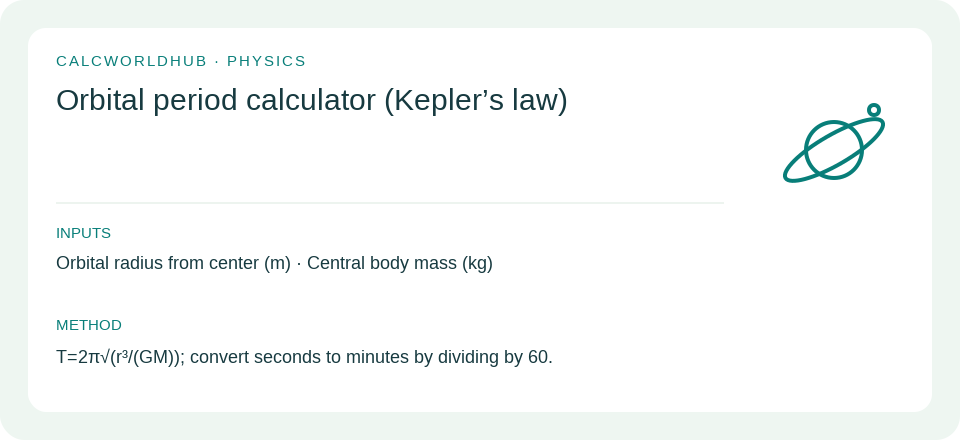
Estimate a circular-orbit period from center-to-center orbital radius and central-body mass.
Calculator
How to use this calculator
Estimate a circular-orbit period from center-to-center orbital radius and central-body mass.
- Enter Orbital radius from center (m), Central body mass (kg). Match the units shown beside each field and review the result together with the assumptions below.
- Read the worked example below to check the expected input format and result.
- Compare another scenario by changing one input at a time. Use Reset to return to the starting values.
Orbital period calculator (Kepler’s law)
Estimate a circular-orbit period from center-to-center orbital radius and central-body mass.
What it measures
For a test object whose mass is negligible compared with the central body, Newton’s form of Kepler’s third law relates the period to r³ divided by GM.
Inputs and units
- Orbital radius from center (m): Distance from the central body’s center to the orbit, in metres.
- Central body mass (kg): Mass of the central body, in kilograms.
Formula and method
T=2π√(r³/(GM)); convert seconds to minutes by dividing by 60.
Worked example
At r=6,771,000 m around Earth (M=5.972×10²⁴ kg), T≈5,545 s≈92.42 minutes.
Interpreting the result
The period is one complete orbit. Increasing radius lengthens the period; the entered radius is measured from the body center, not from its surface.
Assumptions and limits
Assumes a circular two-body orbit, a much lighter orbiting object, and no atmospheric drag, oblateness, third-body perturbations, or thrust.
Sources and method
- Describes Kepler’s third law linking period and semi-major axis for bodies orbiting the same central mass. NASA: Orbits and Kepler’s laws
Frequently asked questions
Should altitude be entered as the radius?
No. Add altitude above the surface to the body’s radius.
Does an elliptical orbit use this radius?
For an ellipse, the corresponding Kepler relation uses semi-major axis; this page models a circular orbit.
How do I use the Orbital period calculator (Kepler’s law)?
Enter Orbital radius from center (m), Central body mass (kg). Match the units shown beside each field and review the result together with the assumptions below.
What is a worked example of Orbital period calculator (Kepler’s law)?
At r=6,771,000 m around Earth (M=5.972×10²⁴ kg), T≈5,545 s≈92.42 minutes.
What does the Orbital period calculator (Kepler’s law) calculate?
Estimate a circular-orbit period from center-to-center orbital radius and central-body mass.
See the calculation methodology.
Good calculators show their work.
CalcWorldHub is built around clear inputs and visible assumptions. Results are estimates for planning; check official sources or your provider’s terms when exact figures matter.