Orbital semi-major axis from period calculator
Estimate a two-body orbit’s semi-major axis from period and gravitational parameter. Enter your values below to see the result and method.
inputs.
Related calculators
How to use this calculator
Estimate a two-body orbit’s semi-major axis from period and gravitational parameter.
- Enter Orbital period (s), Gravitational parameter μ (m³/s²). Match the units shown beside each field and review the result together with the assumptions below.
- Read the worked example below to check the expected input format and result.
- Compare another scenario by changing one input at a time. Use Reset to return to the starting values.
Identify the astronomical quantities
Use this astronomy calculation to connect the listed observation or physical parameters. Estimate a two-body orbit’s semi-major axis from period and gravitational parameter.
Inputs and units
- Orbital period (s):Time for one full orbit, in seconds.
- Gravitational parameter μ (m³/s²):GM for the central body; use SI units consistent with the period.
Equation and checked example
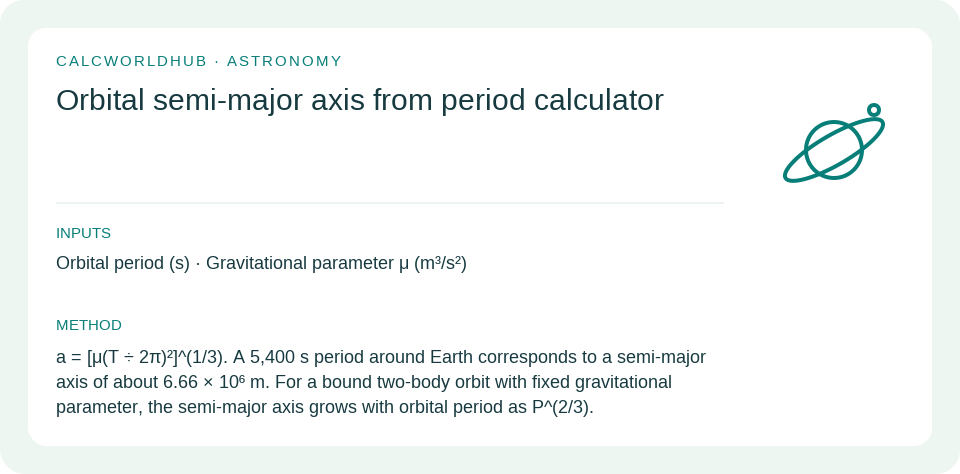
a = [μ(T ÷ 2π)²]^(1/3).
A 5,400 s period around Earth corresponds to a semi-major axis of about 6.66 × 10⁶ m.
For a bound two-body orbit with fixed gravitational parameter, the semi-major axis grows with orbital period as P^(2/3).
Interpreting the estimate
This result follows the explicit model on the page. It is not a substitute for uncertainty analysis when the input measurements are imprecise.
Assumptions and limitations
Uses Kepler’s two-body relation; for an elliptical orbit, the output is the semi-major axis, not the instantaneous orbital radius.
Source and method
Kepler’s third law relates orbital period and semi-major axis; this page rearranges the two-body relation using the central gravitational parameter. NASA — Orbits and Kepler’s laws.
Frequently asked questions
Which values are needed for the orbital semi-major axis from period?
Enter Orbital period (s), Gravitational parameter μ (m³/s²). Check that distances and periods use the units shown beside the inputs.
Does this orbital semi-major axis from period include real-world effects?
Uses Kepler’s two-body relation; for an elliptical orbit, the output is the semi-major axis, not the instantaneous orbital radius.
Is the semi-major axis the same as the current orbital distance?
No. It is half the ellipse's longest diameter and is constant for the ideal two-body orbit; the instantaneous radius changes along an eccentric orbit.
How do I use the Orbital semi-major axis from period calculator?
Enter Orbital period (s), Gravitational parameter μ (m³/s²). Match the units shown beside each field and review the result together with the assumptions below.
What is a worked example of Orbital semi-major axis from period?
a = [μ(T ÷ 2π)²]^(1/3). A 5,400 s period around Earth corresponds to a semi-major axis of about 6.66 × 10⁶ m. For a bound two-body orbit with fixed gravitational parameter, the semi-major axis grows with orbital period as P^(2/3).
Read the calculation methodology and privacy policy.