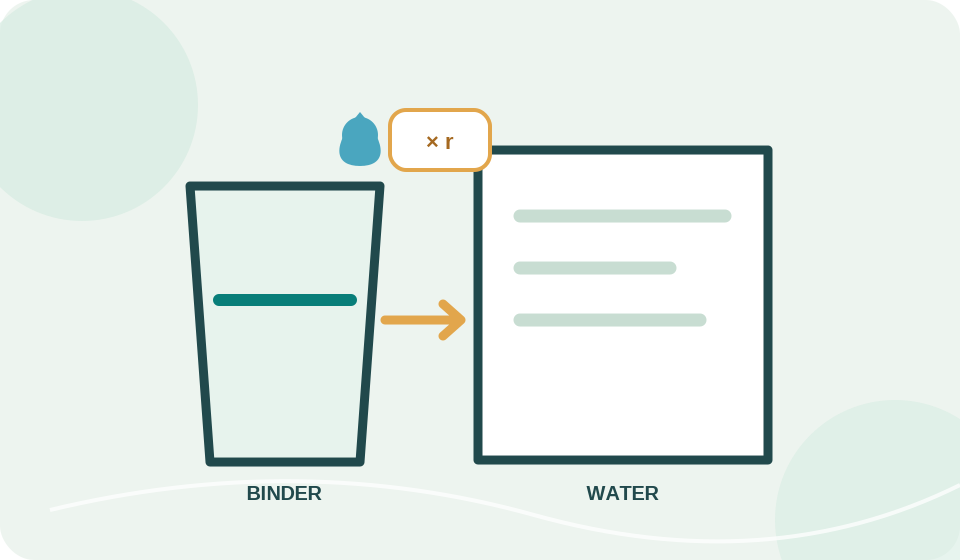

Read the ratio as a mass relationship
Water-to-binder ratio means water mass divided by cementitious binder mass under the convention selected for the mix. The American Cement Association describes water-cement ratio by weight as mixing-water weight divided by cement weight. In this calculator the entered binder mass is the denominator basis, so confirm whether the approved specification means cement alone or a broader cementitious-binder amount before using the output.
The entered ratio is not a percent. A ratio of 0.48 means 0.48 kilograms of water for each kilogram of the stated binder, not 48 kilograms per kilogram. If the ratio is entered as 48, the result becomes one hundred times too large. Write the chosen basis beside the calculation record and keep mass units consistent; mixing kilograms of binder with pounds of water without conversion breaks the relationship.
Calculate nominal water from binder mass
The calculation is simple: water mass = binder mass × water-to-binder ratio. A 320 kg binder batch at 0.48 gives 153.6 kg of nominal water. The output also reports approximately 153.6 litres using the calculator’s one-kilogram-per-litre water conversion. That litre figure is a planning conversion for water, not the volume of the concrete mixture or a measure of the batch yield.
The American Cement Association explains that mixture proportions affect workability, strength, and durability, and that the water-cement ratio is one factor in those outcomes. A ratio alone cannot determine the full batch. Aggregate grading, moisture and absorption, admixtures, air content, cement type, exposure, and placement requirements matter. Follow the approved mix design and treat this result as the arithmetic implied by the two inputs.
Account for water sources outside this simple tool
For field batching, aggregate can carry surface moisture or absorb water, and admixtures may contribute liquid. The theoretical amount calculated here does not subtract aggregate free moisture, account for absorption, or sum other water sources. The Sika concrete handbook describes the water-cement ratio as a ratio by weight, while practical batch records need the relevant materials and moisture basis. Do not treat the displayed nominal water as permission to add that entire amount at the mixer without the mix procedure.
Keep units and scope aligned: the binder amount and ratio must refer to the same batch and material definition. If several truck or mixer batches are involved, calculate each from its actual binder mass or scale the ingredients proportionally only when the mix design allows it. Preserve the batch ticket, approved proportion, moisture correction, and any authorized field adjustment so a later review can reconstruct the water balance.
Use the number as a check, not a design decision
The calculator accepts nonnegative binder mass and a nonnegative ratio. Zero binder or zero ratio produces zero nominal water mathematically, but that does not describe a usable concrete mixture. It does not validate a specification limit or decide whether the mix is suitable. A ratio that passes the input checks may still be inappropriate for strength, durability, placing, curing, or the exposure class of a real project.
Use the result to catch arithmetic or unit mistakes before reviewing the complete mix ticket. If the calculated amount differs from an approved batch record, check whether the ratio uses cement alone or total binder, whether masses use the same units, and whether the document reports total or added water. Only the responsible mix designer or project procedure can approve changes to the specified quantities.
Worked examples
The examples treat the entered binder basis and ratio as approved inputs. Water mass is the product; the approximate litre output uses 1 kg of water ≈ 1 L.
A ready-mix batch check
Inputs: 400 kg cementitious binder at a water-to-binder ratio of 0.45
Calculation: 400 × 0.45 = 180 kg water ≈ 180 L
The nominal water output is 180 kg and approximately 180 L. Any aggregate-moisture correction or other water source belongs to the approved batch calculation, not this two-input product.
A smaller batch with a different ratio
Inputs: 275 kg binder at a ratio of 0.52
Calculation: 275 × 0.52 = 143 kg water ≈ 143 L
The calculator reports 143 kg of nominal water and about 143 L. The ratio is not a recommendation; compare it with the specified mix and confirm that its binder definition matches the entered mass.
