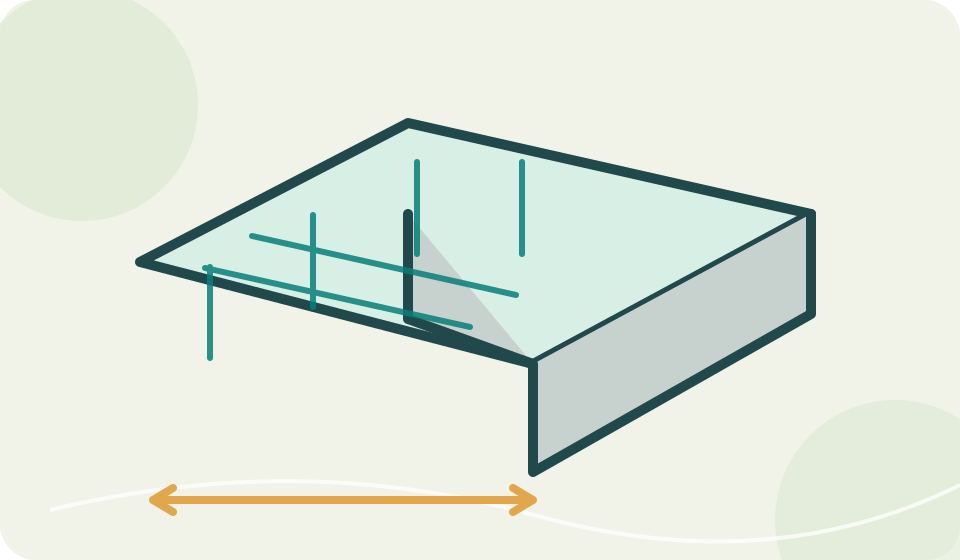

Formula and units
Convert depth from inches to feet by dividing by 12. Base volume (ft³) = length (ft) × width (ft) × depth (in ÷ 12). Adjusted volume (yd³) = base volume × (1 + extra allowance ÷ 100) ÷ 27.
Length and width are entered in feet; depth is entered in inches. The extra allowance is optional and is applied before converting cubic feet to cubic yards. Keep intermediate values unrounded until the displayed result.
Worked examples
Example 1 · 10-by-10-foot slab
Inputs: Length 10 ft; width 10 ft; depth 4 in; entered allowance 10%.
Calculation: Base = 10 × 10 × (4 ÷ 12) = 33.3333 ft³. Adjusted = 33.3333 × 1.10 ÷ 27 ≈ 1.3580 yd³.
About 1.36 yd³ after the entered 10% allowance; confirm ordering units with the supplier.
Example 2 · six-inch depth
Inputs: Length 12 ft; width 8 ft; depth 6 in; entered allowance 5%.
Calculation: Base = 12 × 8 × (6 ÷ 12) = 48 ft³. Adjusted = 48 × 1.05 ÷ 27 = 1.8667 yd³.
The model gives about 1.87 yd³ using the stated 5% allowance.

Check geometry and allowance
The second example uses 12 ft × 8 ft × 6 in: the base is 48 ft³, and a 5% allowance gives 48 × 1.05 ÷ 27 = 1.8667 yd³. It is still a volume estimate, not a delivery quantity guarantee.
For uneven grade, steps, thickened edges, or multiple slab depths, measure sections separately or use a takeoff suited to that shape. Agree with the producer on purchase units, minimums, and rounding; one allowance does not fit every pour.
Keep structural decisions separate
This calculator does not select mix strength, reinforcement, joints, curing, exposure class, or structural details. Use the project drawings and responsible professional’s specifications for those decisions.
NIST lists the cubic-foot to cubic-yard relationship used in the conversion. The unit factor is exact; the dimensions and average depth are measured estimates that may carry uncertainty.
Translate the estimate into a pour plan
Measure the intended footprint and use the same horizontal boundary for length and width. Depth is entered in inches while the footprint is in feet, so convert depth to feet before multiplying. The conversion to cubic yards comes afterward: cubic feet divided by 27. Keeping the units visible at every step prevents a linear conversion from being mistaken for a volume conversion.
For a slab with sloped grade, thickened perimeter, steps, or separate pads, divide the shape into simple sections and calculate each section with its own average depth. Add the volumes only after each section uses consistent units. A single average depth across a complex shape can conceal a meaningful difference in the takeoff.
The allowance is applied to the calculated base volume before conversion to cubic yards. It is an input assumption, not an automatic recommendation. Preserve the base and adjusted values so the crew or supplier can see whether the amount came from measured geometry or an entered buffer.
Actual ordering also depends on the supplier’s minimum load, dispatch increment, mix requirements, site access, and timing. Confirm how the quoted quantity is sold and rounded. Do not use this geometry tool to choose reinforcement, structural thickness, joint spacing, drainage, or mix design; those questions depend on plans and site conditions.
A helpful field note lists the footprint, depth at each section, unit conversion, base volume, and the allowance with its source. If measurements change after excavation or formwork, update the dimensions instead of increasing the allowance to hide a changed geometry. The arithmetic remains transparent and easier to check with the project drawings.
Volume changes directly with each entered dimension, so an inaccurate average depth can affect the total even if the footprint is measured well. Record depth at representative locations and identify where a slab has a different profile. If the design includes a thickened edge, calculate that geometry separately instead of treating the entire footprint as uniformly deeper.
Before calling the estimate an order quantity, compare it with the formwork dimensions and the supplier’s delivery units. The entered allowance may cover only a chosen material buffer; it does not account automatically for spillage, subgrade voids, or a changed pour sequence. Keep those assumptions separate from the geometric volume.