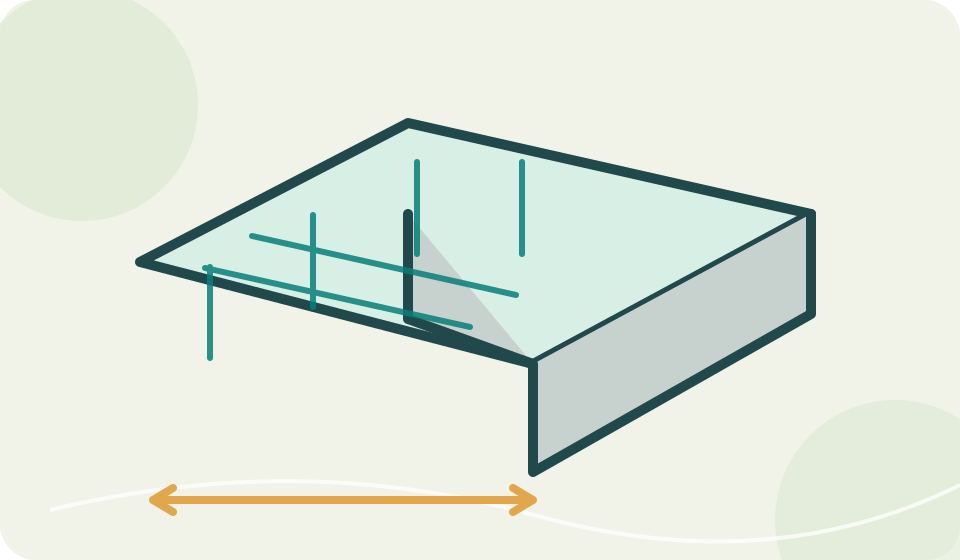
Concrete volume calculator
Convert slab dimensions to cubic yards and optionally include an allowance.
Calculator
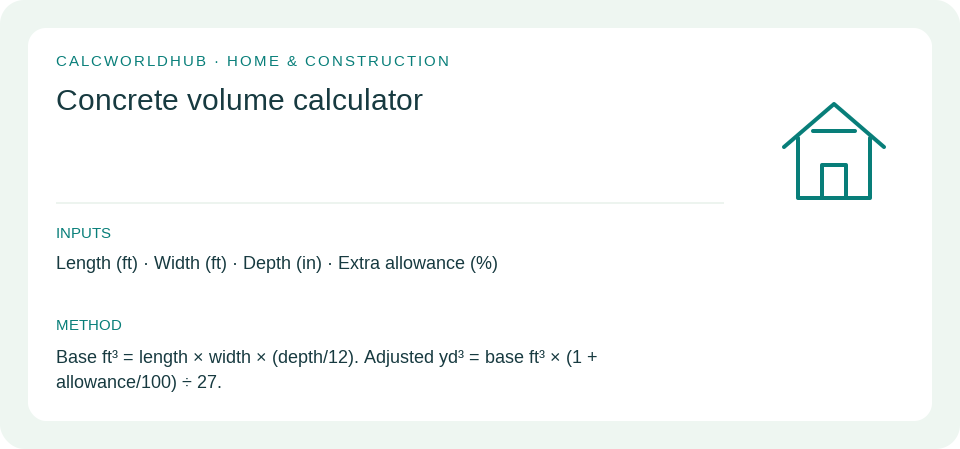
How to use this calculator
Estimate rectangular concrete volume in cubic yards from dimensions and a user-selected overage.
- Enter Length (ft), Width (ft), Depth (in), Extra allowance (%). Match the units shown beside each field and review the result together with the assumptions below.
- Read the worked example below to check the expected input format and result.
- Compare another scenario by changing one input at a time. Use Reset to return to the starting values.
Convert slab dimensions into concrete volume with an allowance
This estimate multiplies a rectangular pour’s length and width by depth, converts the depth from inches to feet, then adds a chosen overage before converting cubic feet to cubic yards.
Inputs and units
- Length (ft): Rectangular pour length in feet.
- Width (ft): Rectangular pour width in feet.
- Depth (in): Average concrete depth in inches.
- Extra allowance (%): Optional additional volume for uneven subgrade or placement variation.
Formula and method
Base ft³ = length × width × (depth/12). Adjusted yd³ = base ft³ × (1 + allowance/100) ÷ 27.
Worked example
For 10 ft × 10 ft × 4 in, base volume is 10 × 10 × 4/12 = 33.33 ft³. With 10% extra, 36.67 ft³ ÷ 27 ≈ 1.36 yd³.
Interpreting the result
The result is an order-planning volume for a rectangular shape. Verify the actual grade, forms, and product ordering units before placing an order.
Assumptions and limits
The estimate assumes constant depth and a rectangular footprint. It does not account for beams, steps, voids, reinforcement, mix yield, placement loss, or structural requirements.
Frequently asked questions
Why convert inches to feet?
Length and width are entered in feet, so depth must also be converted before multiplying.
How should I choose overage?
Base it on measured site conditions and placement method; the field is an explicit assumption, not a universal recommendation.
How do I use the Concrete volume calculator?
Enter Length (ft), Width (ft), Depth (in), Extra allowance (%). Match the units shown beside each field and review the result together with the assumptions below.
What is a worked example of Concrete volume?
For 10 ft × 10 ft × 4 in, base volume is 10 × 10 × 4/12 = 33.33 ft³. With 10% extra, 36.67 ft³ ÷ 27 ≈ 1.36 yd³.
What does the Concrete volume calculator calculate?
Estimate rectangular concrete volume in cubic yards from dimensions and a user-selected overage.
Good calculators show their work.
CalcWorldHub is built around clear inputs and visible assumptions. Results are estimates for planning; check official sources or your provider’s terms when exact figures matter.