How to use this calculator
Estimate the combined concrete volume and whole bag count for a row of identical cylindrical piers. Free calculator with formula, example, and assumptions.
- Enter Number of piers, Pier diameter (in), Pier depth (in), Bag yield (ft³ per bag), then complete the remaining labeled fields. Match the units shown beside each field and review the result together with the assumptions below.
- Read the worked example below to check the expected input format and result.
- Compare another scenario by changing one input at a time. Use Reset to return to the starting values.
How the estimate works
The material order applies the waste allowance to all pier volumes, then rounds the required bag count upward to a whole bag.
Inputs and units
count— Number of piers- Enter the number of identical cylindrical piers.
diameter— Pier diameter (in)- Measure the finished cylindrical diameter.
depth— Pier depth (in)- Enter the concrete depth of one pier.
yieldFt3— Bag yield (ft³ per bag)- Use the yield printed for the chosen bag size.
wastePct— Extra allowance (%)- Optional allowance for spillage and uneven holes.
Formula and method
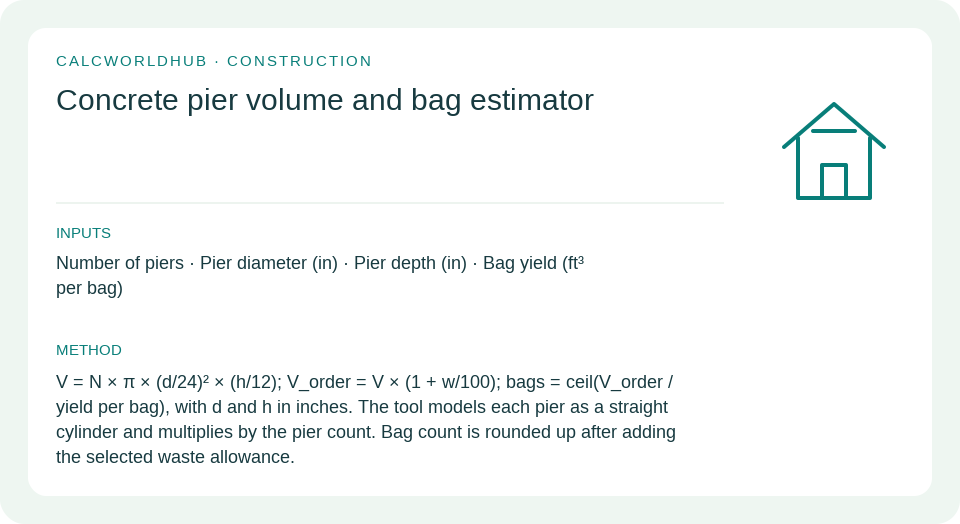
V = N × π × (d/24)² × (h/12); V_order = V × (1 + w/100); bags = ceil(V_order / yield per bag), with d and h in inches.
The tool models each pier as a straight cylinder and multiplies by the pier count. Bag count is rounded up after adding the selected waste allowance.
Worked example
Six 12 in diameter × 36 in deep piers each hold π × 0.5² × 3 ≈ 2.356 ft³. Together they need about 14.14 ft³; with 8% extra and 0.6 ft³ per bag, order ceil(15.27/0.6) = 26 bags.
Assumptions and limits
Use consistent length units for diameter and depth. Bag yield must come from the product label; the result is a material estimate, not a footing design.
Frequently asked questions
Why is bag yield an input?
Different products and bag sizes produce different finished volumes; the package label is the appropriate source.
Does the waste allowance change the pier volume?
No. It increases the suggested order quantity while the geometric volume remains separate.
Can the holes taper or bell out?
This model assumes straight cylinders. Add measured flare volume separately or use supplier guidance for irregular holes.
How do I use the Concrete pier volume and bag estimator?
Enter Number of piers, Pier diameter (in), Pier depth (in), Bag yield (ft³ per bag), then complete the remaining labeled fields. Match the units shown beside each field and review the result together with the assumptions below.
What is a worked example of Concrete pier volume and bag estimator?
Six 12 in diameter × 36 in deep piers each hold π × 0.5² × 3 ≈ 2.356 ft³. Together they need about 14.14 ft³; with 8% extra and 0.6 ft³ per bag, order ceil(15.27/0.6) = 26 bags.
Read our calculation methodology.