Concrete bag quantity estimator
Estimate whole concrete bags from the pour volume and the yield printed on the product.
inputs.
Calculator
How to use this calculator
Estimate concrete bags from required volume, the product’s stated bag yield, and a chosen overage percentage.
- Enter Required volume (cubic ft), Yield per bag (cubic ft), Overage (%). Match the units shown beside each field and review the result together with the assumptions below.
- Read the worked example below to check the expected input format and result.
- Compare another scenario by changing one input at a time. Use Reset to return to the starting values.
Round project volume up to whole bags
Enter the required concrete volume, the yield printed for one bag, and an optional overage percentage. The estimator adds the allowance before dividing by bag yield, then rounds upward because a partial bag still has to be purchased.
Inputs and units
- Required volume (cubic ft): Net volume of the pour before extra allowance.
- Yield per bag (cubic ft): Expected mixed-concrete volume from one bag; use the product label for the exact mix and bag size.
- Overage (%): An explicit allowance for handling loss or small measurement uncertainty; choose it for the job rather than treating it as universal.
Formula and method
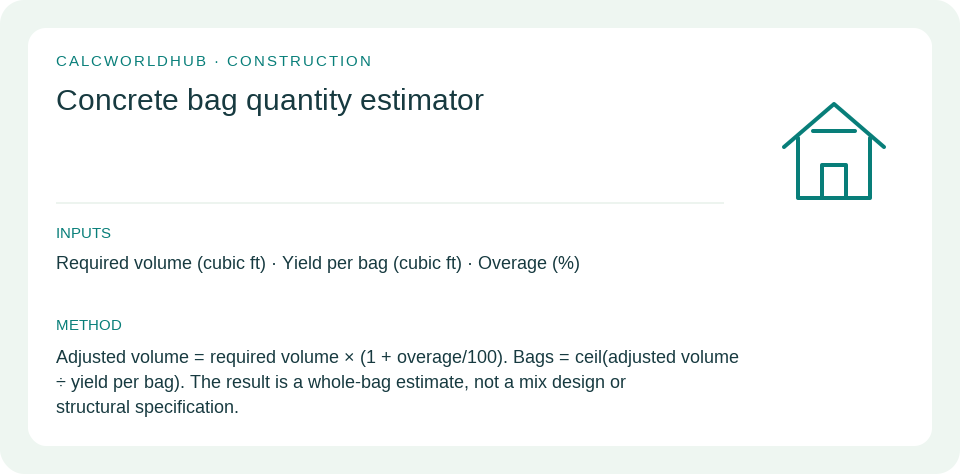
Adjusted volume = required volume × (1 + overage/100). Bags = ceil(adjusted volume ÷ yield per bag). The result is a whole-bag estimate, not a mix design or structural specification.
Worked example
For 18 ft³ of net volume, 0.6 ft³ yield per bag, and 10% overage, adjusted volume = 18 × 1.10 = 19.8 ft³. Then 19.8 ÷ 0.6 = 33 bags.
Interpreting the result
The 33-bag estimate covers the entered volume plus the chosen allowance. Check the bag label and project dimensions; ordering, mixing, and placement needs can introduce additional waste or constraints.
Assumptions and limits
Actual yield varies by product and mix. This calculation does not specify strength, water ratio, reinforcement, weather controls, placement, curing, or code compliance. For structural work, use the project specification and qualified guidance.
Frequently asked questions
Should I always add 10% overage?
No. The entered percentage is a planning choice. Site shape, subgrade, placement method, product yield, and tolerance determine a reasonable allowance for a specific pour.
How do I use the Concrete bag quantity estimator?
Enter Required volume (cubic ft), Yield per bag (cubic ft), Overage (%). Match the units shown beside each field and review the result together with the assumptions below.
What is a worked example of Concrete bag quantity estimator?
For 18 ft³ of net volume, 0.6 ft³ yield per bag, and 10% overage, adjusted volume = 18 × 1.10 = 19.8 ft³. Then 19.8 ÷ 0.6 = 33 bags.
What does the Concrete bag quantity estimator calculate?
Estimate concrete bags from required volume, the product’s stated bag yield, and a chosen overage percentage.
What assumptions apply to Concrete bag quantity estimator?
Actual yield varies by product and mix. This calculation does not specify strength, water ratio, reinforcement, weather controls, placement, curing, or code compliance. For structural work, use the project specification and qualified guidance.
Good calculators show their work.
CalcWorldHub is built around clear inputs and visible assumptions. Results are estimates for planning; check official sources or your provider’s terms when exact figures matter.