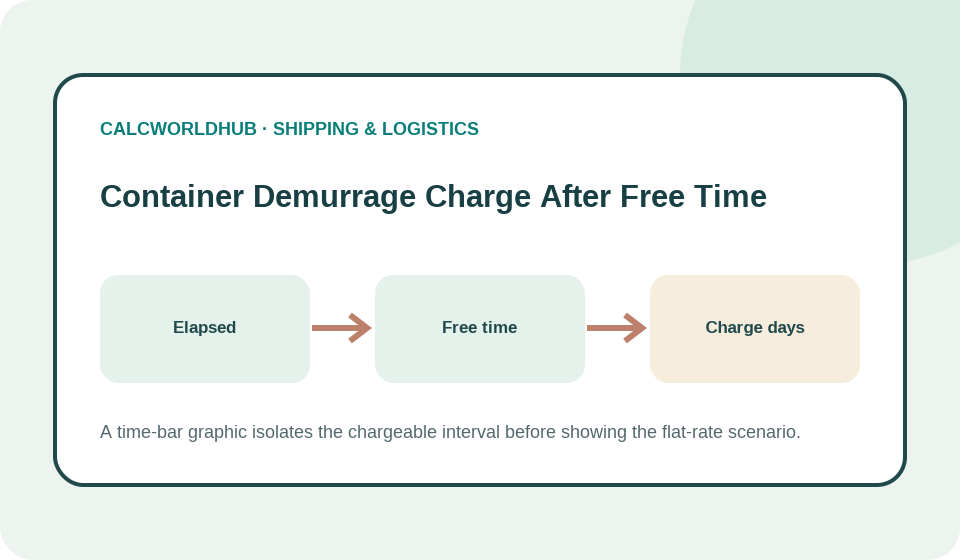

Separate elapsed days from free time
The calculator asks for a container count, elapsed terminal days, free days, and a daily rate per container per day. Use the same shipment and time convention for the elapsed and free-day inputs. Confirm whether your contract counts calendar days, when the clock begins, and what event ends the relevant period.
Free time is not always a universal number. It may depend on the carrier, equipment, location, direction, and booking or service contract. Maersk’s local import information, for example, states local charge rules and describes calendar-day charges for certain Ukraine import cases. Check the current terms for the shipment rather than reusing a remembered allowance.
Apply the calculator’s flat-rate model
Chargeable days per container = max(0, elapsed days − free days). The estimated amount = container count × chargeable days × daily rate. If elapsed time is no greater than free time, the model returns zero chargeable days. If the free allowance has expired, each additional day adds the entered rate for each container.
The rate field is one currency amount and the interface does not select a currency. Keep the rate and resulting estimate in the same currency, and label it in your notes. The calculator uses one flat rate throughout the chargeable period; it does not apply escalating day bands, distinct equipment rates, storage fees, taxes, or administrative charges.
Check how the carrier counts a chargeable day
A tariff may count calendar days or use other terms. In this calculator, container count, elapsed terminal days, and free days must be nonnegative whole numbers; the runtime rejects fractional day counts. The model subtracts those entered counts numerically and does not inspect timestamps, holidays, port closures, or exceptions. Verify the tariff start and end rules before translating dates into an elapsed-day input.
Do not infer that a “day” in your spreadsheet matches the tariff simply because both use that word. Verify the start and stop dates, local time zone, discharge or gate event, and any customs or terminal holds. A difference of one billable day multiplied by several containers can materially change an estimate.
Distinguish demurrage from related charges
Demurrage generally concerns keeping the carrier’s container in the terminal beyond agreed free time, while detention concerns equipment outside the terminal; contracts may combine or define these differently. Terminal storage may be billed separately. The calculator’s title is demurrage, and its four inputs do not calculate detention, storage, chassis, reefer energy, or a combined charge.
A shipment may have a daily rate that changes with time or container type. If the tariff is progressive, break the days into the applicable tiers and calculate each segment separately, or rely on the carrier’s quote. Do not multiply every day by the first rate when the contract says later days cost more.
Use the estimate for scenario planning
A simple estimate can help compare a one-day delay with a longer delay, or understand how several containers multiply the same per-container charge. Keep the input record with the booking reference, carrier, terminal, free-time source, rate currency, and date checked. Update the estimate when the carrier confirms revised dates or terms.
The result is an arithmetic planning aid, not a dispute calculation or legal interpretation. If an invoice differs, reconcile the carrier’s event timestamps, applicable tariff, contract exceptions, equipment type, and terminal bills. Use the written terms and official shipment-specific data as the authority for payment or a claim.
Worked examples
The examples hold one daily rate constant. Actual free-time clocks and rates must be checked against the booking and current carrier or terminal terms.
Two containers beyond four free days
Inputs: Containers = 2; elapsed terminal days = 8; free days = 4; entered rate = 125 currency units per container per day.
Calculation: Chargeable days per container = max(0, 8 − 4) = 4. Container-days = 2 × 4 = 8. Estimate = 8 × 125 = 1,000 currency units.
The flat-rate scenario is 1,000 currency units, before any tariff tiers or other fees.
Three containers with one chargeable day
Inputs: Containers = 3; elapsed terminal days = 6; free days = 5; entered rate = 80 currency units per container per day.
Calculation: Chargeable days per container = max(0, 6 − 5) = 1. Container-days = 3 × 1 = 3. Estimate = 3 × 80 = 240 currency units.
The entered flat rate produces a 240-unit scenario total for the three containers.
