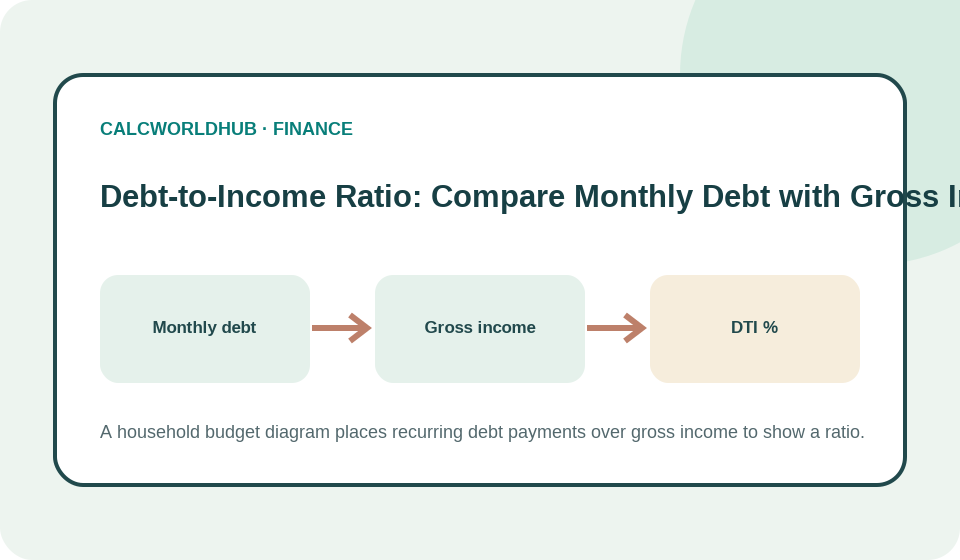

Define the monthly debt total
Enter the monthly debt payments included in the comparison, such as housing debt, auto loans, student loans, or minimum credit obligations according to the definition you are using. This calculator accepts one aggregate; it cannot classify the accounts or determine whether a lender includes each item.
A monthly obligation can be different from a full account balance. Use required monthly payments for a DTI-style measure rather than adding outstanding principal amounts. If a lender or program gives a specific worksheet, follow its categories and treatment instead of assuming this simple total is identical.
Use gross monthly income
The denominator is gross monthly income, generally before income taxes and payroll deductions. If pay is weekly, biweekly, or annual, convert it to a monthly estimate consistently before entering it. Take care with irregular income, multiple earners, self-employment, or bonuses because eligibility rules may treat them differently.
Do not divide monthly debt by take-home pay and label the result a standard DTI without saying that you used net income. That may be a useful household cash-flow comparison, but it answers a different question from the gross-income ratio described by the CFPB.
Calculate and read the percentage
The calculation is monthly debt payments ÷ gross monthly income × 100. A result of 30% means the entered monthly debt amount is 30% of the entered gross monthly income. It does not say that 30% of take-home pay remains after every household expense.
A higher DTI means more gross income is committed to the debt payments included in the numerator. It does not measure savings, utilities, food, taxes withheld, or other living costs unless those are part of a separate analysis. Use a full budget for affordability rather than interpreting DTI alone.
Do not treat one percentage as an approval rule
Lenders may use different debt definitions, income documentation, compensating factors, loan products, and underwriting standards. Regulatory materials describe specific creditor obligations, not a universal guarantee that a given DTI will be approved or declined. The calculator cannot predict a lender’s decision.
For a mortgage discussion, ask the lender which obligations and income sources are included and how the figure is calculated. CFPB materials also explain that DTI is only one part of a creditor’s ability-to-repay assessment; borrowers should not treat an online ratio as a promise of eligibility.
Keep the reporting period and household consistent
Include obligations and income from the same household or application scope and the same month. Do not combine one person’s debts with another person’s income unless that matches the evaluation being prepared. If the income amount is annual, convert it to a monthly figure before using monthly debt.
When comparing before and after scenarios, note whether a debt was paid off, refinanced, or simply omitted from the input. A percentage can improve because the numerator fell, the denominator rose, or both. Showing the underlying monthly totals avoids attributing the change to the wrong cause.
Worked examples
The examples keep both numerator and denominator monthly and use the gross-income basis.
Monthly obligations equal 30% of gross income
Inputs: Monthly debt payments = $1,800; gross monthly income = $6,000.
Calculation: DTI = $1,800 ÷ $6,000 × 100 = 30%.
The entered debt payments equal 30% of gross monthly income; lender calculations can use additional rules.
A higher debt total against a different income
Inputs: Monthly debt payments = $2,450; gross monthly income = $7,000.
Calculation: DTI = $2,450 ÷ $7,000 × 100 = 35%.
This scenario has a 35% ratio because both the debt and income amounts differ from the first example.

Use DTI alongside cash-flow planning
A household can have a modest DTI and still face tight cash flow because of high taxes, childcare, insurance, or essential living costs. Conversely, a higher ratio can coexist with substantial assets or low non-debt expenses. The ratio is a structured comparison, not a complete personal financial assessment.
Keep the estimate current when monthly payments or income change, and avoid using gross income as a spendable amount. For a decision about borrowing, review the full payment, total loan cost, savings, emergency needs, and lender terms with a qualified adviser if needed.