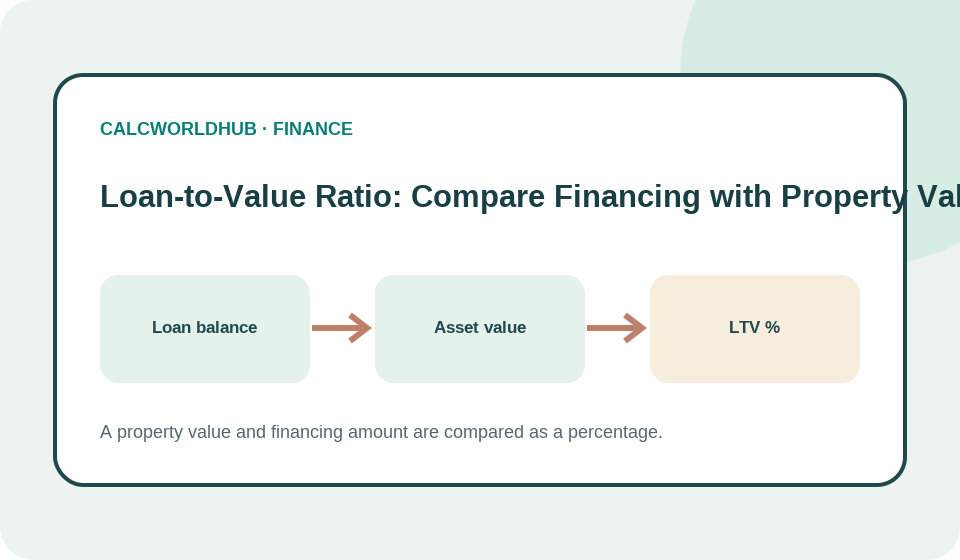

Choose the amount being financed
Enter the loan balance or proposed amount that belongs in the numerator. In a purchase discussion, that might be the amount borrowed; in an existing loan review, it may be the current balance. The calculator does not add subordinate liens, financed fees, or future draws automatically.
For a combined loan-to-value measure, multiple secured balances may need to be included. This calculator accepts one amount, so add only what the definition you are using calls for and document the scope. A lender’s official calculation can include specific liens and rules that differ from a simple single-balance ratio.
Use a defensible property or asset value
The denominator is the property or asset value associated with the financing. A lender may use an appraisal, purchase price, or a value determined under product rules. The input field cannot tell which figure a lender will accept; use the value that matches your question.
Keep currency and valuation date consistent. An old estimate, tax assessment, listing price, and current appraisal are not interchangeable in every lending context. If the value is uncertain, calculate scenarios using a range and label each one rather than implying a precise accepted valuation.
Calculate the ratio as a percentage
The formula is loan balance ÷ property or asset value × 100. If a $240,000 loan is compared with a $300,000 value, the ratio is 80%. Both inputs are dollar amounts, so the currency cancels; the result is a percentage.
A larger percentage means the loan amount is larger relative to the entered value. It does not by itself say how much equity can be accessed, what rate will be offered, or whether mortgage insurance applies. Those outcomes depend on lender, jurisdiction, product, and borrower details.
Relate LTV to borrowing costs cautiously
CFPB materials explain that LTV can relate to mortgage costs, but cost treatment depends on the loan and borrower situation. A lower calculated ratio is not a universal guarantee of approval or a particular rate. Compare actual loan estimates and disclosures for the amounts, terms, fees, and insurance costs offered.
If an appraisal comes in below a purchase price, the value used by a lender may differ from the value a buyer expected. Confirm the lender’s numerator and denominator before trying to reproduce its result. This calculator is a transparent ratio, not an underwriting system.
Use the same loan scope across comparisons
When comparing two offers, use the same property value basis and include the same loan components. If one case includes a second lien and the other does not, the ratios do not describe the same financing scope. Similarly, a refinancing comparison should state whether the balance includes fees or cash-out amounts.
A purchase scenario can change both loan amount and property value. If the borrower increases the down payment, the numerator falls; if the accepted valuation changes, the denominator can move as well. Explain both inputs when describing why the ratio changed.
Interpret LTV as one part of the picture
Equity is related to the difference between value and debt, but this ratio only compares the two entered amounts. It does not deduct transaction costs, taxes, selling expenses, or other liens unless included in the loan figure. It is not a net-worth measure.
For a mortgage decision, review the Loan Estimate and closing documents, ask the lender how value and loan amount are defined, and consider the total repayment cost. For a non-mortgage asset, the relevant valuation method may be entirely different. The output should be read within that context.
Worked examples
The examples use matching dollar amounts and show how a higher loan balance relative to value changes the ratio.
An 80% comparison
Inputs: Loan balance = $240,000; property value = $300,000.
Calculation: LTV = $240,000 ÷ $300,000 × 100 = 80%.
The loan amount equals 80% of the entered property value under this simple ratio.
A higher balance relative to value
Inputs: Loan balance = $315,000; property value = $350,000.
Calculation: LTV = $315,000 ÷ $350,000 × 100 = 90%.
The ratio is 90%, ten percentage points above the first scenario because the loan is larger relative to value.
