
Confirm the dividend period and share basis
Enter annual dividend per share in the same currency as the share price, both on a per-share basis. If a company pays quarterly, add the four declared or expected quarterly amounts for an annual figure only when that assumption is appropriate. The calculator does not infer frequency or convert currencies.
A brokerage statement may show estimated annual income or yield, which can be based on current declarations and holdings data. Check the statement’s date and definition before comparing it with this calculator’s inputs. A split, special distribution, or changed dividend can make an old annual figure stale.
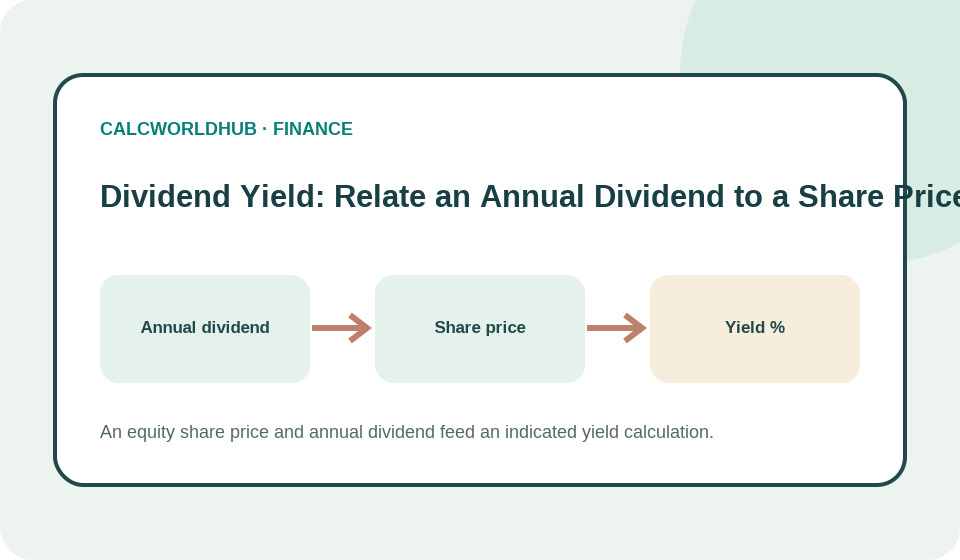
Divide annual dividend by share price
The calculation is annual dividend per share ÷ share price × 100. If the annual dividend is $2.40 per share and the price is $60, the quotient is 0.04, or 4%. Both numerator and denominator are per share, so the share unit cancels.
Use the share price from a clearly stated date. Price moves change the yield even if the declared dividend stays the same. The output is therefore an indicated yield based on the entered values, not a fixed coupon or a guaranteed cash payment.
Distinguish yield from total return
Dividend yield includes only the annual dividend amount relative to price. It omits appreciation or depreciation in the share price, taxes, trading costs, and any dividends reinvested. An investor’s total return can differ substantially from the indicated yield.
A high yield alone does not establish that an investment is attractive or sustainable. It may accompany a falling share price or a dividend that is later reduced. Review the company’s filings, financial condition, and risks rather than treating this ratio as a recommendation.
Treat future dividends as uncertain
Companies can change or omit dividends, and special dividends may not recur. Investor.gov describes dividends as distributions to shareholders, while actual declarations depend on the issuer. Use a stated annual amount carefully and distinguish declared payments from analyst estimates or a forward projection.
If the company has not declared a regular dividend, the calculator can still divide a hypothetical amount by price, but the result is only a scenario. Do not describe that output as an expected or secured yield unless the source supports that claim.
Use consistent currency and share classes
A per-share dividend for one share class should be paired with the price of that same class. If the company has common and preferred shares, their payment terms and prices can differ. Currency conversion, depositary receipt ratios, and foreign withholding are outside the two-input calculation.
Use the same currency in both fields. When comparing issuers from different markets, convert both values with a consistent date and disclose any exchange-rate assumption. The calculator does not adjust for inflation, withholding tax, or brokerage treatment.
Record the date behind the snapshot
Because price and dividend information can change, write down the date of both inputs. A displayed yield can be mathematically correct yet no longer describe a current market quote if the price or annual dividend has moved. Update the inputs before relying on it for a current comparison.
The formula is intentionally narrow: it helps translate two inputs into a percentage. A complete investment review also considers risk, diversification, earnings, balance-sheet strength, and the investor’s goals and time horizon. No single yield number can answer those questions.
Worked examples
The examples show how a different annual dividend and share price produce different indicated yields.
A $2.40 annual dividend
Inputs: Annual dividend per share = $2.40; share price = $60.
Calculation: Dividend yield = $2.40 ÷ $60 × 100 = 4%.
The indicated annual dividend is 4% of the entered share price if the dividend amount continues.
A lower dividend relative to price
Inputs: Annual dividend per share = $1.50; share price = $50.
Calculation: Dividend yield = $1.50 ÷ $50 × 100 = 3%.
The indicated yield is 3%; it excludes any change in the share price and is not a guaranteed return.
