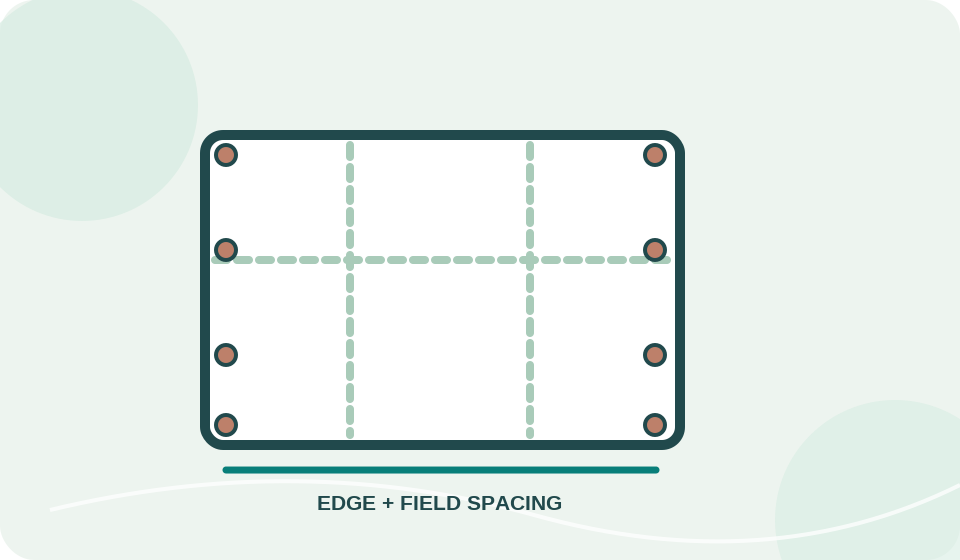

Choose the panel and spacing inputs
Enter a whole number of identical sheets, each sheet’s width and height in feet, and maximum edge and field spacing in inches. The tool uses two separate spacing values because fasteners along the panel edge and through its field are counted differently. Keep feet and inches in their labeled fields.
This calculator counts a repeated rectangular board layout. It does not ask which edge is factory tapered, where framing lies, how many framing members cross the board, whether boards are installed horizontally, or whether the project has multiple layers. Those details can change a real fastener schedule.
How the grid estimate works
For one sheet, the edge term is ceil(24 × height ÷ edge spacing) + 1. The field term estimates columns across the width and rows along the height, then multiplies them. The displayed total multiplies the per-sheet estimate by the entered number of sheets.
Ceiling functions make the estimate conservative relative to the entered maximum interval: partial spacing intervals count as another position. This is a simplified model of edge and field rows, not a drawing of individual screw locations. The reported screw count is a whole number and is not a weighed or packaged quantity.
Spacing is a specification, not a guess
Use project documents and panel-maker instructions to choose the edge and field limits. GA-216 discusses panel application and fastener spacing for different assemblies; the correct values depend on framing, panel type, orientation, layer count, and whether walls or ceilings are involved. The calculator does not select compliant spacing for you.
If two panels share framing, edge fastening may be affected by seams or support locations that a uniform grid cannot see. Do not treat a lower calculator output as permission to increase spacing. Where a fire-rated, shear, or other tested assembly is specified, follow that assembly’s exact fastening schedule.
Review the output before buying
Read both “estimated screws per sheet” and “total screw estimate.” The selected edge and field spacing is shown as an assumption. Check the multiplication independently: per-sheet count times sheets. Then choose screw length, head type, coating, and package size from the application specification.
This estimate does not round to a commercial box size, add a purchasing allowance, or distinguish a field screw from a perimeter screw. A small buffer may be sensible for dropped fasteners, but keep it separate from the calculator result and avoid double-counting an allowance already included in a supplier package.
Know where the estimate stops
Openings, board cutouts, short pieces, corners, blocking, backing strips, resilient channels, and framing spacing are not modeled. A cut sheet may have fewer full-width field rows; complicated framing may add screw lines. The model assumes the same sheet size and spacing throughout the group.
Use the count to compare a consistent takeoff, then verify it against the actual board layout and assembly instructions. It estimates quantity only; it does not assess pull-out resistance, corrosion exposure, substrate compatibility, fire performance, or structural adequacy.
Worked examples
These examples show how edge and field spacing contribute separately to the panel count. The spacing is an assumed project input, and each total is the per-sheet result multiplied by identical sheets.
Twenty-four 4-by-8-foot sheets
Inputs: 24 sheets; width 4 ft; height 8 ft; edge spacing 8 in; field spacing 12 in.
Calculation: Edge term = ceil(24 × 8 ÷ 8) + 1 = 25. Field columns = ceil((12 × 4 − 2 × 8) ÷ 12) = 3; rows = ceil(12 × 8 ÷ 12) + 1 = 9. Per sheet = 25 + 3 × 9 = 52; total = 52 × 24 = 1,248.
The estimate is 52 screws per sheet, or 1,248 for the repeated group. It is a spacing-based count, not a specification approval or box count.
Ten 4-by-12-foot sheets
Inputs: 10 sheets; width 4 ft; height 12 ft; edge spacing 8 in; field spacing 16 in.
Calculation: Edge term = ceil(24 × 12 ÷ 8) + 1 = 37. Field columns = ceil((48 − 16) ÷ 16) = 2; rows = ceil(144 ÷ 16) + 1 = 10. Per sheet = 37 + 2 × 10 = 57; total = 570.
The longer panel produces a larger edge term but the wider field interval reduces the field grid. Keep both entered spacings visible in the takeoff.
