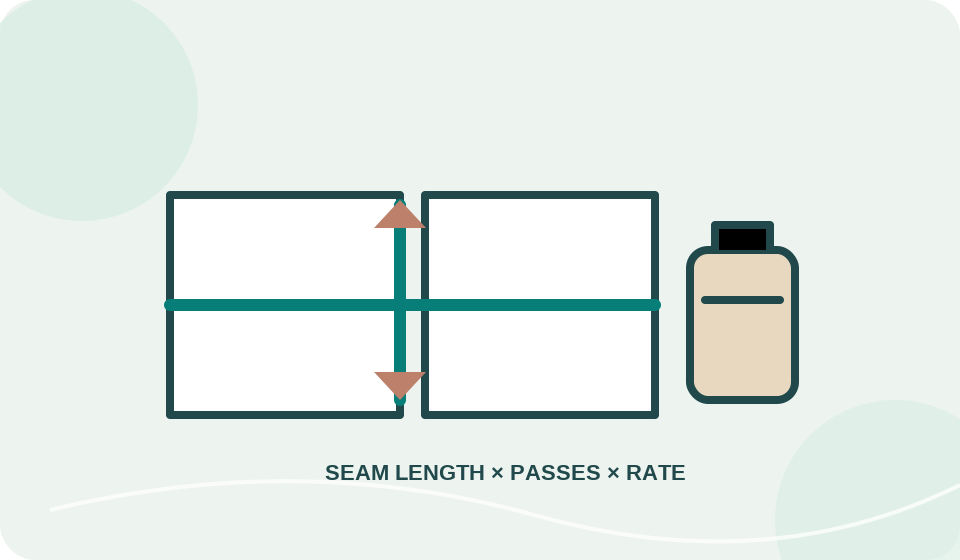

Estimate from seam length
Enter the total joint length in feet, the number of application passes, product use in pounds per 100 feet per pass, the net weight per container, and an optional waste percentage. The rate is intentionally a project or product input: different compounds and finishing methods do not have one universal pounds-per-foot value.
Count seams from the planned board layout rather than multiplying floor area by a guessed rate. Include butt joints, tapered joints, inside corners, and other seams only when they are included in the stated rate and work scope. Keep tape, corner bead, texture, and skim coating separate unless your rate explicitly covers them.
Follow the rate through the formula
Base mass equals seam feet × passes × rate ÷ 100. Multiply that mass by 1 + allowance/100, then divide by the entered pounds per container and round upward to whole containers. The calculator reports estimated mass, mass with allowance, and containers required, which makes the procurement rounding visible.
For example, the rate is applied once per pass. A rate of 4 lb per 100 ft per pass across 360 ft and three passes gives 43.2 lb before allowance. Do not enter a rate that already includes all coats and then enter the number of passes again, because that would count the passes twice.
Choose a defensible coverage rate
Read the compound label or technical data for the product and finish operation. USG publishes application information and coverage examples for specific Sheetrock compounds, but a product’s stated coverage is not automatically a linear seam rate. If the manufacturer describes coverage by board area or pail volume, convert only with a documented project basis.
Joint width, board edge, compound type, embedment, coat thickness, sanding, and installer technique affect actual use. The calculator accepts one rate for every pass, so it cannot distinguish a heavier tape bed from thinner fill and finish coats. Use measured job history or a documented estimating basis for those differences.
Keep the container math separate
Container weight must be entered in pounds and must be positive. The tool rounds container count upward even when only a small fraction remains, because the order must cover the adjusted mass. If products are sold in different sizes, run the estimate with the package size being considered and compare total purchased pounds, not only package count.
The visible result does not prescribe a finish level or include water loss, drying behavior, or sanding dust. A ready-mixed compound’s pail volume is not its net mass; use the stated pounds field rather than substituting gallons or liters without a reliable conversion from the product data.
Use it as a material check
This is a quantity estimate, not a substitute for the product instructions or a complete finishing takeoff. It does not determine whether a joint needs paper or mesh tape, identify a compatible compound system, or estimate labor. Record the seam length and rate source so another person can reproduce the order quantity.
If the work changes after board installation, update the seam takeoff and the selected rate rather than applying an unexplained percentage to the final bucket count. Keep the entered waste allowance distinct from whole-container rounding: the former is an assumed loss; the latter is a purchasing constraint.
Worked examples
Both calculations apply the entered compound rate once for every pass, then add the allowance before converting pounds to whole containers.
Three passes over 360 feet of seams
Inputs: 360 ft of joints; 3 passes; 4 lb per 100 ft per pass; 25 lb per container; 10% allowance.
Calculation: Base mass = 360 × 3 × 4 ÷ 100 = 43.2 lb. With allowance = 43.2 × 1.10 = 47.52 lb. Containers = ceil(47.52 ÷ 25) = 2.
The takeoff is 47.52 lb before packaging, so two 25-pound containers cover the modeled quantity. The entered rate must actually correspond to each pass.
A longer finish with a lower per-pass rate
Inputs: 520 ft of joints; 2 passes; 3.5 lb per 100 ft per pass; 20 lb containers; 12% allowance.
Calculation: Base mass = 520 × 2 × 3.5 ÷ 100 = 36.4 lb. With allowance = 36.4 × 1.12 = 40.768 lb. Containers = ceil(40.768 ÷ 20) = 3.
Three containers are needed at the chosen package weight. The calculator rounds up to whole containers after the allowance, even though the adjusted quantity is only slightly above two containers.
