How to use this calculator
Estimate joint compound containers from measured seam length and product coverage per container.
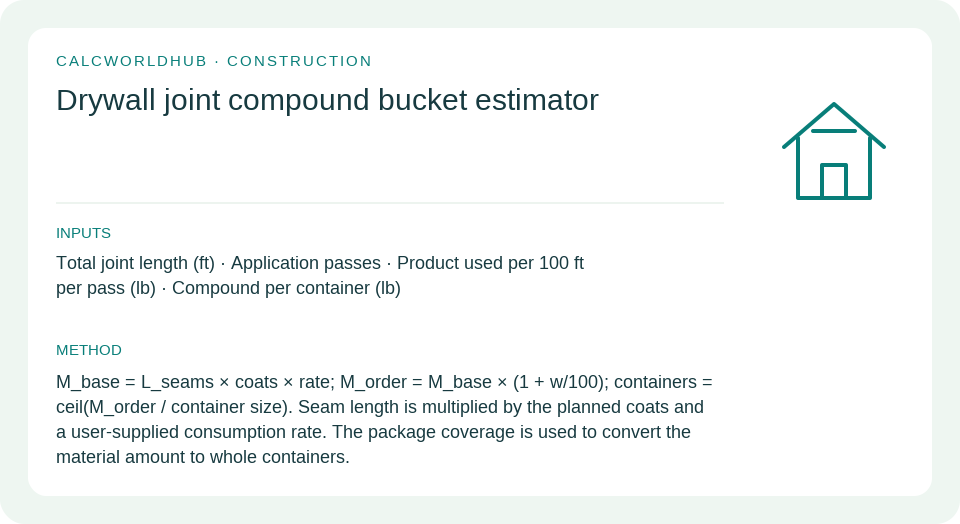
- Enter Total joint length (ft), Application passes, Product used per 100 ft per pass (lb), Compound per container (lb), then complete the remaining labeled fields. Match the units shown beside each field and review the result together with the assumptions below.
- Read the worked example below to check the expected input format and result.
- Compare another scenario by changing one input at a time. Use Reset to return to the starting values.
How this estimate works
Joint compound usage is modeled from seam length, finish passes, and the entered coverage rate; the result changes with those product and finish assumptions.
Inputs and units
seamLength— Total joint length (ft)- Sum the board joints to be finished.
coats— Application passes- Enter the planned number of passes.
rate— Product used per 100 ft per pass (lb)- Use a product or project estimate.
bucketSize— Compound per container (lb)- Enter net container weight.
wastePct— Waste allowance (%)- Optional allowance for handling and sanding loss.
Formula and method
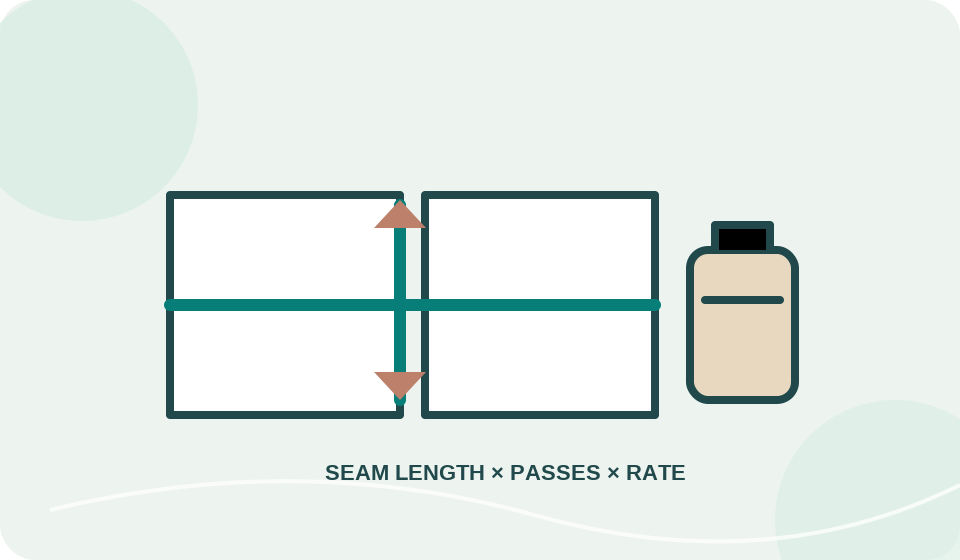
M_base = L_seams × coats × rate; M_order = M_base × (1 + w/100); containers = ceil(M_order / container size).
Seam length is multiplied by the planned coats and a user-supplied consumption rate. The package coverage is used to convert the material amount to whole containers.
Worked example
For 360 ft of seams, three passes at 4 lb per 100 ft use 43.2 lb. With 10% allowance that is 47.52 lb, so 25 lb containers require two.
Assumptions and limits
Rates depend on compound type, joint width, finishing technique, and application losses. Use a product-specific rate; the tool does not specify a finish level.
Frequently asked questions
Is 4 lb per 100 ft universal?
No. It is an example input only; coverage changes by product and finishing method.
Does this include skim coating?
No. The model covers the entered seams, not full-surface skim coats.
Should I count each pass separately?
Enter the number of planned applications; the rate is defined per 100 ft per pass.
How do I use the Drywall joint compound bucket estimator?
Enter Total joint length (ft), Application passes, Product used per 100 ft per pass (lb), Compound per container (lb), then complete the remaining labeled fields. Match the units shown beside each field and review the result together with the assumptions below.
What is a worked example of Drywall joint compound bucket estimator?
For 360 ft of seams, three passes at 4 lb per 100 ft use 43.2 lb. With 10% allowance that is 47.52 lb, so 25 lb containers require two.
Read our calculation methodology.