
List runs and stock length consistently
The calculator accepts three run lengths in feet, a number of horizontal rail rows, and one rail stock length in feet. Use the measured centerline distance for each section and enter zero for an unused run. Rail rows are a whole-number count. The stock length should match the actual product available from the supplier, not a nominal label if the delivered cut length differs.
Keep separate runs separate in your measurement notes. Openings, corners, and changes in rail direction can affect how pieces terminate, and the calculator only knows the entered linear lengths. It does not infer a gate, count posts, or decide whether a rail can safely bridge a particular span.
Round every run before multiplying by rows
For each nonzero run, pieces per row = ceil(run length ÷ stock length). Add those rounded counts across runs, then multiply by rail rows. This order matters: a short leftover from one run is not automatically subtracted from another run’s required piece count. The answer is a number of whole rails before reuse, not a cut list.
For example, a run just over two stock lengths needs three pieces for each row, even though only a small portion of the third piece covers the end. When several lengths are included, round each one separately before adding. Dividing the grand total of all runs by stock length can undercount whenever the cuts leave unusable offcuts.
Understand what stock count means
A piece count is not a precise board-foot total and does not choose splice locations. A real fence design may require rail ends to land at posts, staggered joints, or particular connections. The NRCS field-fence construction specification treats post locations, assemblies, and material details as matters for the project plan. Confirm rail size, grade, fasteners, and span requirements from the fence design and product instructions.
The calculator does not pool offcuts, include damage, add a waste percentage, or distinguish rail lengths by run. Its output is the pre-reuse count. If your shop has a measured cut plan and approved splices, you may be able to use material more efficiently, but that should come from the cut list rather than an assumed area of leftover stock.
Use a cutting plan for corners and openings
A corner often changes where a rail ends or continues. A gate opening may remove rail length, but framing around the opening can add separate pieces. Do not simply subtract opening width unless the measurement plan and assembly detail make that correct. Divide the project into runs whose rail lengths can be independently cut and installed.
If one rail row is a different length or material from another, calculate those rows separately instead of entering a single total. The single row-count input assumes the same set of runs and stock length applies to every horizontal level. This is useful for a first order, but a final takeoff should list every rail type and cut.
Allow for measurement and supplier variation
The length unit in the calculator is feet. NIST gives the international foot as exactly 0.3048 m; convert metres with that exact factor if your drawing is metric. Keep conversion precision until the ceiling step, since rounding a run downward can incorrectly remove a stock piece.
Before ordering, verify actual stock lengths, defects, saw kerf, end trimming, treatment, and the project’s joint rules. A stock count can be higher than a well-designed reuse plan, but a reuse plan needs enough pieces of compatible length and proper support. The output is best used as a transparent baseline that makes those later decisions visible.
Worked examples
Three rows across two independently cut runs
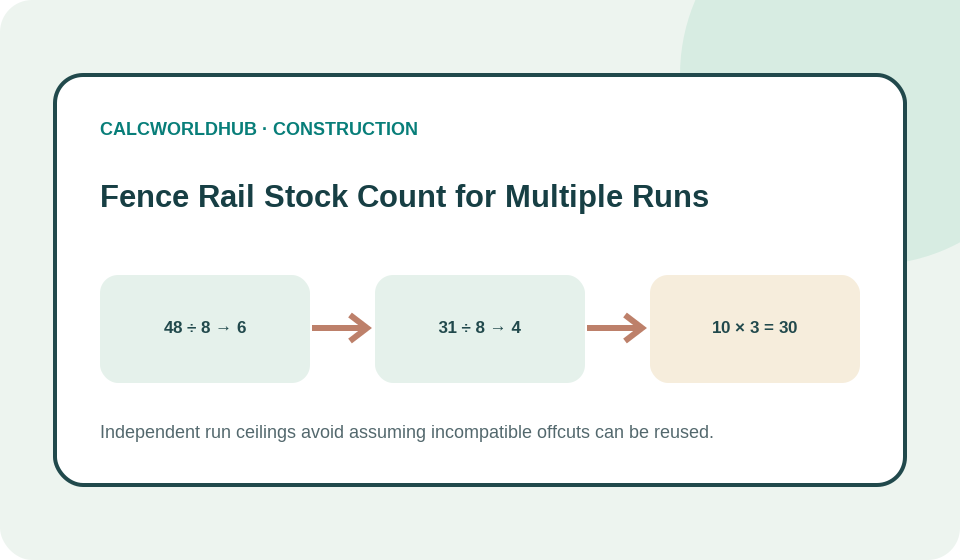
Inputs: Runs = 48 ft and 31 ft; third run = 0 ft; rails per section = 3; stock length = 8 ft.
Calculation: Pieces per row = ceil(48 ÷ 8) + ceil(31 ÷ 8) = 6 + 4 = 10. Total rails = 10 × 3 = 30.
The pre-reuse estimate is 30 whole rails; usable offcuts may reduce a verified cutting plan.
Two rail rows across three runs
Inputs: Runs = 25 ft, 25 ft, and 17 ft; rails per section = 2; stock length = 10 ft.
Calculation: Pieces per row = ceil(25 ÷ 10) + ceil(25 ÷ 10) + ceil(17 ÷ 10) = 3 + 3 + 2 = 8. Total rails = 8 × 2 = 16.
Sixteen whole stock pieces cover the independent run-by-run estimate before any offcut reuse.
