
Measure the fence line and openings
Enter total fence run and combined gate opening width in feet. The run should cover the same boundary segments represented by the gate total. If several gates interrupt the fence, add their clear widths together once. Gate frames, returns, bracing, and separate wing fences are not automatically included just because they sit near an opening.
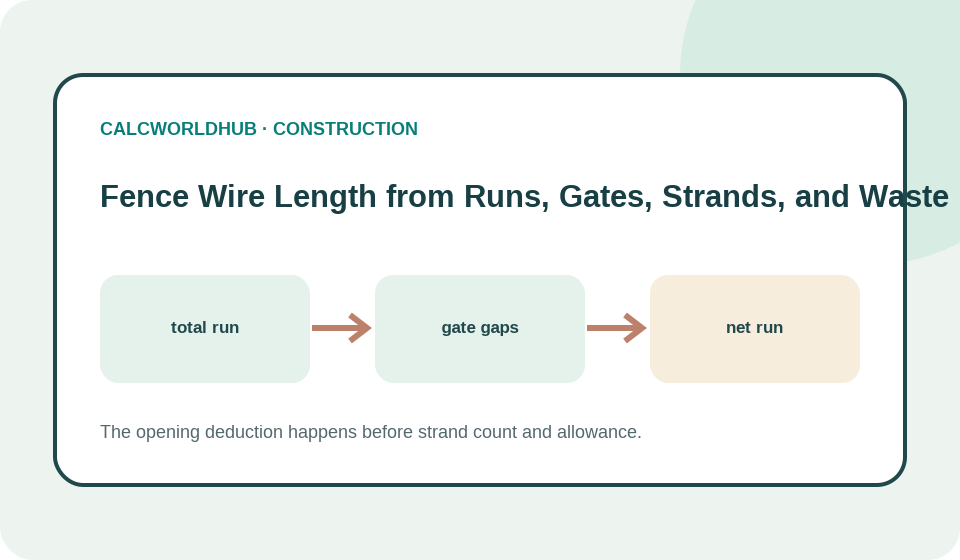
The calculator subtracts openings from the total and requires the remaining wired length to be nonnegative. Measure around corners along the planned line, not as a straight map distance, if the fence follows a boundary. A gate wider than the entered total run is a sign that the measurements do not describe the same scope.
Multiply by the number of strands
Net wired run = total run − gate openings. Wire before allowance = net wired run × strand count. Each horizontal strand follows the wired portion, so five strands along a 100-foot net run require 500 feet before cuts and splices. Strand count is a whole number; the runtime requires a positive count.
Different fences can use woven wire, barbed wire, high-tensile wire, or combinations, each with specific material and installation details. The calculator treats all strands as equal length. It does not choose gauge, coating, spacing, tension, post anchoring, brace details, or the number of strands required for a particular animal or site.
Apply waste as an explicit percentage
The entered allowance increases the base wire length by multiplying it by 1 + waste percentage ÷ 100. It is not a universal code value. The allowance may represent cutting, tying, splices, or handling loss, but choose it from your method and project experience rather than hiding it inside the strand count.
The displayed purchase estimate may be fractional feet because the model reports calculated length, not a package count. Round a supplier order to the available coil or spool sizes only after checking the exact product length. Keep the unrounded base and allowance calculation so the source of any final order rounding is clear.
Include assemblies in the separate design
Corners, ends, gates, pull assemblies, crossings, and changes in elevation can require additional wire or anchoring beyond a simple straight-strand calculation. NRCS construction specifications discuss fence plans, gate locations, post spacing, anchoring, wire fastening, and splice methods. They are project-design details, not terms produced by this length estimator.
If wire returns around a gate or is attached to a frame, the opening may still require short pieces even though the clear span is not strung across. Add those explicitly when the design calls for them. Do not count the same return in both the run length and an added assembly allowance.
Use a measured takeoff before ordering
The model accepts one total run, one combined opening width, a strand count, and one waste percentage. It cannot represent different strand counts by section or estimate energizer leads, underground cable, corner wraps, or hardware. Split a mixed fence into separate calculations and record each material class.
Use the result as a transparent baseline, then compare it with your drawing and the selected construction standard. For a metric plan, convert measured distances with a documented unit factor before using the feet fields. Keep decimals through multiplication; if a final supplier order is in whole coils, round at the package step rather than rounding each run prematurely.
Worked examples
Five strands with an eight-percent allowance
Inputs: Total fence run = 310 ft; combined gates = 12 ft; strands = 5; allowance = 8%.
Calculation: Net wired run = 310 − 12 = 298 ft. Base wire = 298 × 5 = 1,490 ft. Purchase estimate = 1,490 × (1 + 8 ÷ 100) = 1,609.2 ft.
The arithmetic estimate is 1,609.2 ft before rounding to an actual coil or spool length.
A short livestock boundary with four strands
Inputs: Total fence run = 200 ft; gates = 14 ft; strands = 4; allowance = 5%.
Calculation: Net wired run = 200 − 14 = 186 ft. Base wire = 186 × 4 = 744 ft. Purchase estimate = 744 × 1.05 = 781.2 ft.
The result is 781.2 ft of calculated wire; select a coil size that covers the amount and any separate assembly needs.
