How to use this calculator
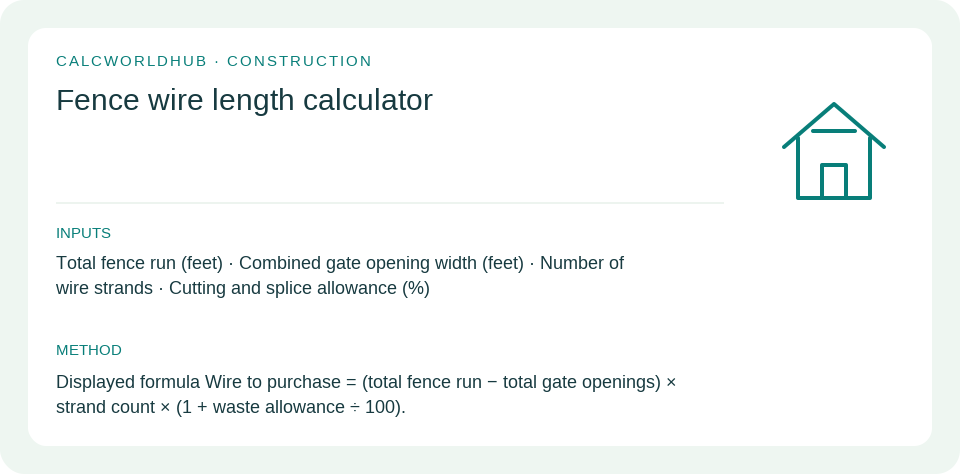
Estimate the combined wire length for multiple fence strands after subtracting gates and adding a cutting allowance.
- Enter Total fence run (feet), Combined gate opening width (feet), Number of wire strands, Cutting and splice allowance (%). Match the units shown beside each field and review the result together with the assumptions below.
- Read the worked example below to check the expected input format and result.
- Compare another scenario by changing one input at a time. Use Reset to return to the starting values.
How this calculation works
Wire quantity depends on the fence run that actually receives wire, the number of horizontal strands, and a small allowance for splices and cutting. Measure gate openings separately because wire generally does not cross them.
Inputs and units
run— Total fence run (feet)- Sum the fence sides before subtracting openings.
gates— Combined gate opening width (feet)- Total width of openings where wire will not be installed.
strands— Number of wire strands- Count each continuous horizontal strand.
waste— Cutting and splice allowance (%)- Optional percentage added for tails, splices, and cuts.
Formula
Wire to purchase = (total fence run − total gate openings) × strand count × (1 + waste allowance ÷ 100).
Method
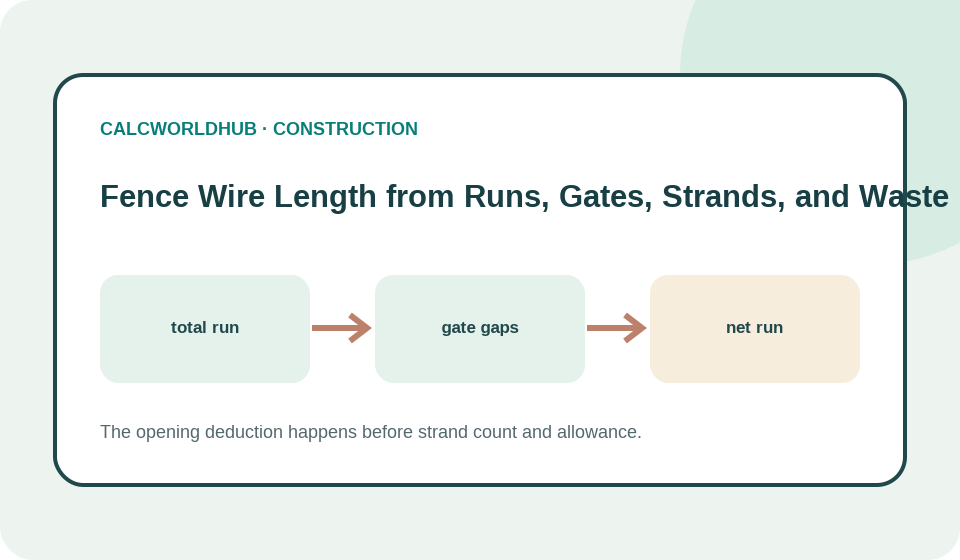
Subtract the combined gate widths from the measured perimeter, multiply the remaining run by the number of wire strands, then apply the selected percentage allowance.
Worked example
A 200 ft fence with 12 ft of gate openings leaves 188 ft to wire. Three strands require 564 ft before allowance; a 5% allowance gives 564 × 1.05 = 592.2 ft.
Assumptions and limits
This is a linear-length estimate. It does not include diagonal braces, end wraps, tensioning tails, vertical stays, corner details, elevation changes, or a supplier's roll-length increments; add those separately where needed.
Frequently asked questions
Do I subtract gates before multiplying by strands?
Yes. The gate opening is removed from each strand's run, so subtract the opening width from the total fence run first.
What allowance should I use?
There is no universal percentage. Choose an allowance based on corners, splices, site geometry, and how wire is sold; the default is only an editable planning value.
Does the result include vertical stays?
No. The output covers horizontal strands only. Estimate stays, brace wire, and terminal wraps separately if your fence design uses them.
How do I use the Fence wire length calculator?
Enter Total fence run (feet), Combined gate opening width (feet), Number of wire strands, Cutting and splice allowance (%). Match the units shown beside each field and review the result together with the assumptions below.
What is a worked example of Fence wire length?
A 200 ft fence with 12 ft of gate openings leaves 188 ft to wire. Three strands require 564 ft before allowance; a 5% allowance gives 564 × 1.05 = 592.2 ft.
Read our calculation methodology.