
Define what belongs in the batch cost
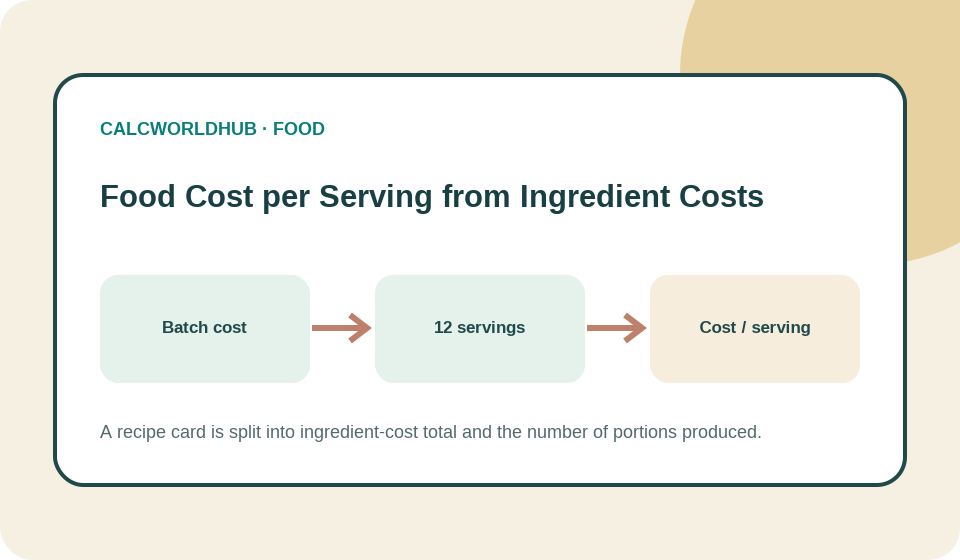
Start with the ingredient cost for the recipe batch, then divide by the portions it actually yields. The calculator has two fields: Total batch cost and Servings. Its arithmetic is batch cost ÷ servings. The answer is a currency amount per serving using the currency represented by the cost input; the tool labels dollars in its display, so use a consistent dollar-based input when interpreting that symbol.
A reliable batch total depends on a consistent costing rule. For an ingredient partly used in a recipe, allocate only the used quantity rather than charging the entire package. If a recipe uses 250 g from a 1 kg bag bought for $8, the ingredient allocation is $2 before any other recipe items are added. Keep package size, unit price, and recipe quantity in the worksheet so another person can reproduce the batch total.
Use the actual serving yield
Servings is the number of sellable or planned portions produced by the batch under the portion rule you choose. It is not automatically the number of people invited or the number printed on a recipe. If a pot yields eleven full portions and a small remainder, decide whether that remainder is a twelfth serving before dividing the cost. The calculator takes a numeric servings value, so a fractional yield can represent a measured portion basis if your costing method allows it.
The runtime divides the entered batch cost by servings and formats the result to four decimal places when needed. The source input panel does not expose a narrow minimum or maximum for these two fields, but zero servings would make the division undefined and negative cost or yield would not describe a normal recipe. Use nonnegative cost and positive serving yield, then review extreme results rather than relying on the field widget to enforce business rules.
Keep cost per serving separate from price
Ingredient cost is one part of a food business’s operating picture. Menu pricing may also need to cover labor, rent, energy, packaging, fees, taxes, and margin. Dividing batch ingredient costs by portions adds none of those items. The Institute of Culinary Education discusses food cost as a share of selling price, a separate measure from this per-portion division.
If the ingredient cost per serving is $3.17, a 30% food-cost target would be a separate menu-pricing calculation, and local pricing choices may incorporate many more factors. Do not divide the $3.17 by 30% and call the result a universally correct price without checking the business’s full cost definition, local taxes, and market. This calculator answers the narrower portion-cost question only.
Make comparisons operationally fair
To compare two recipes or suppliers, use the same portion size, edible-yield assumptions, and purchasing period. A lower cost per serving may reflect a smaller portion rather than a better ingredient price. Likewise, a batch that loses more weight during cooking can yield fewer portions than its raw ingredient weight suggests. Record whether the batch cost includes trim, spoilage, or only ingredients that reach preparation.
When prices change, update the ingredient unit costs instead of adding a blanket adjustment to the final serving figure. For a recipe with several ingredients, calculate each used quantity from the current purchase cost and sum them before dividing by servings. The two-field calculator expects that total already prepared; it does not read recipes, portion sizes, inventory, supplier invoices, or waste rates.
Worked examples
The examples keep the ingredient-cost basis visible and divide by portions actually yielded.
A batch that yields 12 portions
Inputs: Total batch cost = $38.00; Servings = 12.
Calculation: Cost per serving = $38.00 ÷ 12 = $3.166666… ≈ $3.1667.
The ingredient allocation is about $3.17 per portion before labor, overhead, packaging, fees, or margin.
A catering pan yielding 40 portions
Inputs: Total batch cost = $125.00; Servings = 40.
Calculation: Cost per serving = $125.00 ÷ 40 = $3.125.
The smaller per-portion cost comes from a larger batch yield; the total cost still needs the same accounting boundary as the first example.

Interpret the estimate within its limits
The output is an average allocation across the serving count you enter. It cannot reveal whether portions are equal or whether production was lost. It also cannot establish nutrition, food safety, or willingness to pay. Verify recipe weights, cooked yield, current supplier costs, and the full cost categories your business uses.
Note the recipe version, batch date, ingredient-price date, and portion standard beside the result. A later comparison is meaningful only when those boundaries are visible. The calculation is deliberately transparent: its value comes from a defensible batch total and yield, not from adding decimal places to an uncertain estimate.