
Understand bore and stroke
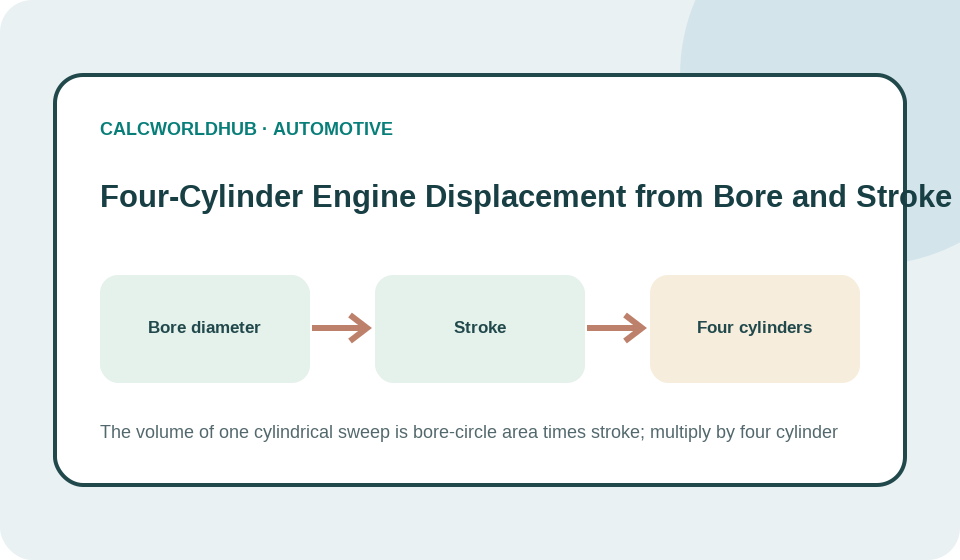
Bore is the inside diameter of a cylinder, usually stated in millimetres. Stroke is the linear distance the piston travels during one full movement between its two end positions. For one cylinder, the swept volume equals circular bore area multiplied by stroke: π × (bore ÷ 2)² × stroke. A four-cylinder total is four times that one-cylinder volume.
With both dimensions in millimetres, the result begins in cubic millimetres. There are 1,000 cubic millimetres in one cubic centimetre, so the four-cylinder conversion is 4 × π × (bore ÷ 2)² × stroke ÷ 1,000. An algebraically equivalent form is π × bore² × stroke ÷ 1,000. Keep the diameter squared; confusing diameter with radius changes the area by a factor of four.
Worked examples
Each example uses the same diameter-times-travel geometry for all four cylinders.
An 86 mm bore and 86 mm stroke
Inputs: Bore = 86 mm; stroke = 86 mm; four cylinders.
Calculation: One-cylinder sweep = π × (86 ÷ 2)² × 86 ≈ 499,557.2142 mm³. Using the unrounded value, total = 4 × π × (86 ÷ 2)² × 86 ÷ 1,000 ≈ 1,998.2289 cm³.
The geometric four-cylinder displacement is about 1,998.23 cm³.
A longer stroke with a smaller bore
Inputs: Bore = 82.5 mm; stroke = 92 mm; four cylinders.
Calculation: Total = 4 × π × (82.5 ÷ 2)² × 92 ÷ 1,000 = 1,967.1868 cm³.
Changing both dimensions produces a total near 1.97 L; the result remains swept volume, not a power rating.

What swept volume does and does not mean
Displacement measures the volume displaced by piston travel from bottom dead centre to top dead centre. It does not include the remaining combustion-chamber clearance volume at the top of the stroke. That remaining volume is needed for compression ratio, a different quantity. A displacement figure alone also cannot determine compression pressure, torque, power, or emissions.
The calculator assumes four identical cylinders with circular bores and the same stroke. A real engine may have manufacturing tolerances, wear, overbore machining, or measurement uncertainty. If a technical specification quotes a rounded displacement, reverse-calculating bore or stroke from that number may not recover the exact production dimensions. Use the engine maker’s data when identification or compatibility depends on the exact configuration.
Measure the dimensions that the formula expects
Use the cylinder’s finished bore diameter rather than a piston diameter measured outside the cylinder. The clearance between piston and wall is part of engine design; bore is the cylinder diameter used for the swept cross-section. Stroke should be measured along the piston path, not the connecting-rod length or crank throw. Technical manuals may provide both nominal and service-limit dimensions, and they serve different purposes.
The form accepts millimetres for both inputs and has no explicit minimum or maximum HTML bound. A meaningful physical calculation requires positive dimensions. Do not enter centimetres or inches without conversion. If an inch specification is converted, retain sufficient digits through the calculation; rounding the dimensions before squaring the bore can alter the final cubic-centimetre result.
Use the estimate for comparison, not certification
When comparing two four-cylinder designs, displacement can explain why a larger bore or longer stroke changes the geometric volume. If one dimension increases while the other stays fixed, the swept volume increases; because bore is squared, its percentage effect is not linear. The calculator provides a consistent geometry calculation for that comparison but does not determine whether a specific engine will fit a chassis or meet a regulatory class limit.
Different cylinder counts require a different multiplier. A three-, six-, or eight-cylinder engine cannot use the four-cylinder total unchanged. Likewise, a rotary engine’s displacement conventions differ from this piston-cylinder geometry. Always check how a manufacturer or racing rule defines and rounds displacement before using the result in a formal specification.
Report units and precision explicitly
The output is cubic centimetres (cm³), often also written as cc. It may be useful to convert cm³ to litres by dividing by 1,000, but the calculator’s result is the total four-cylinder volume in cm³. Avoid labelling it as cubic inches or litres without a proper unit conversion. NIST’s SI volume reference explains the cubic metre as the derived SI unit and provides a basis for understanding volume prefixes.
The formula’s π introduces a repeating decimal, and a measured bore or stroke is not infinitely precise. Report a sensible number of significant figures consistent with the measurement source. A result such as 1,998.2289 cm³ is an arithmetic display, not evidence that the engine’s physical displacement was measured to one ten-thousandth of a cubic centimetre.