
Read L/100 km in the correct direction
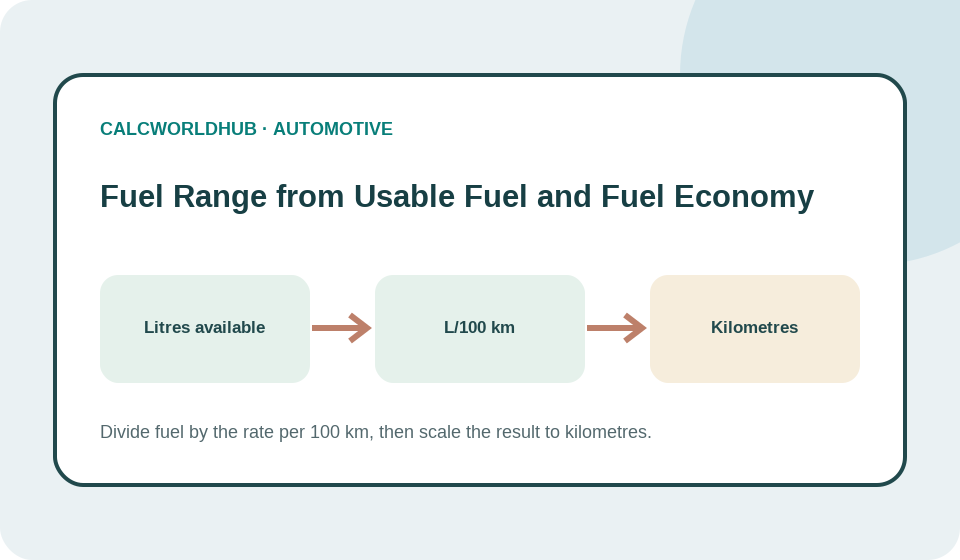
The input is a consumption rate, not kilometres per litre. At 7.0 L/100 km, the vehicle uses an average of seven litres to travel one hundred kilometres under the conditions represented by that rate. Because the rate is in the denominator, a larger number means more fuel used per distance and a shorter estimated range for the same fuel quantity.
The formula is range in kilometres = available litres × 100 ÷ litres per 100 kilometres. The factor of 100 restores the kilometre interval in the consumption unit. If a dashboard or source reports miles per gallon, convert the rate carefully rather than entering that number as if it were L/100 km.
Worked examples
The examples treat the entered fuel and consumption figures as exact for the calculation only; real driving varies.
Forty-two litres at 7.0 L/100 km
Inputs: Fuel available = 42 L; fuel economy = 7.0 L/100 km.
Calculation: Range = 42 × 100 ÷ 7.0 = 600 km.
Under the fixed-rate assumption, the entered fuel corresponds to an estimated 600 km.
A smaller usable amount at a higher consumption rate
Inputs: Fuel available = 28.5 L; fuel economy = 8.2 L/100 km.
Calculation: Range = 28.5 × 100 ÷ 8.2 = 347.5609756… km ≈ 347.56 km.
The estimate falls because less fuel is available and each 100 km uses more fuel.

Use fuel that can actually be consumed
“Fuel available” should represent the amount you are willing to plan around, not automatically the tank’s nominal capacity. A driver may keep a reserve, and not all stated capacity is necessarily available in every operating condition. The calculator does not know the vehicle model, tank shape, warning-light threshold, fuel pump pickup, or route. Enter a conservative usable amount when a stranded vehicle would be a serious consequence.
The rate should be relevant to the vehicle, load, route, and driving pattern. EPA fuel-economy information is designed for comparisons and standardized estimates; a single trip can differ because of speed, stops, temperature, terrain, cargo, tires, maintenance, and accessories. A recent measured trip can be more representative of a specific journey than a general rating, but it still does not eliminate uncertainty.
Separate an arithmetic estimate from a range guarantee
At steady inputs the calculation is simple, but the fuel-consumption rate is not fixed in real traffic. A steep route, cold start, towing load, headwind, or congestion can raise consumption. Conversely, lower speeds or favorable conditions can reduce it. The result should be read as “distance implied by these two inputs,” not as an onboard prediction or a safe-to-empty-tank instruction.
If the remaining fuel is uncertain, test a low, central, and high usable amount or consumption assumption. Keep the route’s detour, traffic, and fueling options in view. A range estimate that leaves no margin can be misleading even when the division is arithmetically correct; decision planning should carry a reserve instead of relying on the last displayed kilometre.
Check unit consistency and boundary behavior
Fuel is entered in litres, and consumption is entered in L/100 km. Both must be positive for a useful finite range. Zero consumption would make the quotient undefined; negative fuel or negative consumption has no physical interpretation. The runtime’s displayed input bounds are permissive, so a reader should still enter physically meaningful positive values rather than treating the form boundary as a recommendation.
The displayed number may be rounded. Preserve the underlying decimal rate until after division when comparing scenarios. For example, do not round 7.46 to 7 before calculating if the extra precision reflects a reliable measurement. Differences in the last digit are rarely meaningful when fuel quantity and consumption themselves are approximate.
Use the estimate to compare scenarios
The calculator is useful for comparing “what if” conditions with the same method: a known fuel quantity at two consumption rates, or two fuel amounts at one rate. Such comparisons can support a refuelling plan or explain why a loaded or high-speed trip may need more frequent stops. The tool does not identify a station, route elevation, or fuel grade, and it does not include a battery range for a hybrid vehicle.
Before a long trip, consult the vehicle manual and live trip information, refuel before the reserve becomes critical, and account for detours and weather. If a manufacturer reports a usable-capacity or reserve convention, use it consistently. A concise record of the inputs makes the result repeatable: fuel amount, source of the consumption estimate, and the conditions for which it was chosen.