
Separate steady demand from startup demand
Start by listing appliances and equipment that will operate at the same time. Their combined running watts are the steady portion of the estimate. A motor may draw more power for a short period while it accelerates, so a generator that covers only the steady total can still struggle at the moment a pump, compressor, or fan starts.
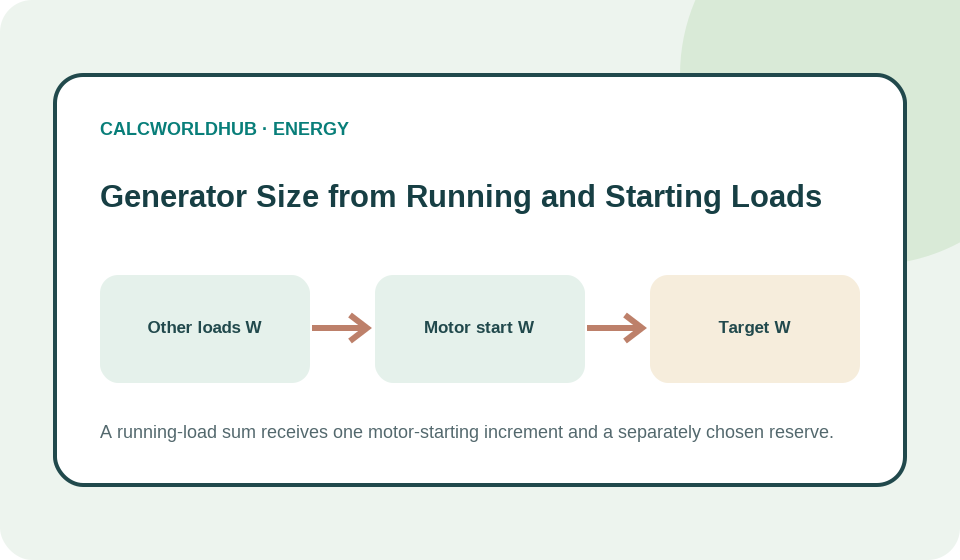
The calculator models one largest motor separately. It adds the running watts of the other simultaneous loads to the selected motor’s running input multiplied by a startup factor. That is a deliberately compact model: it does not sum several overlapping motor starts or infer each appliance’s surge from its nameplate.
Enter electrical input, not just useful output
Other simultaneous loads are entered as a combined watt total, and the motor field is its electrical running input in watts. A pump’s hydraulic output or a heater’s heat output is not the same as electrical input. Use equipment labels or manufacturer data, and keep the units in watts rather than mixing watts with volt-amperes or kilowatts.
The startup multiplier means starting watts divided by that motor’s running input. The form accepts 1 through 20; a factor of 3 models three times the motor’s running watts during the startup allowance. Actual starting current depends on the motor, supply, controls, and generator response, so a generic multiplier should not override a published starting rating.
Read the two calculation stages
First calculate the simultaneous running load: other loads + motor running watts. For the startup peak, replace that motor’s running contribution with motor running watts × startup multiplier, while keeping the other loads in the sum. Finally multiply the peak by 1 + reserve percentage ÷ 100. The displayed target is therefore a planning margin above the modeled startup peak.
A reserve is not a second estimate of motor inrush. It is a user-chosen allowance above the peak calculation, and the input supports 0% to 500%. Avoid adding the same surge twice by inflating the motor wattage and also using an oversized multiplier. If a manufacturer publishes locked-rotor or starting data, use that information to set a defensible scenario.
Compare the result with generator ratings
A generator may advertise a short surge or starting rating that differs from its continuous output rating. Compare the calculator’s target with the rating that can actually support the intended duration and load, not only the largest number on a product page. Also confirm voltage, phase, frequency, receptacle limits, fuel derating, altitude, and whether loads can be sequenced.
Cummins distinguishes motor starting watts from running watts, a useful first-pass distinction. It does not validate a circuit or transfer switch; fixed wiring needs qualified electrical review.
Worked examples
The examples isolate the largest motor’s startup allowance and then show how a reserve changes the target.
A pump starts while household loads remain on
Inputs: Other simultaneous loads = 1,500 W; motor running input = 1,200 W; startup multiplier = 3; reserve = 25%.
Calculation: Running load = 1,500 + 1,200 = 2,700 W. Startup peak = 1,500 + (1,200 × 3) = 5,100 W. Target = 5,100 × (1 + 25/100) = 6,375 W.
The model suggests a 6,375 W target for this scenario. Check continuous and surge ratings, motor data, and the generator’s operating conditions before selecting equipment.
A larger compressor with a smaller reserve
Inputs: Other simultaneous loads = 800 W; motor running input = 2,000 W; startup multiplier = 4; reserve = 10%.
Calculation: Running load = 800 + 2,000 = 2,800 W. Startup peak = 800 + (2,000 × 4) = 8,800 W. Target = 8,800 × (1 + 10/100) = 9,680 W.
The motor-start allowance dominates this case. The reserve is applied after that peak and does not replace verified starting-current information.

Use the estimate as a load plan
Other simultaneous loads are the running demand expected while the selected motor starts. Exclude equipment that will be off or started later, but model it separately if overlap is possible. Record the load boundary so a changed plan can be recalculated.
The result does not estimate runtime, fuel use, noise, or emissions. It also does not predict whether a motor starts under voltage drop or a long cord. Keep the load list and assumptions with the estimate.
Keep safety separate from sizing arithmetic
Sizing does not address safe placement or connection. Operate a portable generator outdoors and away from openings under its manual, and never backfeed building wiring. Carbon monoxide risk remains even when electrical load is small.
Treat this as one input to equipment selection. For fixed wiring or critical loads, confirm the manual, local code, and qualified installer’s guidance; use verified motor data when a failed start matters.