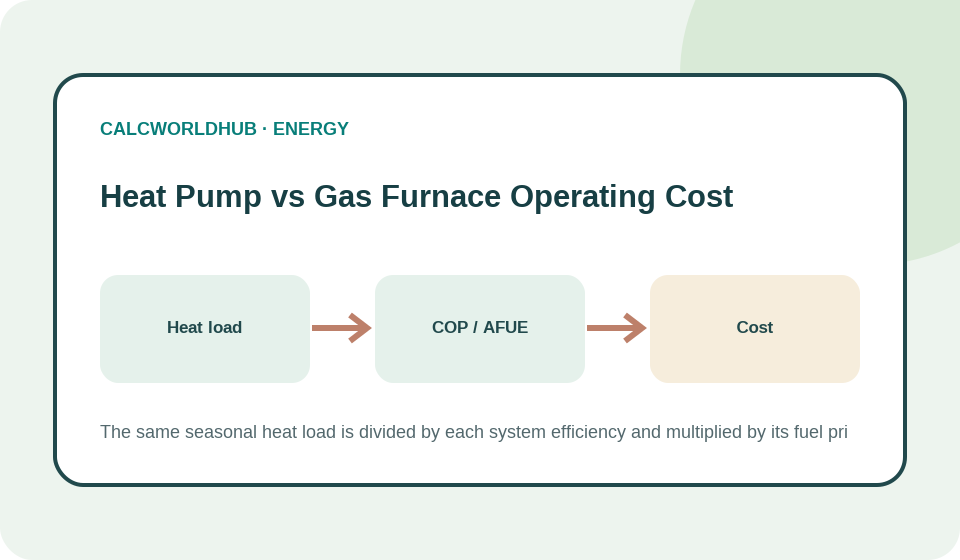

Compare the same delivered-heat requirement
The annual delivered heating field is the useful heat the building needs during the chosen period, in kWh thermal. Use one consistent load for both options. If the heat-pump and furnace cases represent different weather or indoor comfort assumptions, the cost difference will mix performance with a different service level.
A seasonal coefficient of performance (COP) is delivered heat divided by heat-pump electrical input on a matching seasonal basis. The calculator uses heat load ÷ COP to estimate purchased electricity. Seasonal COP is not a fixed rating at every outdoor temperature, and a single value cannot describe every hour of a cold-climate season.
Convert the furnace side with AFUE
AFUE is entered as a percentage. Dividing delivered heat by AFUE as a fraction estimates gas energy input; the calculator converts kWh to therms using its fixed 29.3001 kWh per therm factor and multiplies by the gas price. Enter an AFUE from above zero through 100 and a seasonal value appropriate to the equipment and period.
A higher AFUE means less fuel input for the same modeled heat delivery. The calculation treats AFUE as a single fraction and does not model cycling, duct losses outside the rated boundary, standby use, or a furnace’s part-load behavior. Keep the equipment rating and the heat-load boundary compatible when comparing systems.
Enter variable rates on matching units
Electricity price is dollars per kWh, while natural-gas price is dollars per therm. Enter energy charges that correspond to the same billing period and customer class. Fixed charges, delivery riders, taxes, demand charges, seasonal changes, and tiered rates are not added by this calculator.
The output estimates energy charges, not a full utility bill. If rates vary by time or volume, use a documented weighted rate or interval data when that structure could change the comparison.
Read the cost difference in the right direction
The tool reports heat-pump cost, gas-furnace cost, and their difference with positive values meaning modeled savings for the heat pump. If the number is negative, the heat-pump energy charge is higher under the entered assumptions. Check the two costs themselves rather than interpreting the sign without its label.
The comparison can change when seasonal COP, AFUE, annual heat demand, or rates change. It does not establish which equipment is better overall: purchase cost, maintenance, service life, comfort, backup heat, cooling value, and emissions are outside this arithmetic. A small modeled gap may also be outweighed by uncertainty in seasonal performance.
Worked examples
Each case holds annual delivered heat constant while comparing the entered seasonal efficiencies and rates.
A heat pump is slightly more expensive on energy
Inputs: Annual delivered heat = 24,000 kWh thermal; seasonal COP = 3; electricity = $0.18/kWh; furnace AFUE = 90%; gas = $1.50/therm.
Calculation: Heat-pump electricity = 24,000 ÷ 3 = 8,000 kWh; cost = 8,000 × $0.18 = $1,440. Gas = 24,000 ÷ 0.90 ÷ 29.3001 = 910.1220 therms; cost = 910.1220 × $1.50 = $1,365.18. Difference = $1,365.18 − $1,440 = −$74.82.
Under these inputs, the heat pump’s modeled energy cost is $74.82 higher for the year. Fixed charges and equipment costs are excluded.
A more efficient heat pump at different rates
Inputs: Annual delivered heat = 18,000 kWh thermal; seasonal COP = 4; electricity = $0.15/kWh; furnace AFUE = 95%; gas = $2.00/therm.
Calculation: Heat-pump electricity = 18,000 ÷ 4 = 4,500 kWh; cost = 4,500 × $0.15 = $675. Gas = 18,000 ÷ 0.95 ÷ 29.3001 = 646.6657 therms; cost = 646.6657 × $2.00 = $1,293.33. Difference = $1,293.33 − $675 = $618.33.
The heat-pump energy estimate is $618.33 lower in this scenario. It is not a complete annual savings claim because non-energy costs and rate details are omitted.

Use seasonal data carefully
Heat-pump heat per unit of electricity varies with weather and system design. DOE describes the heat-transfer principle, but a laboratory point rating is not a seasonal COP unless the comparison is limited to that condition.
AFUE summarizes fuel utilization under a rating procedure, not every property-specific loss. The tool does not verify either efficiency input. Model auxiliary resistance or dual-fuel periods separately if they materially affect the season.
Separate operating cost from investment choice
The calculator covers energy charges only; it does not compare equipment, installation, repairs, financing, replacement, or cooling value. A life-cycle or payback comparison needs those cash flows over a stated horizon.
Record the load, efficiencies, rate sources, and date. For a retrofit decision, pair this comparison with a building-specific load calculation and qualified contractor advice.