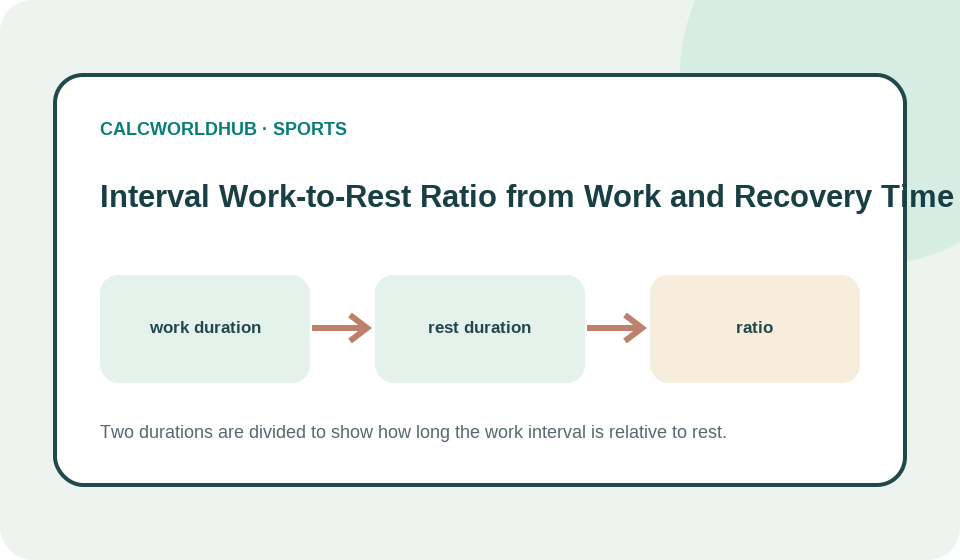

Divide work duration by rest duration
Work-to-rest ratio = work time ÷ rest time. The calculator takes seconds for each field and displays a unitless ratio. A result of 2 means the work interval lasts twice as long as its following recovery interval; it can also be written 2:1. A result of 0.5 means work is half as long as rest, or 1:2.
Use the work duration and the recovery period that actually follows that work bout. Do not divide the whole session duration by the total time spent resting unless that is explicitly the question. The tool compares one pair of intervals; it does not total repetitions, warm-up, cool-down, or the rest after the final effort.
Keep the time units and interval definitions aligned
Both inputs must use the same unit for the ratio to be meaningful. The visible fields request seconds, so convert minutes to seconds before entry. If a workout uses 45 seconds of work and 30 seconds of recovery, use 45 and 30; entering 45 seconds and 0.5 minutes would happen to preserve the mathematical ratio but would not follow the seconds labels or make the input record easy to audit.
Clarify what counts as recovery. Some protocols use complete rest, while others use easy movement. The calculator only sees a duration, not the recovery activity, effort level, interval count, or whether the next work bout starts at the intended time. Record those protocol details separately when comparing sessions or research methods. If your source records work in seconds and recovery in minutes, convert both durations to seconds before entry rather than mixing the field units.
Understand the ratio alongside interval length
The quotient does not preserve the size of either interval. A 30-second work period followed by 15 seconds of rest and a 4-minute effort followed by 2 minutes of rest have the same 2:1 ratio, but the physiological demands are not interchangeable. Duration, effort, modality, recovery activity, and number of repetitions all matter.
Research on interval programs compares complete protocols, not only a ratio. A randomized cycling study, for example, tested repeated six-second sprints with several work-to-rest schedules. Its findings describe that study population and protocol; they are not a universal recommendation. Use published work to understand the design being studied, not as a rule that one ratio suits every athlete.
Count repetitions without confusing totals
If each of N work bouts has the same duration W and each of the first N−1 recoveries has duration R, total planned work is N×W and between-bout recovery is (N−1)×R. A separate recovery after the final repetition changes total session time but not the pairwise ratio. The calculator returns neither of those totals, so use the schedule itself when estimating how long a session will take.
For variable intervals, calculate each relevant pair or keep the full list of work and rest durations. One overall ratio may hide short-recovery sections or a change in pace across rounds. The input fields accept one work time and one rest time, so the result cannot represent a mixed ladder, pyramid, or progressive recovery plan.
Use the result descriptively and check the domain
A ratio is a planning descriptor, not a training prescription. It does not include power, speed, resistance, heart-rate response, age, health history, or experience. Choose exercise structure with appropriate coaching or clinical advice when relevant, and do not treat a calculator result as a safety assessment.
The calculator accepts nonnegative work time and requires rest time above zero. A zero work interval therefore gives a zero ratio, while zero or negative recovery time triggers a correction message. Very small positive rest values can produce a large finite ratio, but that does not establish that the schedule is practical. Confirm seconds, interval order, and the exact definition of recovery before interpreting the displayed value.
Worked examples
The ratio is work time divided by rest time, with both durations in the same unit.
Work lasts twice as long as recovery
Inputs: Work = 30 s; rest = 15 s.
Calculation: Work-to-rest ratio = 30 ÷ 15 = 2, or 2:1.
The work interval is twice the duration of the following recovery.
A 3:2 work-to-rest schedule
Inputs: Work = 45 s; rest = 30 s.
Calculation: Work-to-rest ratio = 45 ÷ 30 = 1.5, or 3:2.
Work lasts one and a half times as long as recovery in this pair.
