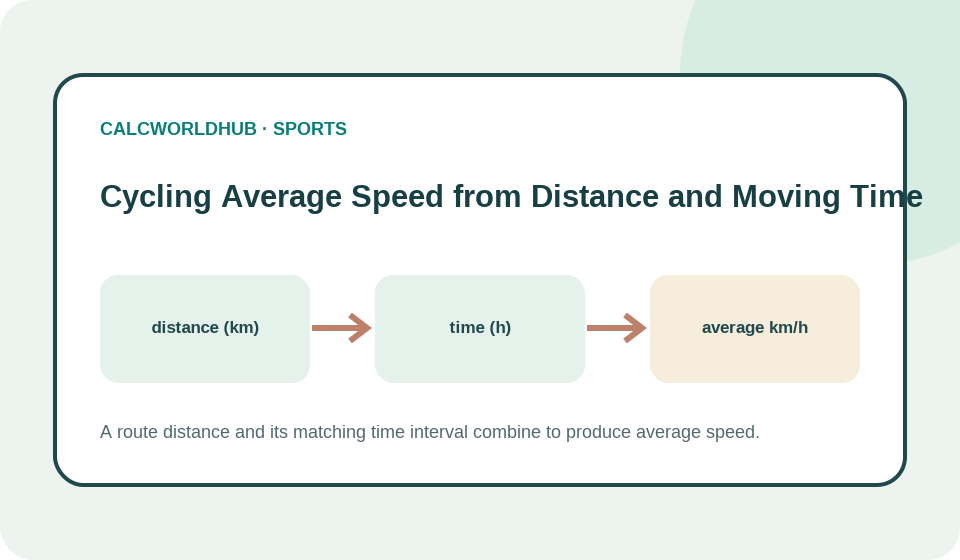

Use distance divided by the matching time
Average speed = distance ÷ time. With distance in kilometres and time in hours, the quotient is kilometres per hour (km/h). The calculator reports this route-wide average; it does not find speed at each point or the rider’s fastest segment. The output is formatted to three decimal places, which is more precision than most ride measurements justify.
Choose the time that describes the question. Moving time measures time in motion, while elapsed time runs from start to finish and includes stops. The equation is unchanged, but the denominator changes. A rider who pauses for a long café break can therefore have a higher moving-time average than an elapsed-time average for the same route.
Enter one distance and one duration
Use the distance and duration from the same ride segment. For a GPS activity, align the distance and time boundaries before dividing; a whole-route distance paired with only part of its duration does not describe the full ride. The calculator has no fields for route segments, pauses, or timing method.
Elapsed time is entered as decimal hours. Convert minutes by dividing by 60: 1 hour 45 minutes is 1.75 hours. Do not enter 1.45 to mean 1 hour 45 minutes; decimal hours are base ten, not hours-and-minutes notation. If a device reports minutes, convert them consistently and retain the original display so the conversion can be checked.
Read average speed as a summary, not a ride profile
A single average compresses the whole interval into one number. It cannot show whether a rider climbed slowly, descended quickly, stopped at intersections, or alternated between hard efforts and recovery. Two rides with equal distance and equal time can have very different power, cadence, heart rate, elevation, and perceived effort. Those details require separate measurements.
GPS distance itself may be estimated. Device algorithms can differ in how they detect movement and filter location noise, so two platforms may report different distance or moving time for the same file. A small discrepancy is not automatically evidence that either platform used the wrong arithmetic; inspect the recorded track and time definitions before comparing results.
Make a fair comparison between rides
For a useful comparison, hold the measurement basis steady: moving time against moving time, or elapsed time against elapsed time. Also consider route length, gradient, surface, wind, temperature, traffic, equipment, drafting, and whether the rider travelled alone. The calculator cannot adjust for these conditions or estimate a normalized performance score.
A faster average on one ride does not by itself establish improved fitness. A tailwind, smoother road, longer descent, or fewer stops can change the quotient without a change in capacity. Keep a note of the route and conditions when tracking personal progress, and compare repeated rides that are sufficiently similar to support the question you want to answer.
Worked examples
Use one distance and its matching duration; the examples show the arithmetic before rounding.
A 42 km ride in 1.75 hours
Inputs: Distance = 42 km; elapsed time = 1.75 h.
Calculation: Average speed = 42 ÷ 1.75 = 24 km/h.
Using this timing boundary, the ride averaged 24 km/h.
A longer ride with a different average
Inputs: Distance = 68.4 km; elapsed time = 2.4 h.
Calculation: Average speed = 68.4 ÷ 2.4 = 28.5 km/h.
The second ride averaged 28.5 km/h; this value alone does not explain the route or conditions.

Check units, rounding, and valid inputs
The visible distance field is in kilometres and the time field is in hours. Convert miles to kilometres or minutes to decimal hours before entry; do not mix units. The page marks distance as nonnegative and requires elapsed time above zero. The calculation does not itself reject a negative distance, however, and can return a negative speed. Such a result has no valid ride interpretation, so use a measured distance of zero or greater.
The displayed average is rounded to three decimal places, but the underlying quotient is distance divided by time. Keep the source values if you need to reproduce the result. Do not infer a rider’s maximum speed, energy expenditure, or expected arrival time from the average: each needs additional information that this calculation does not collect.