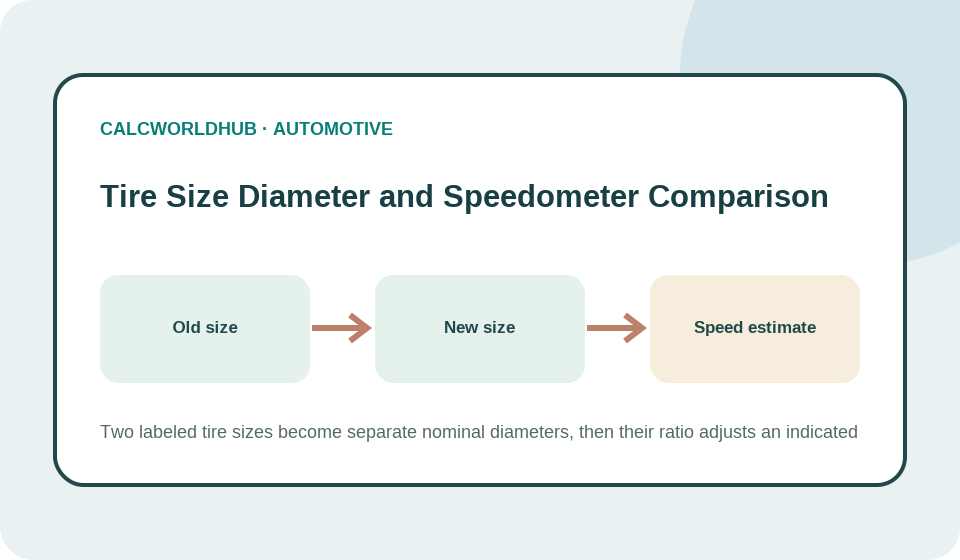

Decode the size inputs
A size such as 205/55R16 contains a nominal section width of 205 mm, an aspect ratio of 55%, and a 16-inch rim diameter. The sidewall height is width × aspect ratio ÷ 100. Overall nominal diameter is rim diameter converted to millimetres plus two sidewalls, because the tire extends above and below the rim.
Enter original and replacement sizes separately. Rim diameter is in inches; widths are in millimetres; aspect ratios are percentages from 1 to 100. The indicated speed is in km/h. Mixing a rim value in millimetres or entering 0.55 instead of 55 changes the calculation. Use the tire size printed on the sidewall, not a wheel’s outside diameter.
Compare nominal diameters
The formula is D = 25.4 × rim inches + 2 × width × aspect ratio ÷ 100. For 205/55R16, the nominal diameter is 25.4 × 16 + 2 × 205 × 0.55 = 631.9 mm. For 225/45R17 it is 634.3 mm. Their diameter ratio is 634.3 ÷ 631.9, which is about 1.0038 before rounding.
The speedometer estimate multiplies the indicated speed by new diameter ÷ original diameter. At an indicated 100 km/h, the example ratio implies about 100.38 km/h under ideal geometry. The percentage-change output describes the nominal diameter ratio, not a measured road speed or a promise that the speedometer was exactly calibrated before the change.
Understand what diameter changes
A larger nominal rolling circumference travels farther per wheel rotation in the simple model. If the speedometer still interprets wheel rotation using the original tire size, the same indicated speed corresponds to a slightly higher estimated road speed. A smaller replacement diameter moves the estimate in the opposite direction. This is a ratio, so units cancel when both diameters use the same unit.
Keep the displayed precision in context. Nominal tire dimensions are not a laboratory measurement of the installed tire’s loaded rolling radius. Construction, tread depth, inflation, load, pressure, wear, and manufacturer tolerances can change the effective rolling circumference. The calculator compares a labeled size formula; it does not read wheel rotation or test the vehicle’s instrument.
Use the comparison as a screening step
Before choosing a replacement tire, use the vehicle manual and tire placard to check the recommended size and specifications. NHTSA advises drivers to consult the owner’s manual or Tire and Loading Information Label for the correct size. Load capability and speed rating also matter; a diameter comparison does not check either requirement.
The calculator does not test rim width compatibility, wheel offset, suspension clearance, fender clearance, brake clearance, load index, pressure, or local rules. A close diameter match does not establish that a tire fits safely. Ask a qualified tire professional to verify fitment and vehicle-specific requirements before changing sizes.
Interpret the limits honestly
Use this result to understand a geometric difference, not to recalibrate a dashboard or decide a safe legal speed. The reference speedometer may already read high or low, and its error can vary across the speed range. Applying the nominal ratio to a single indicated value assumes the only change is tire diameter and the original calibration remains fixed.
For a practical comparison, record the old and new size codes, calculated diameters, and indicated speed used. Then compare with manufacturer guidance and measured data if available. The result is most useful for narrowing a question to ask a technician; it cannot establish clearance or compliance by itself.
Worked examples
Each comparison computes both nominal diameters before applying their ratio to the indicated speed.
205/55R16 compared with 225/45R17
Inputs: Original = 205/55R16; new = 225/45R17; indicated speed = 100 km/h.
Calculation: Dold = 25.4 × 16 + 2 × 205 × 55/100 = 631.9 mm; Dnew = 25.4 × 17 + 2 × 225 × 45/100 = 634.3 mm; speed ≈ 100 × 634.3/631.9 = 100.38 km/h.
The nominal diameter change is about 0.38%; the modeled speed corresponding to 100 km/h indicated is 100.38 km/h. Tire construction and vehicle calibration are not measured.
195/65R15 compared with 215/55R16
Inputs: Original = 195/65R15; new = 215/55R16; indicated speed = 90 km/h.
Calculation: Dold = 25.4 × 15 + 2 × 195 × 65/100 = 634.5 mm; Dnew = 25.4 × 16 + 2 × 215 × 55/100 = 642.9 mm; speed ≈ 90 × 642.9/634.5 = 91.19 km/h.
The new nominal diameter is about 1.32% larger, so the geometry-only estimate is about 91.19 km/h at 90 km/h indicated. Confirm actual tire fitment and vehicle requirements separately.
