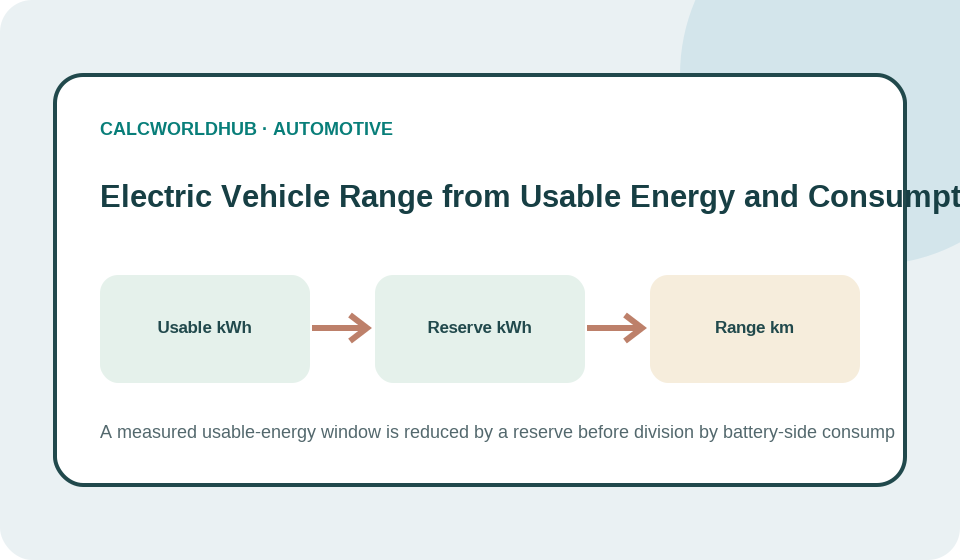

Use usable energy, not a brochure number
The calculator starts with usable battery energy in kWh, not necessarily the pack’s gross nameplate capacity. A vehicle may keep an operating buffer that drivers cannot draw on, so enter energy available for the trip window you intend to model. Subtracting an additional reserve makes that boundary visible instead of quietly assuming that every displayed kilowatt-hour is available.
Consumption is entered in Wh/km. This is energy drawn at the battery for each kilometre in the model. Keep the basis consistent: a wall-meter figure may include charging losses and is not automatically the same as battery-side driving consumption. Published ratings are useful comparison points, while your own trip log can represent speed, climate, terrain, and accessory use more closely.
What each input means
Usable battery energy and additional reserve are both measured in kWh; consumption is measured in Wh/km. The reserve must be nonnegative and cannot exceed usable energy, while consumption must be positive. Those relationships matter because the usable trip budget is energy minus reserve. If the reserve equals the usable energy, the modeled distance is zero; a larger reserve has no physically meaningful range.
Convert units before entering values. One kWh is 1,000 Wh, which is why the formula multiplies the remaining kWh by 1,000 before dividing by Wh/km. Do not enter miles per kWh into the Wh/km field or use a vehicle’s estimated miles of range as if it were energy. A unit mismatch can change the result by a large factor while still producing a plausible-looking number.
Read the range calculation
The equation is range in kilometres = (usable kWh − reserve kWh) × 1,000 ÷ consumption in Wh/km. The units cancel to kilometres. If 60 kWh remains after reserve and the car uses 180 Wh/km, the model gives about 333.3 km. This is a straight-line division of an energy budget by a constant rate, not a route simulation with elevation, traffic, weather, or charging stops.
Consumption changes the estimate in inverse proportion. Holding energy fixed, a higher Wh/km value means fewer kilometres. A lower number produces more range, but only if the road conditions and driving pattern really support that average. Use a plausible trip-specific rate rather than selecting the most favourable figure in a vehicle listing.
Use scenarios for route planning
For a route, model a conservative and a typical case with the same usable energy and reserve. If the difference is large, the uncertainty is operationally important: speed, cold weather, cabin heating, hills, headwinds, payload, and repeated acceleration can all move energy use. The calculator does not forecast these effects; they must already be represented in the consumption input.
Keep the reserve separate from usable capacity so a safety margin is easy to explain. When comparing routes, say whether the reserve is a fixed number of kilowatt-hours or a percentage of the usable window; those choices leave different trip-energy budgets as the pack size changes. This makes the planning boundary explicit without turning a constant-consumption estimate into a route forecast.
Where this estimate stops
FuelEconomy.gov explains that rated electric range varies with driving conditions and driving style. Battery temperature, speed, road grade, tires, HVAC use, aging, and route conditions can make a real trip differ from a constant-consumption estimate. This calculator does not predict state-of-charge at each point, charging availability, charging duration, or a safe arrival reserve beyond the reserve value you enter.
Use vehicle-specific information for planning a real journey, follow the owner’s manual, and leave a margin for conditions that may change. Do not treat a high calculated number as evidence that a route is feasible without charging. The result is a transparent energy-budget calculation: it shows what follows from the selected inputs and no more.
Worked examples
The first case preserves a modest reserve; the second uses a lower consumption rate with a separate energy budget.
Moderate highway planning case
Inputs: Usable battery energy = 68 kWh; reserve = 8 kWh; consumption = 180 Wh/km.
Calculation: Range = (68 − 8) × 1,000 ÷ 180 = 333.333… km, or 333.3 km displayed.
The trip energy budget is 60 kWh. At the assumed constant 180 Wh/km, the arithmetic supports about 333.3 km before reaching the stated reserve; it does not predict a specific route.
Lower consumption with a smaller energy window
Inputs: Usable battery energy = 52 kWh; reserve = 4 kWh; consumption = 160 Wh/km.
Calculation: Range = (52 − 4) × 1,000 ÷ 160 = 300 km.
The modeled trip budget is 48 kWh. The lower assumed consumption yields 300 km; the comparison is meaningful only if both consumption values use the same battery-side unit and driving context.
