How to use this calculator
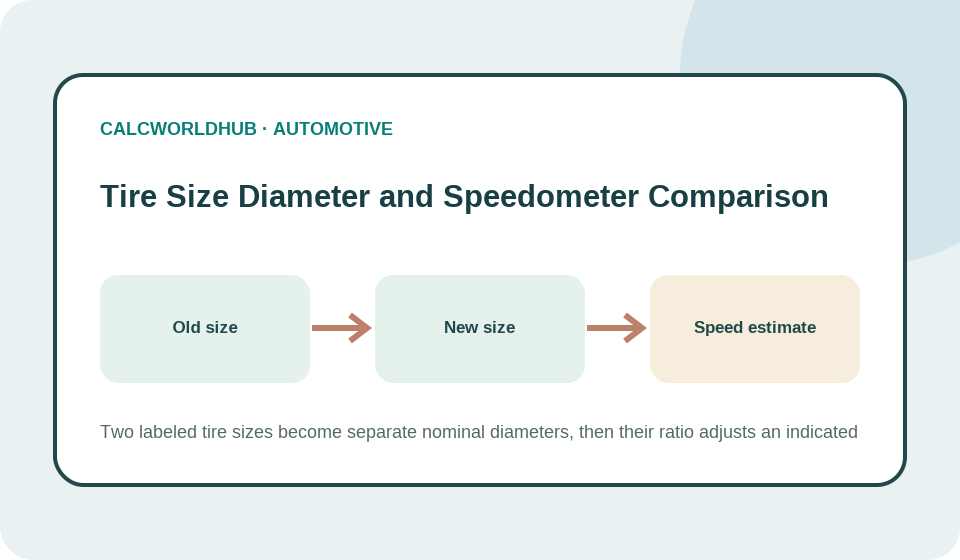
Compare the nominal diameters of two tire sizes and estimate the speedometer effect of a diameter change.
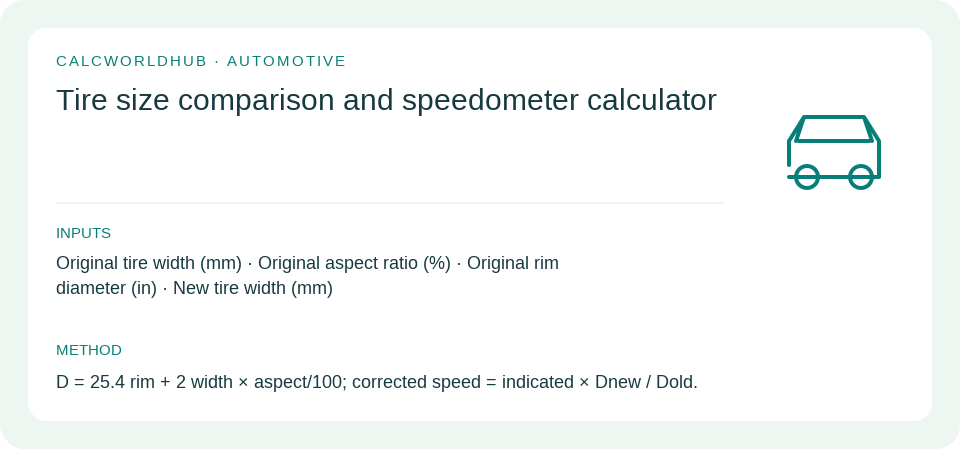
- Enter Original tire width (mm), Original aspect ratio (%), Original rim diameter (in), New tire width (mm), then complete the remaining labeled fields. Match the units shown beside each field and review the result together with the assumptions below.
- Read the worked example below to check the expected input format and result.
- Compare another scenario by changing one input at a time. Use Reset to return to the starting values.
Tire size comparison and speedometer explained
With unchanged wheel rotations, estimated road speed scales with the replacement-to-original nominal diameter ratio; actual loaded rolling radius can differ.
Inputs and units
- Original tire width (mm)
- Nominal section width of the original tire.
- Original aspect ratio (%)
- Sidewall height as a percentage of width.
- Original rim diameter (in)
- Nominal rim bead-seat diameter.
- New tire width (mm)
- Nominal section width of the replacement tire.
- New aspect ratio (%)
- Replacement sidewall percentage.
- New rim diameter (in)
- Replacement rim diameter.
- Indicated speed (km/h)
- Dashboard speed with the old calibration.
Formula and method
D = 25.4 rim + 2 width × aspect/100; corrected speed = indicated × Dnew / Dold.
A worked example
Original tire width (mm) = 205; Original aspect ratio (%) = 55; Original rim diameter (in) = 16; New tire width (mm) = 225; New aspect ratio (%) = 45; New rim diameter (in) = 17; Indicated speed (km/h) = 100.
- Estimated actual speed: 100.38 km/h
- Diameter change: 0.38 %
- Original diameter: 631.9 mm
- New diameter: 634.3 mm
The inputs above are an illustrative scenario. Display values are rounded after the calculation.
Assumptions and special cases
Nominal sidewall geometry is an approximation. This does not check clearance, rim fitment, load rating, or legal fitment requirements.
The existing tire circumference tool describes one tire. This comparison calculates the relative calibration change between two tires.
Frequently asked questions
Does a larger tire make actual speed higher?
At the same wheel rotation rate, a larger rolling circumference covers more distance.
Does this guarantee tire clearance?
No. Suspension travel, width, offset, and body clearance require separate checks.
Is nominal diameter the same as rolling diameter?
No. Load, pressure, tread, and construction affect the real rolling circumference.
How do I use the Tire size comparison and speedometer calculator?
Enter Original tire width (mm), Original aspect ratio (%), Original rim diameter (in), New tire width (mm), then complete the remaining labeled fields. Match the units shown beside each field and review the result together with the assumptions below.
What is a worked example of Tire size comparison and speedometer?
Original tire width (mm) = 205; Original aspect ratio (%) = 55; Original rim diameter (in) = 16; New tire width (mm) = 225; New aspect ratio (%) = 45; New rim diameter (in) = 17; Indicated speed (km/h) = 100. Estimated actual speed: 100.38 km/h Diameter change: 0.38 % Original diameter: 631.9 mm New diameter: 634.3 mm The inputs above are an illustrative scenario. Display values are rounded after the calculation.
See our calculation methodology.