How to use this calculator
Convert engine rpm into theoretical road speed using the selected transmission ratio, final drive, and effective tire diameter.
- Enter Engine speed (rpm), Selected gear ratio, Final-drive ratio, Loaded tire diameter (mm). Match the units shown beside each field and review the result together with the assumptions below.
- Read the worked example below to check the expected input format and result.
- Compare another scenario by changing one input at a time. Use Reset to return to the starting values.
Vehicle speed from engine RPM explained
Use Engine speed (rpm) with Selected gear ratio to reproduce the sample calculation, then review the stated limits before carrying the result into another scenario.
Example with entered values
Engine speed (rpm) = 3000; Selected gear ratio = 0.8; Final-drive ratio = 3.9; Loaded tire diameter (mm) = 650.
- Theoretical road speed: 117.81 km/h
The inputs above are an illustrative scenario. Display values are rounded after the calculation.
The calculation behind the result
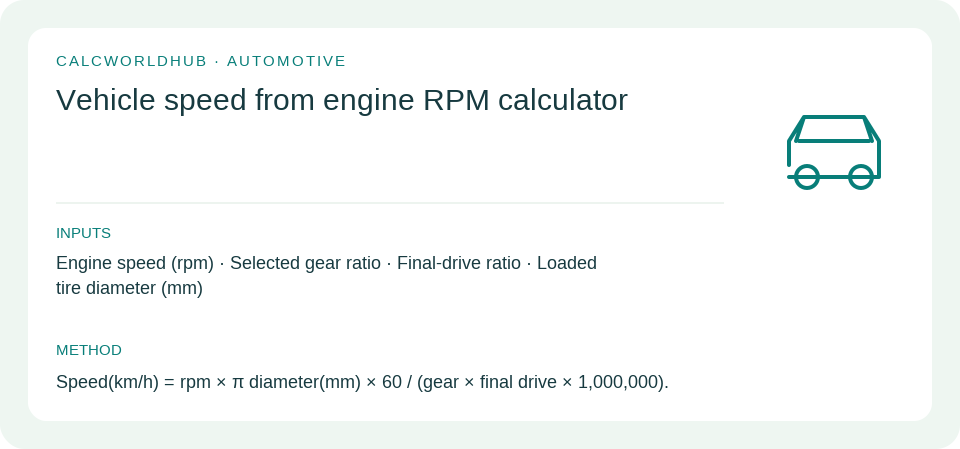
Speed(km/h) = rpm × π diameter(mm) × 60 / (gear × final drive × 1,000,000).
Inputs and units
- Engine speed (rpm)
- Crankshaft speed before the transmission.
- Selected gear ratio
- Transmission input revolutions per output revolution.
- Final-drive ratio
- Final reduction before the driven wheels.
- Loaded tire diameter (mm)
- Effective rolling diameter at the road.
Before interpreting the result
Assumes locked mechanical ratios, no wheel slip, and an effective loaded diameter. Converter slip and tire growth are excluded.
This follows drivetrain reduction. The tire comparison tool instead estimates calibration changes between two tire sizes.
Frequently asked questions
Should I enter overall gearing instead?
Enter it as the gear ratio and set final drive to 1.
Does tire width enter the formula?
Only through the effective rolling diameter, not directly.
Why can actual speed differ?
Loaded rolling radius, slip, and instrument calibration change the observed result.
How do I use the Vehicle speed from engine RPM calculator?
Enter Engine speed (rpm), Selected gear ratio, Final-drive ratio, Loaded tire diameter (mm). Match the units shown beside each field and review the result together with the assumptions below.
What is a worked example of Vehicle speed from engine RPM?
Engine speed (rpm) = 3000; Selected gear ratio = 0.8; Final-drive ratio = 3.9; Loaded tire diameter (mm) = 650. Theoretical road speed: 117.81 km/h The inputs above are an illustrative scenario. Display values are rounded after the calculation.
See our calculation methodology.