
Define whose orders and customers are counted
The tool asks for total customers and total orders. Both totals need the same reporting window, channel, and order status rule. Decide whether cancelled, refunded, test, wholesale, or subscription renewals count. Decide whether a customer is a unique account, household, or another identifier, and apply that definition to both the numerator’s population and the denominator.
Shopify’s reporting documentation distinguishes customers and orders and describes cohort-based orders per customer. Your chosen calculator inputs are aggregate totals, so they do not provide a cohort breakdown. If you want to compare first-time and returning buyers, collect those counts separately rather than assuming the single quotient answers both questions.
Read the result as a group mean
The formula is total orders ÷ total customers. A result of 1.6 means 1.6 orders per counted customer on average during the stated measurement, not that each customer placed a fractional order. Some may have placed one order, some several, and some may not belong in the denominator depending on how the report defines the group.
If the selected denominator is only customers who ordered, every included person contributes at least one order. If the denominator includes all customers on file, including inactive profiles, the average will be lower. The calculator cannot select or verify that population rule; write it next to the result when sharing the metric.
Keep numerator and denominator aligned
A common mistake is to divide this month’s orders by all customers ever acquired, or to divide lifetime orders by this month’s active customers. Either mismatch creates a quotient, but it does not represent a clean period average. Use the same dates and business scope, then reconcile duplicates and order edits before comparing the figure across reports.
Counts should be nonnegative, and the customer denominator must be greater than zero for a meaningful average. If no customers are present, the average is undefined; do not replace the denominator with one just to force an answer. A zero-order period with a positive customer count yields zero, but it may indicate a reporting filter that needs checking.
Do not confuse frequency with value or loyalty
Orders per customer is a count ratio. It does not include order value, margin, product mix, or elapsed time between purchases. A customer with three small orders and another with three high-value orders contribute equally to the order count. Use average order value or revenue per customer for monetary questions, and retention or repeat-customer measures for loyalty questions.
A single average can conceal a long tail of behavior. A small group of frequent buyers can pull the mean upward while most customers place one order. For operational decisions, review the distribution, cohort sizes, and the time to second purchase as separate evidence rather than translating the mean into a prediction about a typical individual.
Use the quotient beside the customer definition
For a stable comparison, log the order-status filter, date range, timezone, customer identity rule, and whether the count includes only purchasers or a broader audience. If any of these change, mark the break in the series. Analytics documentation notes that cohort periods and full order histories can affect how customer reports display purchase counts.
The result is most useful as a descriptive group measure, such as comparing two store cohorts processed under the same rules. It cannot explain why a customer returned, assign cause to a marketing campaign, or estimate future demand. Pair it with sales, retention, and service-quality evidence before changing a loyalty program or inventory plan.
Worked examples
These examples use a shared period and customer population; the decimal is an average across the whole group.
More orders than customers
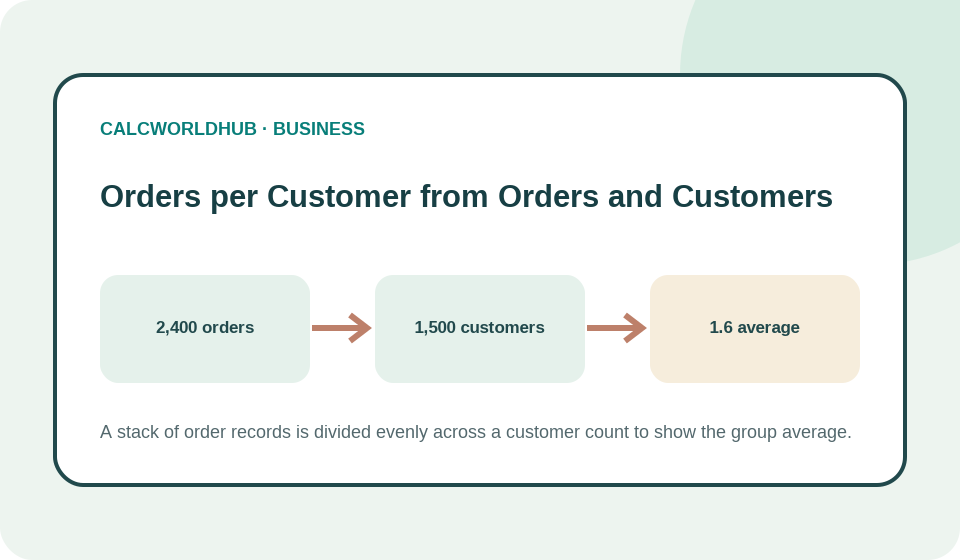
Inputs: Orders = 2,400; customers in the same group = 1,500.
Calculation: Orders per customer = 2,400 ÷ 1,500 = 1.6 orders/customer.
Across the group, the average is 1.6 orders per counted customer; it does not mean every buyer placed 1.6 orders.
A separate period with fewer orders per customer
Inputs: Orders = 825; customers in the same group = 750.
Calculation: Orders per customer = 825 ÷ 750 = 1.1 orders/customer.
The average is 1.1 for this group and period under the stated customer rule.
