
Define the two packaging options
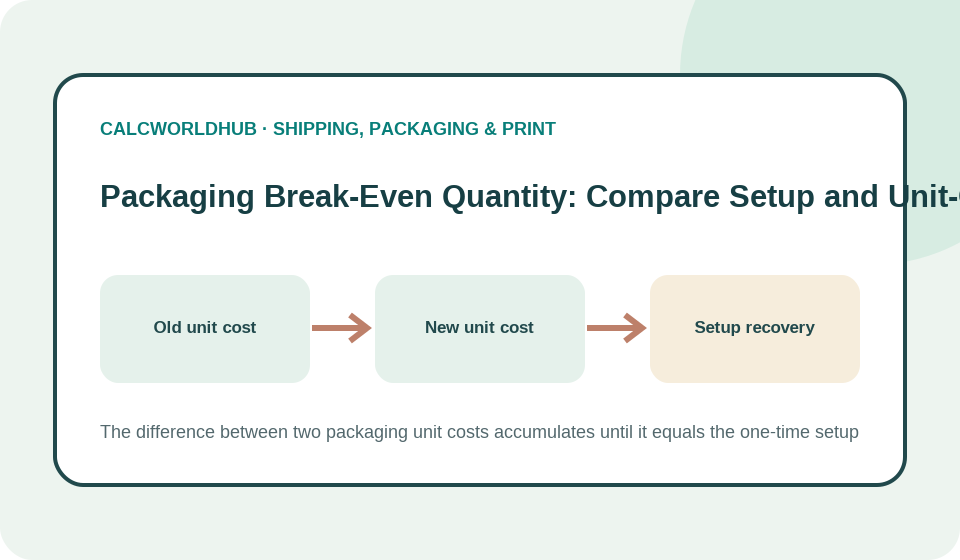
The model assumes one option has a one-time setup cost and a lower cost for each unit than the alternative. The comparison asks when the repeated saving has caught up with that setup charge. This is a narrow break-even calculation: it can make a tooling or plate charge easier to compare with a unit-price reduction, provided the two quotes cover the same product and service scope.
Enter costs on a consistent basis
Enter all three amounts in the same currency and on the same unit basis. The setup input and both unit costs must be finite and nonnegative. The new per-unit cost must be strictly lower than the old cost for a finite recovery quantity to exist; otherwise each unit saves nothing or costs more, so the setup cannot be recovered through the modeled saving.
Compare prices that refer to the same specification, material, print coverage, quantity tier, and delivery boundary. If one supplier's rate includes freight or finishing and another's does not, the per-unit difference is not a like-for-like saving. Convert currencies or normalize per-unit pricing outside the calculator with a dated, documented method before relying on the result.
Calculate the break-even quantity
The per-unit saving is old cost minus new cost. Divide setup cost by that positive saving to get the mathematical recovery threshold. Since orders are counted in whole units, round the quotient upward unless it is already effectively an exact whole number. This gives the smallest whole quantity at which cumulative modeled savings are at least as large as setup.
The calculator uses a small floating-point tolerance around an exact whole-number quotient before applying ceiling, so a value such as 1,200.0000000000002 is not incorrectly pushed to 1,201 because of binary representation noise. It displays the quantity as a whole number and the saving and setup to cents. Do not round the saving difference before division; early cent rounding can move the threshold when costs have finer precision.
Understand what happens before and after the threshold
Below the threshold, cumulative savings on the lower-rate option are smaller than the setup amount. At the threshold, the modeled total costs are equal or the new option has just crossed below the alternative, depending on whether the exact quotient is whole. Above it, additional units add the same per-unit saving under the model. The calculation does not state that the setup has been paid in cash or recognized as an accounting expense at a particular date.
Add practical quote and quality checks
A mathematically lower package cost may involve a different material thickness, barrier, print process, tolerances, recycling profile, or production lead time. Verify that each offer meets the required performance and compliance needs before comparing money. The calculator does not inspect artwork, validate a package specification, estimate defect rates, or model a supplier's capacity and delivery risk.
Also check whether setup is truly a one-time cost and whether there are minimum quantities, repeat setup charges, annual license fees, or price breaks. A tiered unit price changes the saving by quantity and requires a tier-by-tier model. If setup or savings vary with order size, the constant-cost break-even equation is not enough; ask the supplier for the complete schedule and compare total costs at plausible quantities.
Use the threshold in a real quote decision
Record the quote date, setup scope, old and new unit rates, order conditions, and assumptions beside the displayed threshold. A buyer can then revisit the estimate when volume, currency, freight, or specification changes. The break-even quantity is a useful screening figure, not a procurement instruction or a guaranteed saving.
Worked examples
The examples compare cumulative per-unit savings with the setup amount and round up to a whole unit when necessary.
A $600 setup with fifty cents saved per unit
Inputs: Setup = $600; old unit cost = $1.50; new unit cost = $1.00.
Calculation: Saving = $1.50 − $1.00 = $0.50/unit; break-even = ceil($600 ÷ $0.50) = 1,200 units.
At 1,200 units the modeled savings equal $600, exactly recovering the setup amount.
A setup recovery point between whole units
Inputs: Setup = $500; old unit cost = $1.49; new unit cost = $1.10.
Calculation: Saving = $1.49 − $1.10 = $0.39/unit; $500 ÷ $0.39 = 1,282.051282…; ceil gives 1,283 units. At 1,282, savings are $499.98; at 1,283, savings are $500.37.
The first whole quantity that covers setup is 1,283 units; the fractional threshold is not an orderable unit count.
