
Why the minimum quantity changes unit cost
A supplier may quote a price per item while also charging a one-time setup amount and freight for the order. Those costs do not necessarily grow in the same way as the number of units. Dividing the included total by the order quantity expresses the entered costs as an average per unit for that run. It is a useful comparison when two offers have different minimum quantities or fixed charges.
Enter quantity and comparable cost figures
Enter a positive order quantity, a nonnegative unit price, a nonnegative tooling or setup amount, and nonnegative freight, all in dollars. The calculator rejects a nonpositive quantity, negative cost, non-finite value, or a total outside its supported range. Use the supplier's actual minimum quantity for that quote; do not put a different planned sales quantity into the field unless you are intentionally modelling a different run.
Keep all amounts on the same currency and tax basis before combining them. If a quote is in another currency, convert it using a documented exchange rate and date first. If freight is per shipment, enter the charge for the order being compared; if it is per unit, convert it to a total for the run or otherwise make the cost basis consistent. The calculator has one freight input and cannot distinguish those pricing structures.
Read the total-cost-per-unit formula
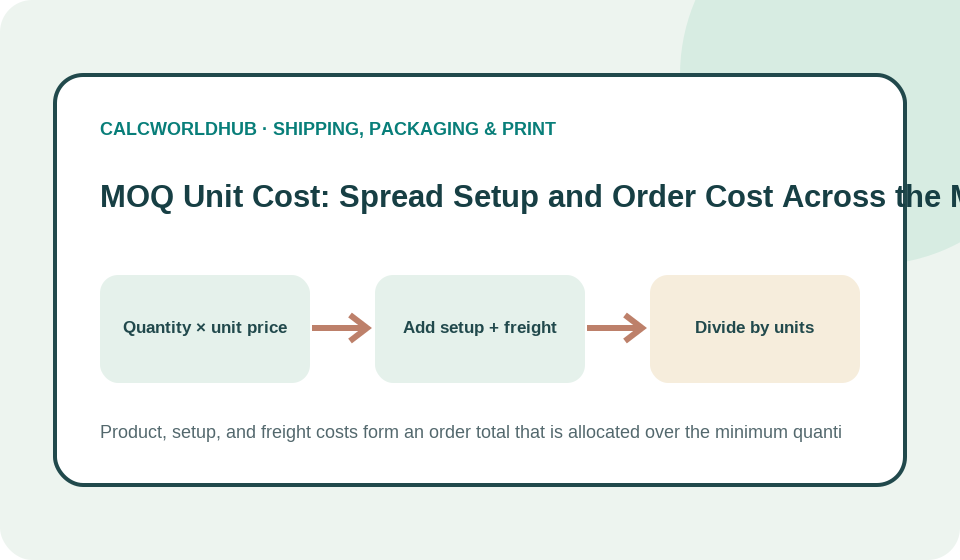
The calculation is (quantity × unit price + setup + freight) ÷ quantity. Multiplying quantity by the unit price gives the product line total. Adding setup and freight gives the included order total. Dividing by quantity allocates those two amounts evenly across the units for a simple average. The unit price is already per item, while setup and freight are order-level dollars in this model.
The output displays the average unit cost and order total to cents, and a setup-plus-freight summary. The arithmetic uses the entered values before the display is rounded. When checking the result by hand, retain more precision until the final cent display. A difference of a fraction of a cent per unit can matter when quantities are large, even though the interface shows currency rounded to two decimals.
Separate average cost from inventory accounting
This calculation is a planning average, not a formal inventory valuation policy. Accounting treatment can depend on what a cost is, how it is incurred, and the reporting framework in use. The tool spreads the entire setup and freight input evenly over one quantity because that is the model it implements; it does not determine whether an amount should be capitalized, expensed, allocated to a different product, or recognized in another period.
Compare supplier quotes on equal terms
A lower average for the minimum order does not automatically mean the offer is better. Compare product specification, print quality, tolerances, delivery timing, payment terms, rejection policy, and the quantity you can realistically use. An inexpensive large run can tie up cash or create obsolete stock, while a smaller run can carry a higher average cost but lower inventory exposure.
The quantity also changes how fixed charges are spread. Holding the other costs constant, a larger run usually allocates the same setup and shipment amount across more items. But the quoted product unit price may change by tier, freight may rise with weight or volume, and setup may not be fixed across designs. Use the values for each actual offer and treat the output as one cost comparison, not an order recommendation.
Use the result as a quote comparison
Save the quote date, currency, order quantity, product unit rate, setup charge, freight basis, and exclusions next to the result. That context lets a buyer reproduce the calculation and notice when an updated quote changes a cost component. The per-unit output is most informative when compared with alternatives that use the same product specification and cost boundary.
Worked examples
The examples use the same currency for unit price, setup, and freight, then divide the combined order cost by units.
A 500-unit run with setup and freight
Inputs: Quantity = 500; unit price = $1.20; setup = $250; freight = $100.
Calculation: Order total = 500 × $1.20 + $250 + $100 = $950; average = $950 ÷ 500 = $1.90 per unit.
The entered cost basis averages $1.90 per unit across the 500-unit order.
A larger run with lower unit and setup costs
Inputs: Quantity = 1,200; unit price = $0.78; setup = $180; freight = $75.
Calculation: Order total = 1,200 × $0.78 + $180 + $75 = $1,191; average = $1,191 ÷ 1,200 = $0.9925, displayed as $0.99 per unit.
Before cent rounding, the modeled average is $0.9925; the displayed unit amount is $0.99.
