
Convert cargo volume into average height
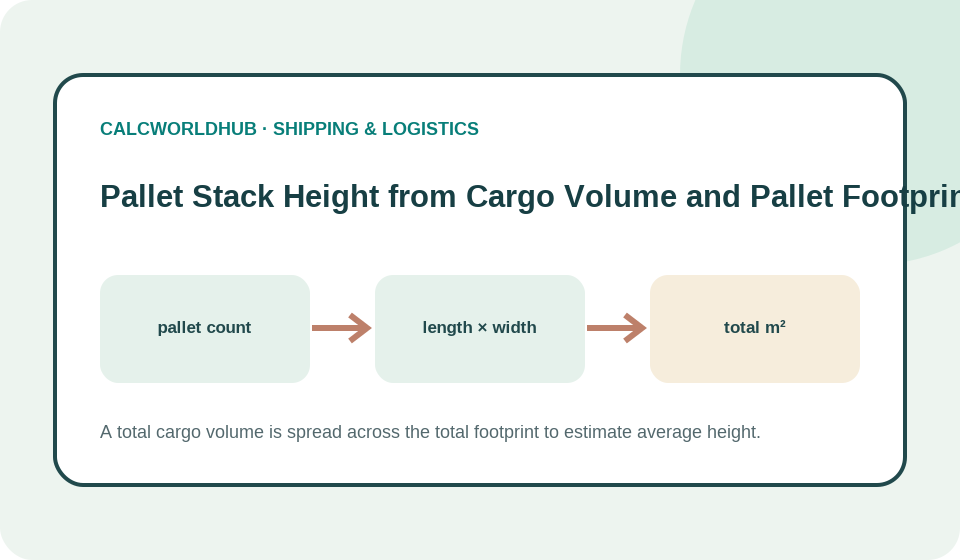
The calculator uses height = cargo volume ÷ (pallet count × pallet footprint), with one pallet footprint equal to length × width. With volume in cubic metres and footprint in square metres, the quotient is metres. For identical pallet sizes, the combined footprint is count × length × width. The value describes an average over those footprints.
This assumes the entered cargo volume is distributed over the footprint area represented by the count. It does not arrange cartons, calculate layers, or account for overhang, gaps, pallets nested together, mixed dimensions, or cargo shape. A volume can be concentrated on one pallet even when the mean across many footprints is modest.
Measure the load boundary and pallet base
Use pallet length and width in metres and a cargo volume in cubic metres. Use the same definition for every unit: if volume covers only the goods, the calculated height is goods-volume divided by base area and excludes the pallet deck itself. The calculator does not have a pallet-height or packaging field, so add those dimensions separately when total handling-unit height is required.
The pallet count must represent the footprints over which that volume is allocated. A count of 72 means the model divides by 72 equal base areas; it does not mean 72 layers. Make sure the volume and count refer to the same shipment group. A partial shipment, empty pallets, or a mixture of footprints changes the result’s interpretation.
Read average height, not stack geometry
A volume-based average can be useful for space planning or comparing a planned load with an available envelope. It cannot tell whether each pallet has the same height. For example, a low average may hide one very tall unit beside many short ones. If storage slots or trailer clearances are tight, measure or calculate each handling unit, then compare the maximum individual height with the applicable limit.
The calculator displays the average in metres to four decimal places. That rounding does not describe measurement precision. Small pallet dimension errors affect footprint area multiplicatively, and total volume estimates may include voids or exclude wrapping. Preserve the dimensions, how volume was obtained, and whether pallets themselves are included.
Keep safety and load capacity separate
The calculator does not evaluate pallet condition, load distribution, packaging strength, rack capacity, floor capacity, forklift stability, or whether a stack is secured. OSHA’s materials-handling rules require stored materials to be stacked, blocked, interlocked, and limited in height so they remain stable and resist sliding or collapse. That principle cannot be reduced to this average-height quotient.
Use site procedures, equipment ratings, rack specifications, package limits, and applicable safety rules to decide stack height. A volume-derived value is not an authorization to stack to that height. Uneven loads, damaged pallets, shifting contents, moisture, and handling impacts can change stability even if the calculated average remains the same.
Understand input validation and omissions
The calculation divides cargo volume by pallet count and footprint, then checks only whether the result is finite. It does not require positive pallet dimensions, a positive count, or nonnegative cargo volume. For a meaningful average, use positive dimensions and count with nonnegative cargo volume; a negative dimension or count can still produce a finite but meaningless result.
The result panel may also show zero-valued detail entries that do not correspond to the four measurements described here. Treat the height as the quotient of cargo volume and combined pallet footprint; do not interpret unrelated zeros as additional measured inputs. This limitation does not change the stated geometric estimate.
Worked examples
Examples use metres, square metres, and cubic metres; calculated height is an average only.
Eighteen cubic metres across 72 footprints
Inputs: Pallet length = 1.2 m; width = 1.0 m; count = 72; cargo volume = 18 m³.
Calculation: Combined footprint = 72 × 1.2 × 1.0 = 86.4 m². Average height = 18 ÷ 86.4 = 0.208333… m ≈ 0.2083 m.
The entered volume corresponds to an average cargo depth of about 0.2083 m across the 72 footprints.
A smaller consignment on fewer bases
Inputs: Pallet length = 1.0 m; width = 0.8 m; count = 10; cargo volume = 4.8 m³.
Calculation: Combined footprint = 10 × 1.0 × 0.8 = 8 m². Average height = 4.8 ÷ 8 = 0.6 m.
The calculated average is 0.6 m; actual pallet-by-pallet heights may differ.
