Pallet stack height from volume calculator
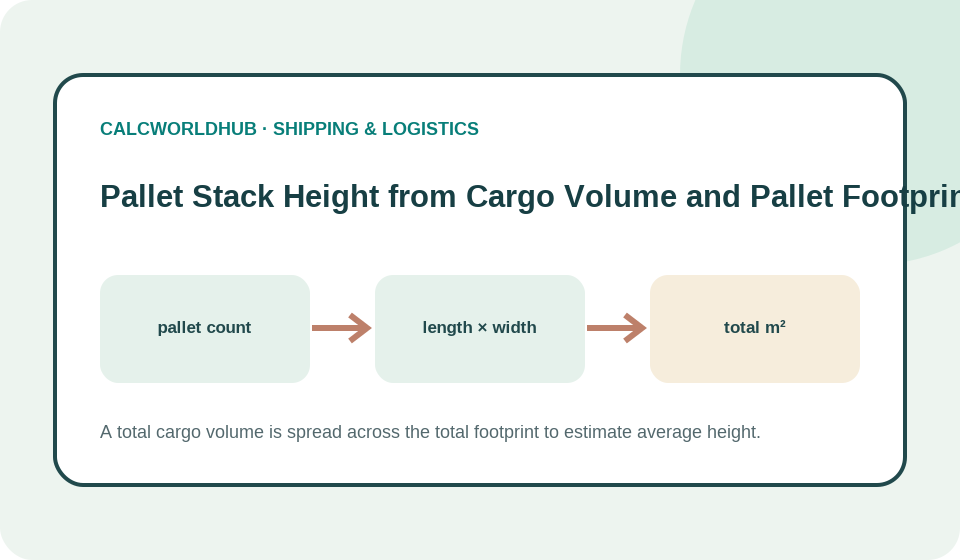
Divide cargo volume by the footprint area of all pallets.
Calculator

How to use this calculator
Estimate average cargo stack height from total volume and the combined footprint area of identical pallets.
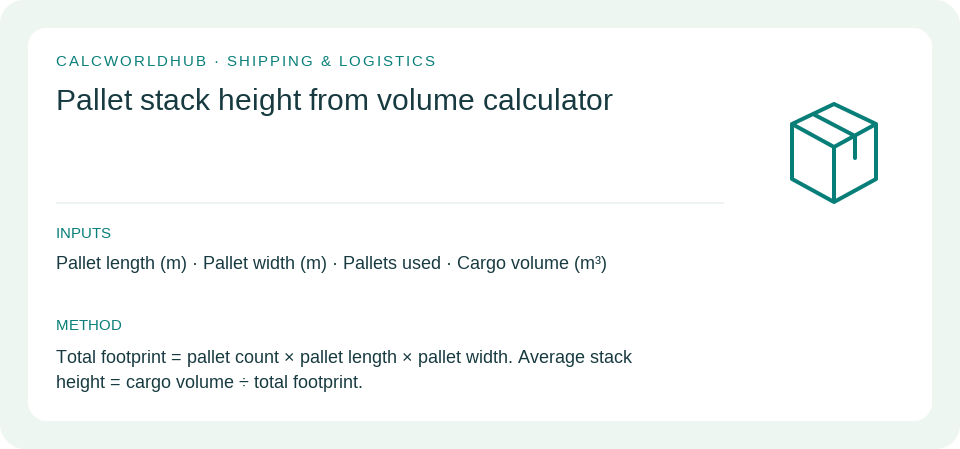
- Enter Pallet length (m), Pallet width (m), Pallets used, Cargo volume (m³). Match the units shown beside each field and review the result together with the assumptions below.
- Read the worked example below to check the expected input format and result.
- Compare another scenario by changing one input at a time. Use Reset to return to the starting values.
Estimate average cargo height over pallet footprints
Divide cargo volume by the total footprint area of the pallets used. Warehouse floor area and cargo mass do not determine this geometric average height and were removed.
Inputs and units
- Pallet length (m): Length of each identical rectangular pallet footprint.
- Pallet width (m): Width of each identical pallet footprint.
- Pallets used: Count of pallet footprints supporting the cargo volume.
- Cargo volume (m³): Total volume distributed over those pallet footprints.
Formula and method
Total footprint = pallet count × pallet length × pallet width. Average stack height = cargo volume ÷ total footprint.
Worked example
For 18 m³ over 72 pallets measuring 1.2 m × 1 m, total footprint is 86.4 m² and average height is 18 ÷ 86.4 ≈ 0.2083 m.
Interpreting the result
This is an average geometric height over the combined footprints. It does not describe the tallest carton, uneven loading, or actual stack arrangement.
Assumptions and limits
Check floor load, pallet capacity, stability, overhang, rack clearance, and fire-code limits separately. Cargo mass and warehouse area do not affect this volume-to-footprint ratio.
Frequently asked questions
Does the average height guarantee a safe stack?
No. Stability, load distribution, packaging, rack ratings, and site rules require separate checks.
Why were warehouse area and cargo mass removed?
Neither appears in the height equation; they do not change the average height for the same volume and pallet footprint.
How do I use the Pallet stack height from volume calculator?
Enter Pallet length (m), Pallet width (m), Pallets used, Cargo volume (m³). Match the units shown beside each field and review the result together with the assumptions below.
What is a worked example of Pallet stack height from volume?
For 18 m³ over 72 pallets measuring 1.2 m × 1 m, total footprint is 86.4 m² and average height is 18 ÷ 86.4 ≈ 0.2083 m.
What does the Pallet stack height from volume calculator calculate?
Estimate average cargo stack height from total volume and the combined footprint area of identical pallets.
Good calculators show their work.
CalcWorldHub is built around clear inputs and visible assumptions. Results are estimates for planning; check official sources or your provider’s terms when exact figures matter.