How to use this calculator
Find the highest carton count in an aligned two-orientation row layout and estimate layers under entered height and payload limits.
- Enter Pallet deck length (mm), Pallet deck width (mm), Carton length (mm), Carton width (mm), then complete the remaining labeled fields. Match the units shown beside each field and review the result together with the assumptions below.
- Read the worked example below to check the expected input format and result.
- Compare another scenario by changing one input at a time. Use Reset to return to the starting values.
How this calculation works
A volume-only pallet estimate cannot show how cartons occupy the deck. This planner tests aligned rows in both footprint orientations, reports the best two-band pattern, then limits vertical layers by the available stack height and carton payload.
Inputs and units
palletLengthMm— Pallet deck length (mm)- Usable deck dimension along the chosen carton-row direction.
palletWidthMm— Pallet deck width (mm)- Usable deck dimension across rows; the pattern does not allow overhang.
cartonLengthMm— Carton length (mm)- One footprint dimension of each identical carton.
cartonWidthMm— Carton width (mm)- The other footprint dimension of each identical carton.
cartonHeightMm— Carton height (mm)- Vertical carton dimension, unchanged when the footprint is rotated.
maxStackHeightMm— Maximum loaded height above pallet deck (mm)- Available vertical height for cartons, excluding the pallet itself.
cartonMassKg— Gross mass per carton (kg)- Gross mass of one loaded carton.
maxPayloadKg— Maximum carton payload on pallet (kg)- Load limit available for cartons; pallet tare mass is not included.
Formula
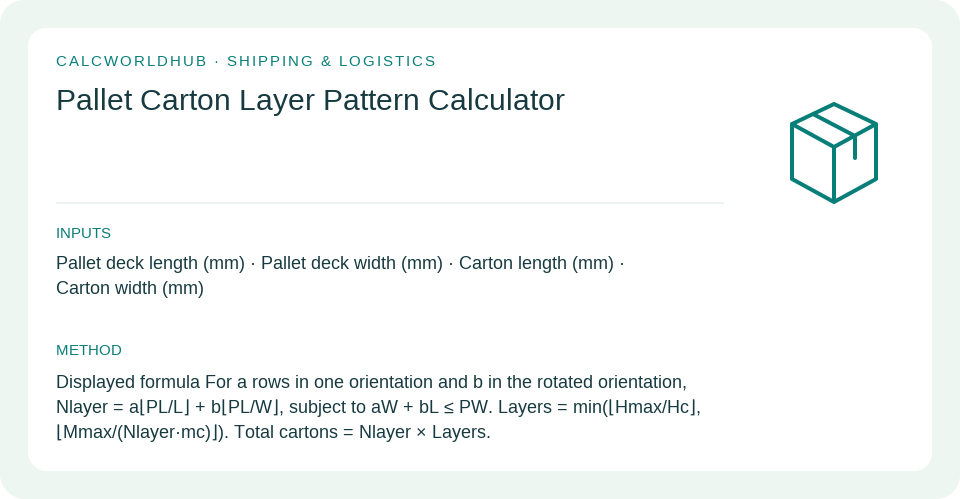
For a rows in one orientation and b in the rotated orientation, Nlayer = a⌊PL/L⌋ + b⌊PL/W⌋, subject to aW + bL ≤ PW. Layers = min(⌊Hmax/Hc⌋, ⌊Mmax/(Nlayer·mc)⌋). Total cartons = Nlayer × Layers.
Method
The search compares integer row counts with no overhang. It treats each carton as identical and assumes a single vertical orientation. Dimensions are entered in millimetres and masses in kilograms.
Worked example
On a 1,200 × 1,000 mm deck, 400 × 300 × 200 mm cartons fit as two 300 mm-deep rows of 3 plus one 400 mm-deep row of 4: 10 cartons per layer. A 1,200 mm height limit allows 6 layers, but a 500 kg payload limit at 10 kg per carton allows 5, so plan 50 cartons.
Assumptions and limits
This is an aligned row-band layout estimate, not an exhaustive 2D/3D packing solver or a pallet stability, compression, or transport-safety approval. It excludes pallet tare, slip sheets, load restraint, and overhang.
Frequently asked questions
Can the tool mix different carton sizes?
No. It plans one repeated carton footprint and height at a time. Run separate plans for different carton sizes.
Does the highest count guarantee a stable load?
No. Pattern count alone does not evaluate center of gravity, carton strength, wrapping, acceleration, or layer bonding.
Can cartons overhang the pallet?
No. The tested row layouts stay within the entered deck dimensions; overhang is not included.
How do I use the Pallet Carton Layer Pattern Calculator?
Enter Pallet deck length (mm), Pallet deck width (mm), Carton length (mm), Carton width (mm), then complete the remaining labeled fields. Match the units shown beside each field and review the result together with the assumptions below.
What is a worked example of Pallet Carton Layer Pattern?
On a 1,200 × 1,000 mm deck, 400 × 300 × 200 mm cartons fit as two 300 mm-deep rows of 3 plus one 400 mm-deep row of 4: 10 cartons per layer. A 1,200 mm height limit allows 6 layers, but a 500 kg payload limit at 10 kg per carton allows 5, so plan 50 cartons.
Read our calculation methodology.