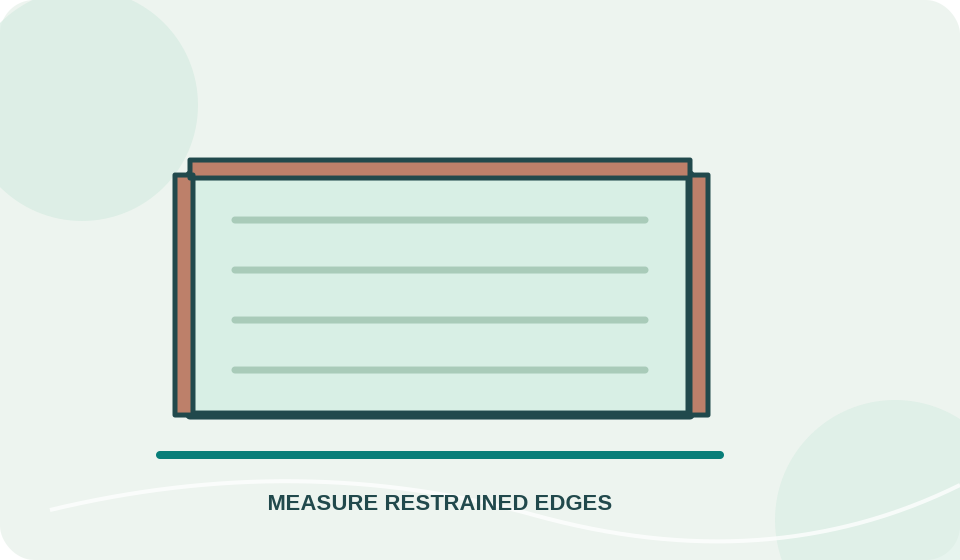

Measure only the restrained runs
Enter the total paver perimeter in feet, the length of edges that do not need a restraint, each stock piece’s length, and a cut allowance. The calculator subtracts openings first, increases the net run by the allowance, and divides by stock length. It rounds up to whole pieces.
Use measured edge lengths rather than assuming every patio is a rectangle. Steps, thresholds, walls, transitions, and other boundaries may already restrain a run or need a different detail. The tool asks for the total and the unrestrained portion so the net figure represents only runs receiving stock restraint.
Keep the subtraction visible
Net restraint length equals perimeter minus unrestrained edges. The percentage is applied to that net length, not to the full perimeter. The resulting quantity is divided by nominal stock length and rounded upward. For instance, a 96-foot perimeter with 12 feet excluded leaves 84 feet to cover before cuts.
The opening or excluded-edge value must not exceed the measured perimeter. The calculator checks that cross-field rule and rejects the input when it is violated. An impossible negative run therefore cannot be used as a valid material estimate; correct the measurements before calculating.
Restraint is an installation detail
CMHA guidance says edge restraints are needed around interlocking concrete pavement perimeters or at changes in pavement material, with the restraint selected for the base and site conditions. A count does not decide whether a building edge, curb, buried concrete, metal, or plastic product is suitable.
Some restraints need spikes, anchors, or a stable base extension; curves, corners, transitions, and joints may require connectors or extra cuts. CMHA describes these details in its technical note. Use that guidance and the manufacturer’s installation instructions to select the system and confirm where the measured run begins and ends.
Interpret whole stock pieces
The output reports net run, adjusted run, and piece count. It is an order estimate based on nominal length; it does not calculate a cut schedule that reuses every offcut. A run of 17 feet with 8-foot stock may require three pieces even before allowance because two full pieces cannot span the measured line.
An allowance may cover damaged ends and unusable short remnants, but it is not a substitute for checking joint connectors or corner details. If stock comes in a fixed package or several lengths, calculate each option using its actual nominal length and compare the total pieces and likely offcuts.
Use the quantity with the plan
This estimator is best for a regular installation whose edge runs have already been identified. It does not design pavement structure, determine restraint spacing, assess vehicle loads, or set anchoring depth. Keep perimeter and excluded runs documented so another person can verify the count.
Confirm that all edges requiring restraint are included, including transitions between pavers and other surfaces. Some edge units can serve as restraints depending on the layout. The number of commercial pieces should therefore be reconciled against the approved plan rather than treated as a stand-alone design recommendation.
Worked examples
The two examples keep the included perimeter and excluded transitions separate so the net restrained length can be audited before whole-piece rounding.
A simple patio perimeter
Inputs: Perimeter 96 ft; 12 ft unrestrained at a step; stock length 8 ft; allowance 8%.
Calculation: Net run = 96 − 12 = 84 ft. Adjusted run = 84 × 1.08 = 90.72 ft. Pieces = ceil(90.72 ÷ 8) = 12.
The estimate is 12 stock pieces. Confirm that the excluded step edge truly needs no separate restraint detail.
A longer installation with two transitions
Inputs: Perimeter 142 ft; 18 ft without restraint; stock length 10 ft; allowance 12%.
Calculation: Net run = 142 − 18 = 124 ft. Adjusted run = 124 × 1.12 = 138.88 ft. Pieces = ceil(138.88 ÷ 10) = 14.
Fourteen pieces cover the adjusted length at the entered stock size. Connector, anchor, corner, and curved-run requirements need a separate product takeoff.
