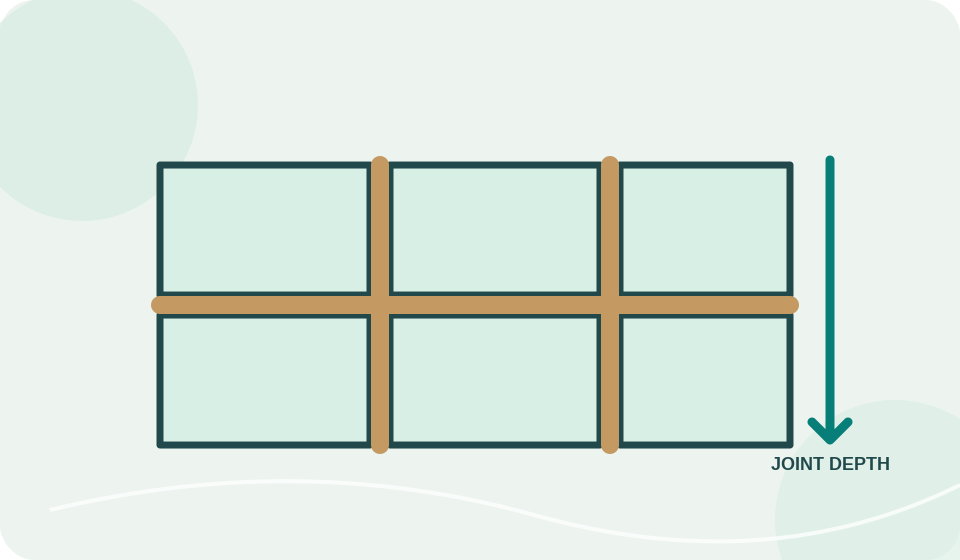

Describe the repeating paver joint
Enter the paved plan area in square feet, paver face width and length, average joint width, filled depth, and handling allowance. The calculator estimates the fraction of each regular paver module occupied by joints. Multiplying that fraction by field area and depth gives a theoretical joint-fill volume.
All three dimensions are in inches except for the paved area. The model assumes a rectangular grid with uniform pavers and joints; it is a planning approximation, not a direct measurement of bags. Pattern edges, special units, open joints, and local variations can alter the actual volume.
Follow the volume conversion
The joint share is one minus paver face area divided by the combined paver-plus-joint module. The calculator multiplies the share by square feet of field and joint depth in inches, then divides by 12 to obtain cubic feet. It divides by 27 and applies the allowance to show cubic yards for ordering.
The displayed outputs are joint-area share, theoretical volume in cubic feet, and allowance-adjusted volume in cubic yards. The last value is a volume only; it is not pounds or bags. To estimate bag count, use the selected product’s stated yield or bulk density and follow its installation data.
Choose the sand system for the installation
Joint material must match paver type, joint width, drainage design, exposure, and the specified installation. CMHA construction guidance describes how joint sand is swept into joints and compacted for interlocking concrete pavement. The material choice and gradation are not decided by this geometric calculator.
Some locations may need a different jointing product or stabilization because of water flow, permeability, or maintenance requirements. CMHA notes that sand can wash from joints exposed to channelized flow. Consult the project details and product instructions before using the calculator’s volume as a purchase quantity.
Check assumptions and rounding
Joint width and depth must be positive for a meaningful fill estimate; the runtime fields also carry individual minimum and maximum values. A wider joint increases the modeled joint fraction. The tool reports a small decimal volume, so compare the unrounded output with bag yield before rounding to a purchase unit.
The allowance compensates for handling or sweeping loss only when you choose it for that purpose. It does not cover changes in base, bedding sand, or paver quantities. Avoid applying a second allowance if the entered percentage already includes the expected loss for the same operation.
Where this estimate stops
The calculation assumes regular dimensions and consistent full-depth fill. It does not measure joint width from installed pavers, account for joint taper, estimate compacted density, distinguish open-graded aggregate from sand, or predict washout. Its theoretical volume can help compare design scenarios but cannot establish pavement compliance.
For an order, confirm the material’s yield and the installation method with its manufacturer or project specification. Keep the measured area, paver dimensions, joint width and depth, and allowance with the estimate. If the pattern uses multiple paver sizes, calculate each distinct module or use a more detailed takeoff.
Worked examples
Both calculations use paver and joint dimensions in inches; the final ordering output is a volume in cubic yards, not a sand mass or bag count.
A small-joint rectangular paver field
Inputs: Area 360 ft²; paver 6 in × 9 in; joint 0.25 in; depth 2 in; allowance 10%.
Calculation: Joint share = 1 − (6 × 9 ÷ (6.25 × 9.25)) = 6.5946%. Joint volume = 360 × 0.065946 × 2 ÷ 12 = 3.9568 ft³. Order volume = 3.9568 ÷ 27 × 1.10 = 0.1612 yd³.
The calculator reports about 3.9568 cubic feet in the joints and 0.1612 cubic yards after allowance. Product yield is needed to translate this volume into bags.
A wider joint and shallower fill
Inputs: Area 240 ft²; paver 4 in × 8 in; joint 0.375 in; depth 1.5 in; allowance 15%.
Calculation: Joint share = 1 − (4 × 8 ÷ (4.375 × 8.375)) = 12.6652%. Volume = 240 × 0.126652 × 1.5 ÷ 12 = 3.7996 ft³. Order = 3.7996 ÷ 27 × 1.15 = 0.1618 yd³.
The adjusted volume is about 0.1618 cubic yards. The wider joint increases joint share, while the smaller fill depth changes total volume in the opposite direction.
