How to use this calculator
Estimate the volume of sand occupying joints in a rectangular paver field. Free calculator with formula, example, and assumptions.
- Enter Paved area (ft²), Paver width (in), Paver length (in), Joint width (in), then complete the remaining labeled fields. Match the units shown beside each field and review the result together with the assumptions below.
- Read the worked example below to check the expected input format and result.
- Compare another scenario by changing one input at a time. Use Reset to return to the starting values.
How the estimate works
Estimate the joint fraction from the repeating paver-plus-gap module in both directions, multiply by paved area and filled depth, then convert cubic feet to cubic yards. Apply the handling allowance after the base joint volume is calculated.
Inputs and units
fieldArea— Paved area (ft²)- Enter the plan area of the paver field.
paverWidth— Paver width (in)- Enter the face width of one paver.
paverLength— Paver length (in)- Enter the face length of one paver.
jointWidth— Joint width (in)- Enter the average joint width.
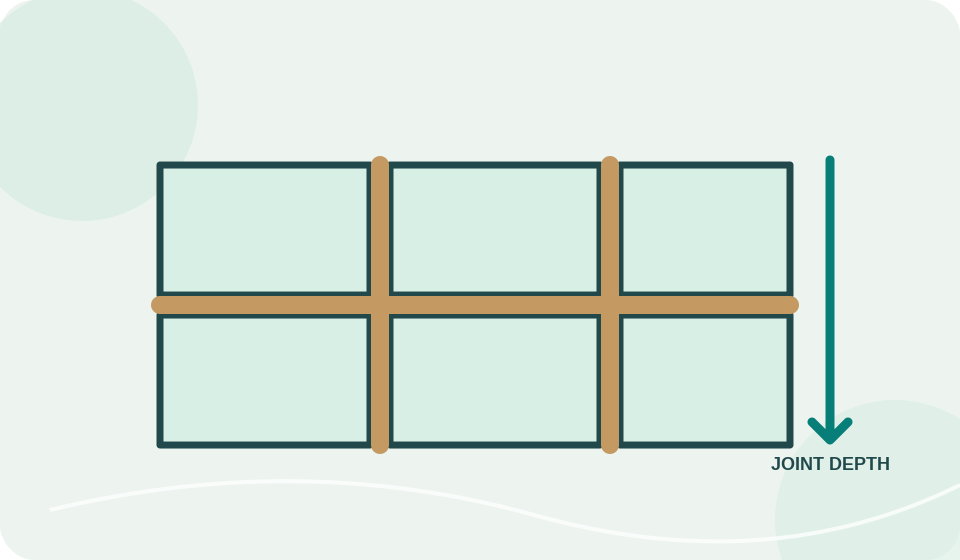
jointDepth— Filled joint depth (in)- Enter the sand depth within the joints.
wastePct— Handling allowance (%)- Optional allowance for sweep-in losses.
Formula and method
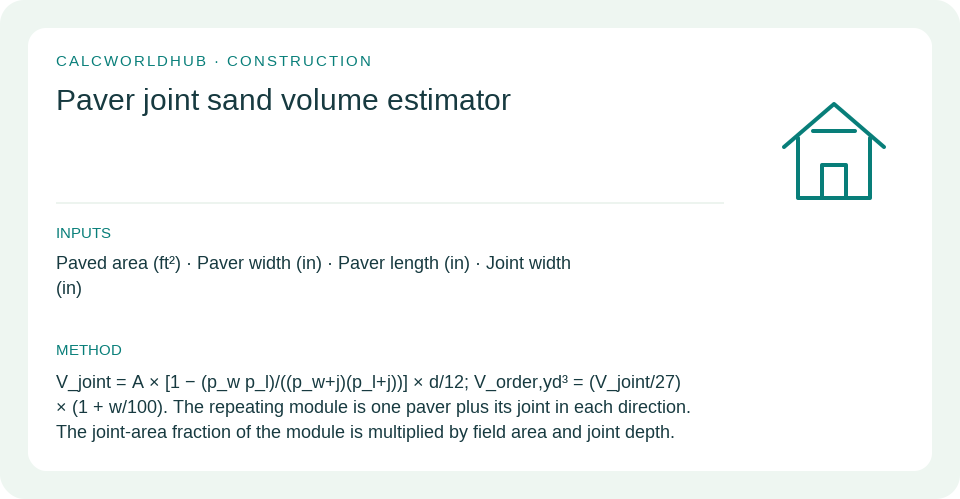
V_joint = A × [1 − (p_w p_l)/((p_w+j)(p_l+j))] × d/12; V_order,yd³ = (V_joint/27) × (1 + w/100).
The repeating module is one paver plus its joint in each direction. The joint-area fraction of the module is multiplied by field area and joint depth.
Worked example
For 360 ft² using 6×9 in pavers, ¼ in joints, and 2 in fill depth, the joint share is 1−54/(6.25×9.25) ≈ 6.59%. The joint volume is about 3.95 ft³; with 10% handling allowance, about 0.161 yd³.
Assumptions and limits
This regular-grid approximation assumes uniform rectangular pavers and consistent joints. It does not convert volume to bag mass without a product bulk density.
Frequently asked questions
Is this the same as bedding sand?
No. It estimates material in the joints only, not the leveling bed below the pavers.
Why is the joint share approximate?
It uses a repeating rectangular module and uniform joints; borders, cuts, and joint patterns change the exact fraction.
Can I estimate bag count?
Convert the volume using the chosen sand product’s stated yield or bulk density.
How do I use the Paver joint sand volume estimator?
Enter Paved area (ft²), Paver width (in), Paver length (in), Joint width (in), then complete the remaining labeled fields. Match the units shown beside each field and review the result together with the assumptions below.
What is a worked example of Paver joint sand volume estimator?
For 360 ft² using 6×9 in pavers, ¼ in joints, and 2 in fill depth, the joint share is 1−54/(6.25×9.25) ≈ 6.59%. The joint volume is about 3.95 ft³; with 10% handling allowance, about 0.161 yd³.
Read our calculation methodology.