Gravel estimator
Estimate volume and tons from area, depth, and density. Enter your values below for a free estimate, with no account required.
Calculator
How to use this calculator
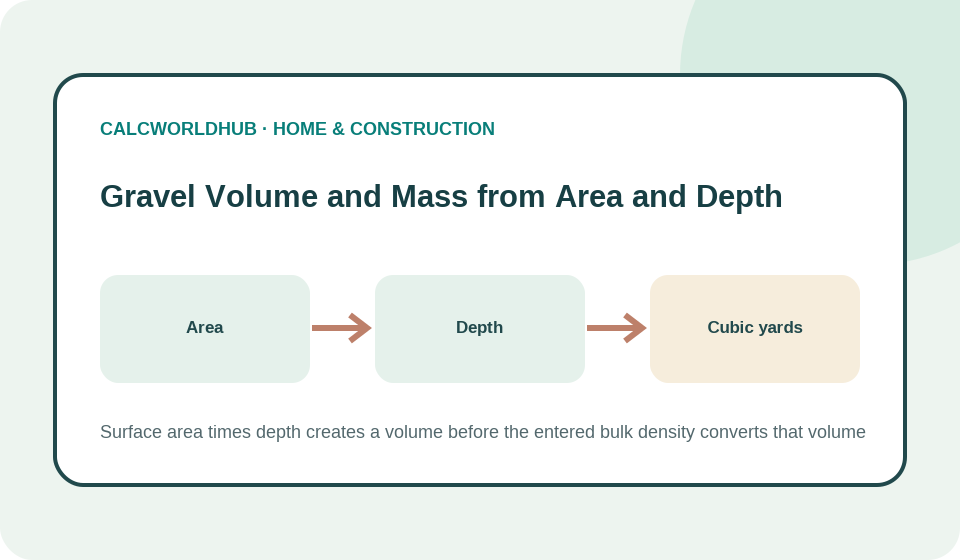
Convert depth from inches to feet, multiply by area, add the entered allowance, and multiply volume by bulk density for estimated mass.
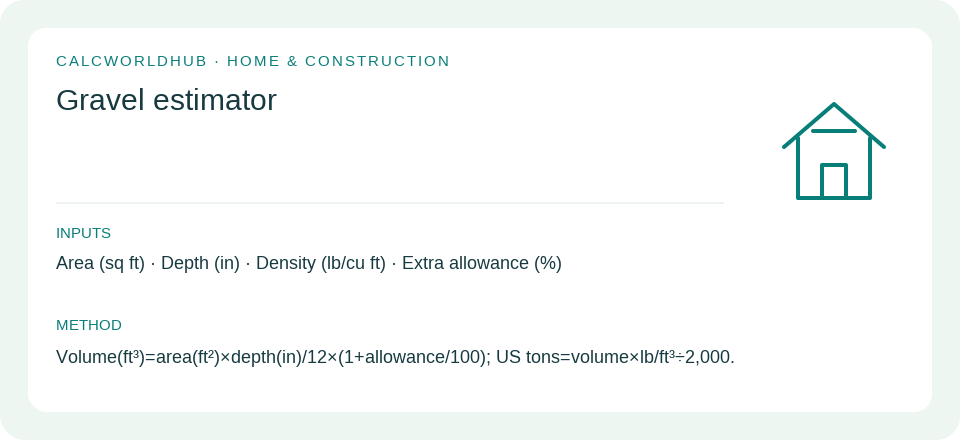
- Enter Area (sq ft), Depth (in), Density (lb/cu ft), Extra allowance (%). Match the units shown beside each field and review the result together with the assumptions below.
- Read the worked example below to check the expected input format and result.
- Compare another scenario by changing one input at a time. Use Reset to return to the starting values.
Estimate gravel volume and weight
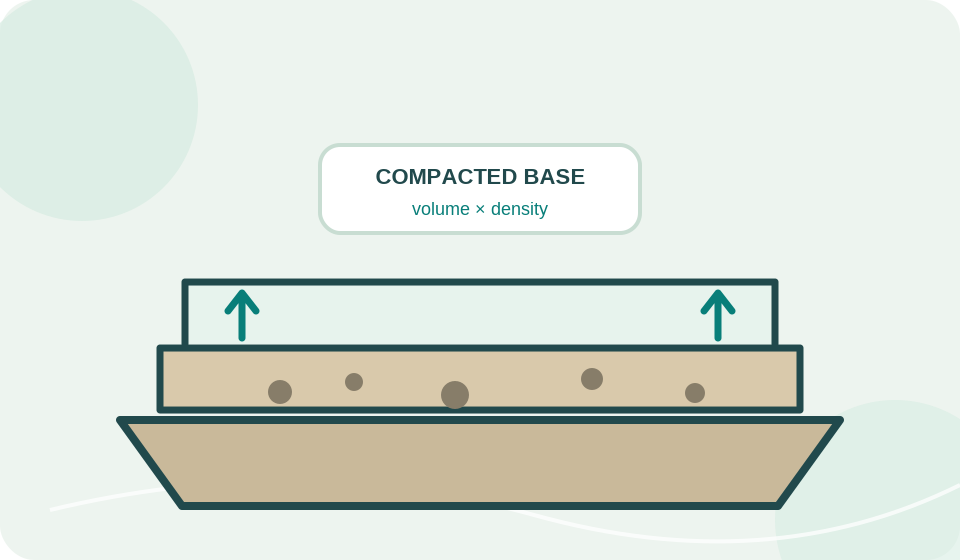
Convert depth from inches to feet, multiply by area, add the entered allowance, and multiply volume by bulk density for estimated mass.
Inputs and units
- Area (sq ft)
- Depth (in)
- Density (lb/cu ft)
- Extra allowance (%)
Formula and method
Volume(ft³)=area(ft²)×depth(in)/12×(1+allowance/100); US tons=volume×lb/ft³÷2,000.
Worked example
200 sq ft at 3 in depth is 50 ft³; adding 10% gives 55 ft³. At 100 lb/ft³, that is 2.75 US tons.
Interpreting the result
The allowance increases both estimated volume and weight.
Assumptions and limits
Bulk density varies with stone, grading, moisture, and compaction. Confirm supplier units and material density before ordering.
Frequently asked questions
Why can the delivered weight differ?
Actual moisture and bulk density differ from the entered estimate.
How do I use the Gravel estimator?
Enter Area (sq ft), Depth (in), Density (lb/cu ft), Extra allowance (%). Match the units shown beside each field and review the result together with the assumptions below.
What is a worked example of Gravel estimator?
200 sq ft at 3 in depth is 50 ft³; adding 10% gives 55 ft³. At 100 lb/ft³, that is 2.75 US tons.
What does the Gravel estimator calculate?
Convert depth from inches to feet, multiply by area, add the entered allowance, and multiply volume by bulk density for estimated mass.
What assumptions apply to Gravel estimator?
Bulk density varies with stone, grading, moisture, and compaction. Confirm supplier units and material density before ordering.
Good calculators show their work.
CalcWorldHub is built around clear inputs and visible assumptions. Results are estimates for planning; check official sources or your provider’s terms when exact figures matter.