
Measure the gravel-filled trench
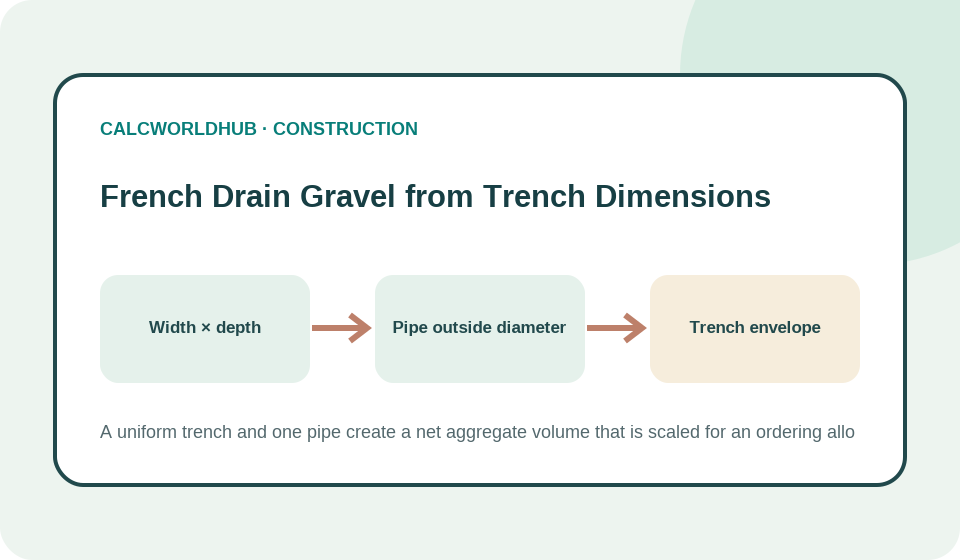
Use the length of the straight run, the inside trench width, and the depth that will actually contain aggregate. The rectangular envelope is length × width × depth. Keep all dimensions in metres because the calculator returns cubic metres and kilograms. If the trench changes size along the route, separate it into sections and sum estimates rather than pretending one set of dimensions describes the whole excavation.
The calculator models a uniform cross-section and one pipe along that full run. Its validation requires the pipe outside diameter to fit within both entered trench width and depth. A pipe that nearly fills the cross-section leaves little room for aggregate; check the dimensions against the planned installation rather than relying on the numeric result alone.
Subtract the pipe’s displaced volume
Treat the pipe as a cylinder: displacement = π × (outside diameter ÷ 2)² × trench length. The outside diameter matters because the wall and corrugations occupy space; the inside opening is not the volume displaced from the gravel. Net aggregate volume before allowance = max(0, trench envelope − pipe displacement).
The max(0, …) expression keeps aggregate volume nonnegative. When the pipe diameter fits within both trench dimensions, its circular cross-section occupies less area than the rectangular trench. The result still assumes a straight cylinder and uniform excavation, without couplings, bends, filter fabric, bedding, or irregular overbreak.
Apply the ordering allowance once
The calculator multiplies net aggregate volume by 1 + allowance percent ÷ 100. A 10% allowance therefore means net volume × 1.10. This is a purchasing buffer entered by the user, not a measured expansion factor or a universal construction standard. Select it for expected handling loss and uncertainty in the excavation, and avoid adding the same waste factor again outside the result.
Density then converts the allowed volume to estimated mass: kilograms = cubic metres × loose aggregate bulk density in kg/m³. Use a density from the supplier or a technical source that matches the material and whether it is loose. Rock particle density is not the same as bulk density because bulk material contains voids between particles.
Use volume and mass for different decisions
Volume helps compare a supplier’s cubic-metre quote with the trench estimate. Mass can help with a delivery load or an order stated in tonnes, but moisture, gradation, compaction, and how the supplier measures bulk material affect the conversion. Keep the density and allowance assumptions beside the result so another person can understand why two estimates differ.
A working French drain also depends on grade, an outlet, soil, and filter details. Extension guidance describes free-draining material around a perforated pipe that collects and carries water away; this calculator estimates material quantity only.
Worked examples
Each example subtracts the pipe’s circular cross-section along the trench before applying the percentage allowance and density.
A ten-metre trench with a 100 mm pipe
Inputs: Length = 10 m; width = 0.50 m; gravel-filled depth = 0.60 m; pipe outside diameter = 0.10 m; allowance = 10%; bulk density = 1,600 kg/m³.
Calculation: Trench = 10 × 0.50 × 0.60 = 3.000 m³; pipe = π × (0.10 ÷ 2)² × 10 ≈ 0.07854 m³; net = 2.92146 m³; order volume = 2.92146 × 1.10 ≈ 3.21361 m³; mass ≈ 3.21361 × 1,600 = 5,141.8 kg.
The calculator estimates about 3.214 m³ of aggregate with allowance, or about 5,141.8 kg at the entered bulk density.
A shorter trench with a larger pipe and a different allowance
Inputs: Length = 8 m; width = 0.50 m; gravel-filled depth = 0.45 m; pipe outside diameter = 0.11 m; allowance = 15%; bulk density = 1,500 kg/m³.
Calculation: Trench = 8 × 0.50 × 0.45 = 1.800 m³; pipe = π × (0.11 ÷ 2)² × 8 ≈ 0.07603 m³; net = 1.72397 m³; order volume = 1.72397 × 1.15 ≈ 1.98257 m³; mass ≈ 1.98257 × 1,500 = 2,973.9 kg.
The estimated allowed volume is about 1.983 m³, with a mass near 2,973.9 kg using the stated density.

Check the design and material before ordering
Before ordering, confirm dimensions, pipe outside diameter, aggregate type, supplier density, and sales unit. Convert to the vendor’s unit and compare like with like. The estimate cannot account for compaction, moisture, soil collapse, or irregular trench walls.
For drainage near a foundation, retaining structure, well, or regulated shoreland, check local requirements and consult a qualified professional. Water needs a safe outlet, and excavation can affect utilities or nearby property. This output is a material estimate, not a drainage design or a promise that a basement will stay dry.