
Start with a demand figure you can defend
Daily demand is the number of litres per day that the stored supply is intended to cover. It may represent drinking and cooking only, a broader household plan, or a measured operating requirement. Choose the scope before entering a value; a figure for essential use cannot be compared fairly with a figure that also includes laundry, flushing, or irrigation.
The CDC advises households to store at least one gallon per person per day for three days for emergency preparedness, while also explaining storage and sanitation considerations. That guidance is not the calculator's assumed demand and should not be silently converted into a universal tank size. Follow the current advice for your situation and local authority, and use a demand input that matches the purpose of the tank.
Working volume and nominal tank capacity
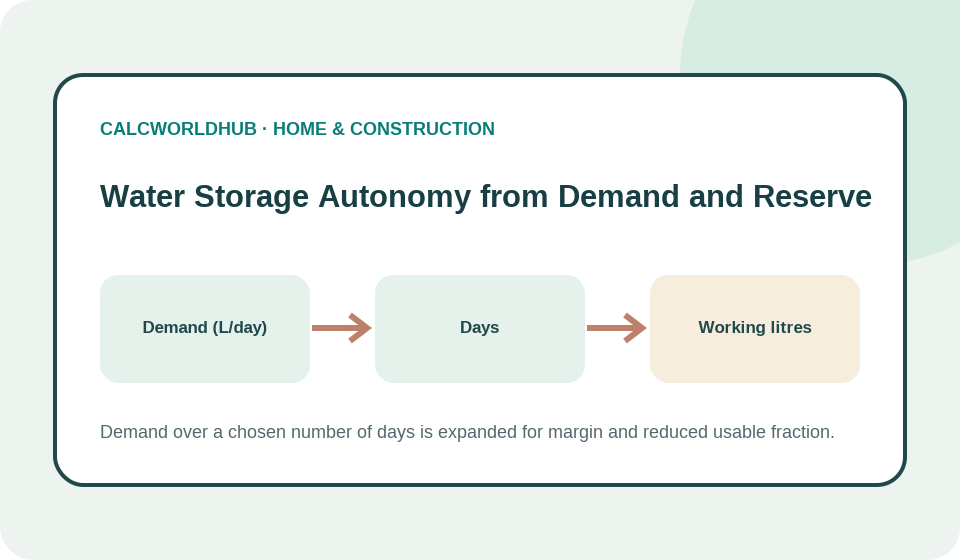
The first result is working reserve = daily demand × reserve days. Litres per day multiplied by days gives litres. The second result adjusts that working amount: nominal capacity = working reserve × (1 + margin percent ÷ 100) ÷ (usable percent ÷ 100). The margin increases planned volume; the usable fraction converts the desired usable amount into a larger vessel volume.
Usable volume can be less than a tank's nameplate capacity because of pump cutoff, sediment space, dead storage, or a deliberately untouched reserve. A 90% input means the model treats that share of nominal capacity as available. Use tank dimensions and the pump cutoff to estimate it.
Separate margin from usable fraction
A margin and an unusable-volume allowance act in different places in the equation. A 15% margin multiplies the working reserve by 1.15. An 80% usable fraction divides the target by 0.80, because only four-fifths of nominal capacity is assumed to serve the planned draw. Entering a single combined percentage in both fields would count the same concern twice.
The fields accept daily demand and days from zero upward, a usable fraction greater than zero and no more than 100%, and a nonnegative margin. A zero demand or zero reserve duration gives no working volume. The tool reports a planning estimate; it does not determine structural support, tank pressure rating, freeze protection, source reliability, treatment, or whether stored water remains potable.
Plan for changes in supply and handling
An autonomy estimate assumes that demand and available volume remain as entered. Leaks, evaporation, flushing, a delayed refill, or a larger-than-planned household draw reduce the actual duration. If a tank is refilled while in use, this static reserve calculation does not credit the incoming supply. Model a changing source separately with a water-balance schedule rather than adding an informal adjustment to the result.
Storage is also a water-quality system, not just a volume. CDC safe-storage guidance stresses that container choice and handling matter. Use suitable, cleanable containers, protect stored water from contamination, and follow the applicable treatment and replacement guidance. The calculator has no field for container material, disinfection, turnover, or inspection, so its result cannot certify safety.
Worked examples
The examples calculate working reserve first, then increase it by the selected margin and divide by the usable fraction.
Four days at 260 litres per day
Inputs: Daily demand = 260 L/day; reserve duration = 4 days; usable fraction = 80%; margin = 15%.
Calculation: Working reserve = 260 × 4 = 1,040 L; nominal capacity = 1,040 × 1.15 ÷ 0.80 = 1,495.00 L.
The assumptions require 1,040 L of working reserve and about 1,495 L of nominal tank capacity.
A longer reserve with a smaller usable fraction
Inputs: Daily demand = 500 L/day; reserve duration = 3.5 days; usable fraction = 85%; margin = 20%.
Calculation: Working reserve = 500 × 3.5 = 1,750 L; nominal capacity = 1,750 × 1.20 ÷ 0.85 = 2,470.59 L.
The working volume is 1,750 L. The margin and the 85% usable assumption raise the estimated nominal capacity to 2,470.59 L.
