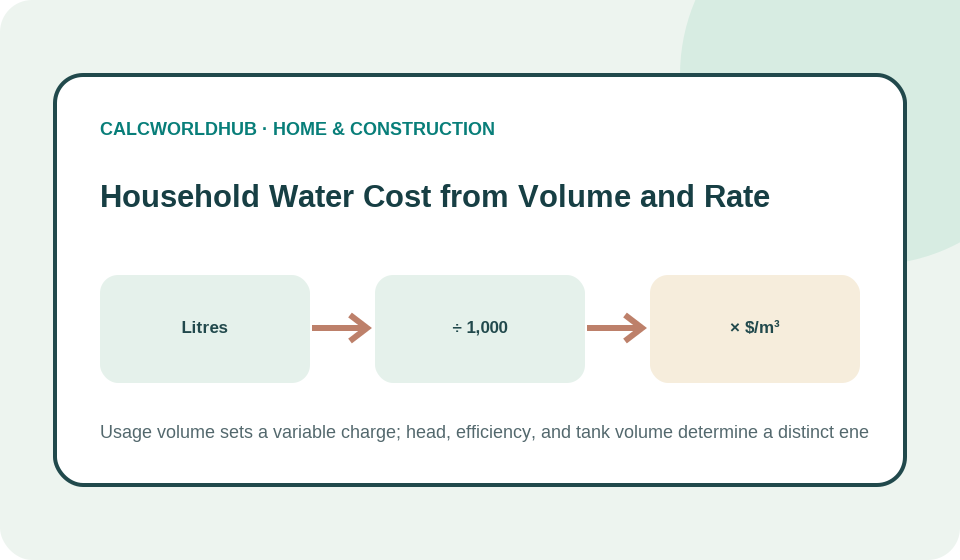

Read the six inputs as two related but separate models
Flow rate is entered in litres per minute, duration in minutes, and water price in dollars per cubic metre. These first three fields produce the usage charge. Pump head in metres, efficiency as a fraction from greater than zero through one, and tank volume in cubic metres feed a separate estimate of energy to lift that tank volume.
The form does not treat the tank volume as the water used for the tariff calculation; usage litres come from flow multiplied by duration. Likewise, the tariff does not determine pump energy. Keep both calculations distinct when explaining the result or comparing it with an invoice.
Calculate the variable water-use charge
Water used in litres = flow × minutes. Divide litres by 1,000 to get cubic metres, then multiply by the entered unit price: estimated usage charge = flow × minutes ÷ 1,000 × dollars per m³. Because price is a supplied value, check the unit and billing period on the utility’s current schedule before using it.
Many bills include a fixed service charge, wastewater or sewer charges, taxes, minimum bills, and tiered usage blocks. EPA WaterSense describes different billing structures and fixed charges. A single rate multiplier cannot reproduce them all. The result is the variable charge for the entered volume at one rate, not a complete bill.
The separate pump-energy estimate
The tool calculates lift energy as E = ρgVH ÷ η, where the model uses water density 1,000 kg/m³, standard gravity 9.80665 m/s², entered tank volume V in cubic metres, entered head H in metres, and efficiency η as a fraction. Dividing joules by 3,600,000 converts the idealized result to kilowatt-hours.
This second output is for the whole entered tank volume, not the flow-and-duration volume used in the tariff calculation. The efficiency field must be greater than zero and no more than 1. A value of 0.65 means 65%; enter 0.65, not 65. The estimate does not include a separate electricity price or calculate pump operating time.
Choose a tariff and efficiency carefully
Use the volumetric usage rate from the relevant bill or utility tariff. If the bill has blocks, seasonal rates, or a combined water-and-sewer charge, one blended price may be useful only when you clearly identify how it was derived. Do not divide a monthly total by usage and present it as the utility’s official unit rate without checking fixed charges and other components. Use a nonnegative listed rate for a conventional usage-cost estimate; the displayed result follows the entered arithmetic and does not interpret a negative value as a utility credit.
Pump efficiency is a simplified system input. A pump’s actual operating point, motor, controls, pipe losses, and maintenance condition affect energy. If the manufacturer provides a combined wire-to-water efficiency for the relevant flow and head, that may be more representative than a generic guess. The calculator does not select a pump or verify an efficiency curve.
Use the result as a partial bill estimate
Compare the usage charge only with the matching variable line on the bill and the same volume period. Check whether the utility charges sewer based on metered incoming water or another measure, and whether the price is per cubic metre. If the billing structure changes across usage bands, calculate each band separately from the tariff rather than applying a single average indiscriminately.
Use the energy output as a theoretical comparison for moving the stated tank volume through the entered elevation head. It is not the household’s total electricity use or a forecast of the next bill. The article and calculator keep cost and energy side by side for planning, but the units and inputs remain independent.
Worked examples
Each example shows the variable water charge and the separate tank-lift energy estimate.
A 198-litre use estimate at $3.20 per cubic metre
Inputs: Flow = 11 L/min; time = 18 min; tariff = $3.20/m³; pump head = 14 m; efficiency = 0.65; tank volume = 0.9 m³.
Calculation: Water = 11 × 18 = 198 L = 0.198 m³; charge = 0.198 × $3.20 = $0.6336 ≈ $0.63. Lift energy = 1,000 × 9.80665 × 0.9 × 14 ÷ (3,600,000 × 0.65) ≈ 0.0528 kWh.
The variable usage charge rounds to $0.63. The separate tank-lift model gives about 0.0528 kWh; it does not include a fixed bill charge or electricity price.
A longer use interval with a different tariff
Inputs: Flow = 7.5 L/min; time = 40 min; tariff = $1.85/m³; pump head = 8 m; efficiency = 0.72; tank volume = 0.75 m³.
Calculation: Water = 7.5 × 40 = 300 L = 0.3 m³; charge = 0.3 × $1.85 = $0.555 ≈ $0.56. Lift energy = 1,000 × 9.80665 × 0.75 × 8 ÷ (3,600,000 × 0.72) ≈ 0.0227 kWh.
The rounded variable usage charge is $0.56. The energy estimate remains a separate output based on tank volume, head, and efficiency.
