
Measure the outlet rather than guessing a household average
The calculator asks for tap flow in litres per minute and an operating duration in minutes. A practical way to measure a faucet is to collect water for a timed interval in a container whose volume markings are clear, then divide the collected litres by elapsed minutes. Repeat the measurement if flow fluctuates or the first run changes as an aerator or hose warms up.
Use a flow rate that represents the same outlet and operating condition as the event you are estimating. A shower, kitchen tap, hose, and refill valve can have different rates. The result does not infer how many people live in the home, which fixtures are used, or how often they run.
Formula and unit meaning
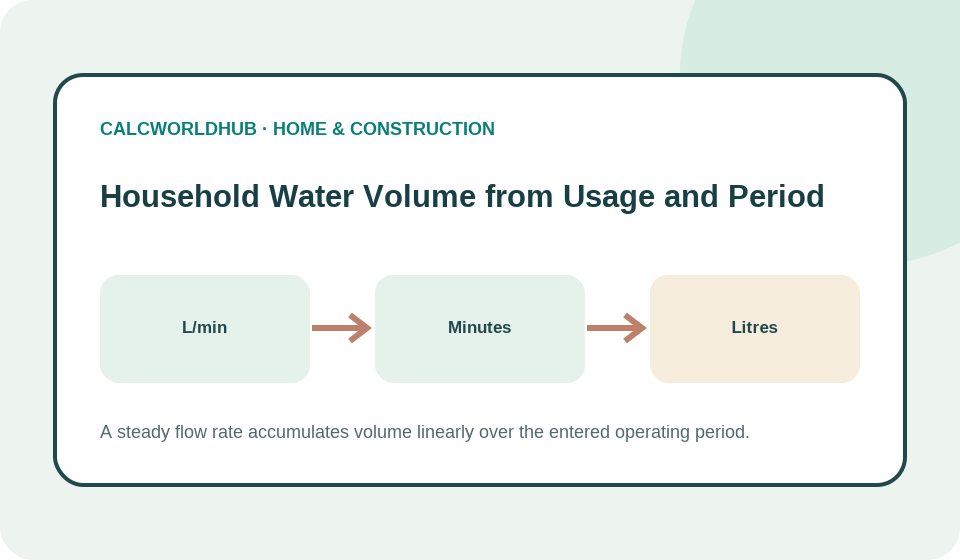
Volume = flow rate × time. With litres per minute multiplied by minutes, the minutes cancel and the remaining unit is litres: (L/min) × min = L. This is a direct volume calculation, so both inputs can be zero but cannot be negative or non-finite in the calculator’s stated validation.
If you want to total multiple separate activities, calculate each one using the corresponding measured flow and run time, then add the volumes. Do not multiply a single event by a number of days unless you have decided that its rate and frequency are representative. A per-day estimate and a billing-period estimate require a schedule that the two-input calculator does not collect.
Use the total for a specific comparison
The output answers how much water would pass through the measured outlet during the chosen interval if its average flow remained steady. It can support comparisons such as a shorter rinse, a different nozzle, or a repeated filling task. A rate label on a fixture may be a maximum or a nominal test value; a direct timed measurement may better match site conditions.
USGS explains household water activities and common flow-rate labels, but its broad examples should not be substituted for your own measurement. Pressure, valve position, plumbing restrictions, and fixture condition affect actual flow. The calculation scales the input you provide; it does not diagnose those factors or promise that a future run will use the same quantity.
Keep a period estimate transparent
If the same activity happens several times, multiply the measured event volume by the number of events only when the count is known. If the flow differs between events, calculate each category separately. For a monthly total, note which days were measured, how many events were counted, and whether weekends or unusual usage were included.
Water meters usually record volumes over a billing interval, while this calculator reconstructs an estimate from flow and time. A meter reading can provide a useful cross-check, but it may include toilets, leaks, appliances, outdoor use, and other outlets. The difference between the two is not automatically an error in either figure; the scopes may not match.
Check what the flow measurement represents
Write down the unit beside each number before entering it. A rate in gallons per minute cannot be entered as if it were litres per minute, and seconds should be converted to minutes before multiplication. For example, a 30-second collection interval is half a minute; using 30 as the time would overstate the result by a factor of sixty.
The model assumes a constant average rate over the entered duration. It does not subtract splashing, water diverted to another use, or water left in a pipe after shutoff. Where water use matters for billing or compliance, compare against the utility meter and the applicable measurement rules rather than treating a small sample as an audited total.
Worked examples
Both examples multiply the entered litres per minute by the elapsed minutes.
A faucet runs for 24 minutes
Inputs: Measured flow = 10.5 L/min; operating time = 24 min.
Calculation: Volume = 10.5 L/min × 24 min = 252 L.
The measured run would use 252 litres if the average flow stayed at 10.5 litres per minute throughout.
A lower-flow outlet runs for 45 minutes
Inputs: Measured flow = 7.2 L/min; operating time = 45 min.
Calculation: Volume = 7.2 L/min × 45 min = 324 L.
The longer interval produces 324 litres. The result is based on this outlet’s measured rate, not a household-wide daily-use estimate.
