
Enter the amount that still needs to be added
The calculator’s tank-volume field is in cubic metres and the tap-flow field is in litres per minute. Enter the unfilled volume, not automatically the tank’s nameplate capacity. For a tank holding 0.3 m³ that needs to reach 1.0 m³, the amount to add is 0.7 m³, assuming the target is exactly one cubic metre.
Flow must be positive and finite; tank volume may be zero but not negative. The tool accepts a zero volume and returns zero time. If a flow meter shows litres per second or gallons per minute, convert it to litres per minute first so the division uses matching units.
Convert volume before dividing
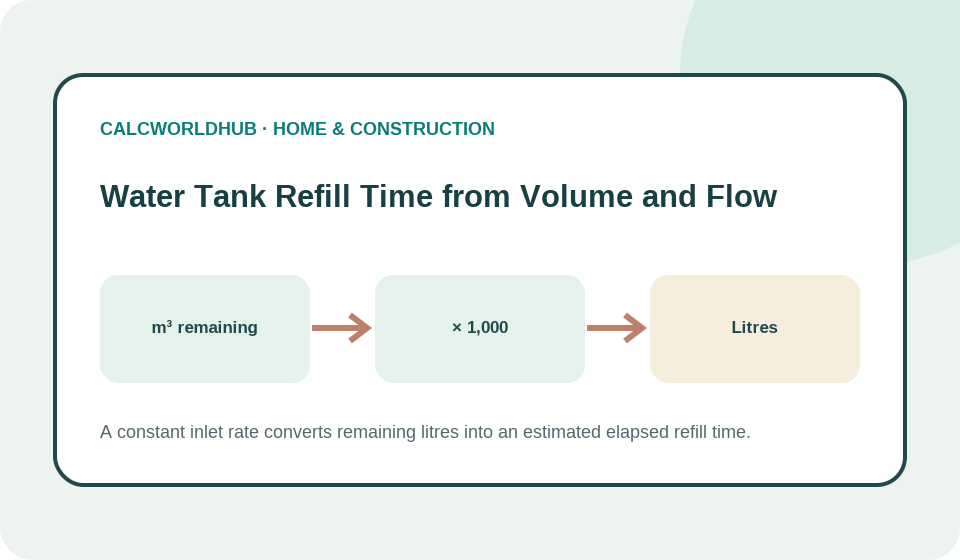
One cubic metre is 1,000 litres, so the calculation is time in minutes = tank volume in m³ × 1,000 ÷ flow in L/min. The litres cancel, leaving minutes. For instance, a 0.75 m³ fill is 750 litres; at 8 L/min it takes 750 ÷ 8 minutes under a steady-rate assumption.
The formula is a rate calculation, not a pump curve or tank design. It does not model pressure changing as the tank fills, a float valve throttling near the top, a low-flow restriction, or a pump cycling on and off. Those conditions can make measured elapsed time longer than the simple estimate.
Use a representative inlet rate
A faucet or hose label may describe a rated maximum, not the rate delivered at the tank connection. Measure the actual inlet under the same supply conditions if the timing matters. A timed bucket measurement can estimate flow, but keep the collection unit and interval explicit and avoid testing against an unsafe or unsuitable outlet.
If several inlets fill the tank simultaneously, the rate is the combined effective flow only if they remain independent and steady. If they share a restricted supply line, adding their separate maximum ratings may overstate the total. Measure the combined flow at the tank or calculate separate contributions only when their operating conditions are understood.
Plan around shutoff and level controls
The calculator treats the entered volume as a simple target amount. It does not ask for current level, overflow reserve, dead volume, sensor position, or automatic shutoff behavior. Leave room for the tank’s actual control and safety arrangement; never rely on an arithmetic estimate as an overflow protection system.
A tank’s shape may not map linearly from height to volume. For a horizontal cylinder, irregular reservoir, or tank with a sloped bottom, the volume associated with a level change can differ from the same height fraction in another vessel. Use the tank’s level-to-volume chart or measured calibration to determine the amount remaining.
Interpret the time as a steady-flow estimate
Read the displayed minutes as a planning value based on the entered flow and fill volume. Small flow changes accumulate over a long refill. A valve that opens slowly, a clogged filter, supply-pressure swings, and simultaneous household demand can all affect actual duration.
To compare observed and estimated time, start and stop at defined levels, measure the actual flow during the same interval, and note any interruptions. If the difference is persistent, inspect the flow measurement and tank’s control behavior rather than adjusting the arithmetic to force a match. The result is useful for scheduling and comparison, not a guarantee.
Worked examples
The calculator converts each tank volume from cubic metres to litres before dividing by litres per minute.
A three-quarter cubic-metre fill at 8 L/min
Inputs: Remaining volume = 0.75 m³; incoming flow = 8 L/min.
Calculation: Litres to add = 0.75 × 1,000 = 750 L; time = 750 L ÷ 8 L/min = 93.75 min.
At a steady 8 litres per minute, the estimate is 93.75 minutes, or 1 hour 33 minutes 45 seconds.
A 2.4 cubic-metre fill at 12.5 L/min
Inputs: Remaining volume = 2.4 m³; incoming flow = 12.5 L/min.
Calculation: Litres to add = 2.4 × 1,000 = 2,400 L; time = 2,400 L ÷ 12.5 L/min = 192 min.
The steady-rate estimate is 192 minutes, or 3 hours 12 minutes. A real fill may take longer if the inlet rate falls or pauses.
