
Measure the same room envelope
Measure the clear inside length and width at the floor, then measure the vertical height from the same floor level to the ceiling. The calculator accepts all three dimensions in feet. If a tape measure gives feet and inches, convert the inches to a fraction of a foot before entering them; for example, 8 ft 6 in is 8.5 ft. Mixing feet with inches changes the result by a factor of twelve or more.
The tool requires positive, finite dimensions. Its simple model treats the room as a rectangular prism, which is reasonable for a regular room with a flat ceiling. A sloped ceiling, stepped floor, alcove, or open connection to another room needs to be divided into simpler shapes and summed, or measured with a more suitable method.
The formula and unit conversions
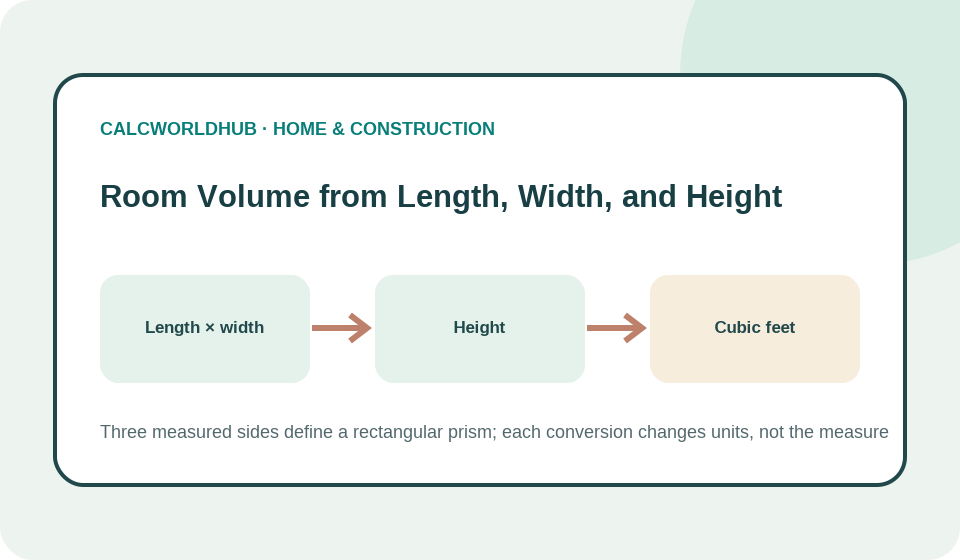
First multiply length by width to obtain floor area in square feet, then multiply by height: V = L × W × H. Because each input is measured in feet, the product is cubic feet. Divide cubic feet by 27 for cubic yards, since one cubic yard contains 3 × 3 × 3 = 27 cubic feet. For cubic meters, multiply by 0.0283168, the conversion used by the calculator.
These conversions do not change the underlying geometric estimate. Small differences in the last displayed digit can appear when a conversion factor is rounded for presentation. The calculator reports volume to two decimal places, so a displayed metric value is a rounded equivalent rather than extra measurement precision.
Use volume for the decision it supports
Room volume can help compare spaces or estimate how much geometric air a rectangular room contains. It is not automatically a ventilation, heating, cooling, dehumidification, or air-cleaning recommendation. Those decisions may depend on occupancy, outdoor air requirements, equipment performance, climate, leakage, and building rules—inputs this three-dimension calculator does not request.
When the result is being used for a material order, check what the seller means by volume and whether the material compacts or has a specified fill depth. Cubic yards of loose aggregate, for instance, do not represent the same delivered mass for every aggregate. This calculator supplies geometric units only; it does not estimate weight, cost, or how much of a product will fit after settling.
Account for openings and connected spaces
The room estimate does not subtract doors, windows, built-in cabinets, furniture, or other objects. For many planning comparisons, the gross room envelope is the relevant quantity. If the task specifically needs net empty volume, decide which objects materially displace volume and measure them separately; a casual subtraction based on floor area can be misleading because an object may not extend to the ceiling.
Open-plan rooms need special care. If two spaces connect without a full-height divider, treating them separately may be useful for floor-by-floor comparisons, but it does not describe two sealed air volumes. Add the component volumes only when the question calls for the combined geometric envelope, and keep the boundaries consistent.
Check the result before relying on it
A quick reasonableness check is to multiply the floor area by the height. A 12 ft by 10 ft floor has 120 square feet; at 8 ft high, its volume is 960 cubic feet. If the result is unexpectedly large, check whether inches were entered as feet or whether a dimension was measured to the outside rather than the inside.
For an irregular room, sketch rectangles and rectangular blocks, calculate each part using its own dimensions, and add the volumes without overlapping the parts. Record the assumptions next to the total. The estimate becomes less dependable when boundaries are curved, sloped, open to adjacent areas, or difficult to measure; those are signs to use a plan or a professional measurement rather than adding false precision.
Worked examples
These examples use the calculator’s feet-based inputs and show the unit conversions separately.
A 14 by 11 foot room with a 9 foot ceiling
Inputs: Length = 14 ft; width = 11 ft; height = 9 ft.
Calculation: Cubic feet = 14 × 11 × 9 = 1,386 ft³; cubic yards = 1,386 ÷ 27 = 51.33 yd³; cubic meters = 1,386 × 0.0283168 = 39.25 m³.
The rectangular envelope is 1,386 cubic feet, or approximately 51.33 cubic yards and 39.25 cubic meters. These are unit conversions of the same gross room volume.
A lower room with an 8.5 foot ceiling
Inputs: Length = 10.5 ft; width = 8 ft; height = 8.5 ft.
Calculation: Cubic feet = 10.5 × 8 × 8.5 = 714 ft³; cubic yards = 714 ÷ 27 ≈ 26.44 yd³; cubic meters = 714 × 0.0283168 ≈ 20.22 m³.
The rectangular estimate is 714 cubic feet. The converted values are rounded to two decimals; the source dimensions may not justify more precision.
